Showing posts with label Art Nelson. Show all posts

Saturday, April 01, 2023

Poster: Funk vs. Brisco in Greensboro (1972)

By Brack Beasley
Mid-Atlantic Gateway Contributor

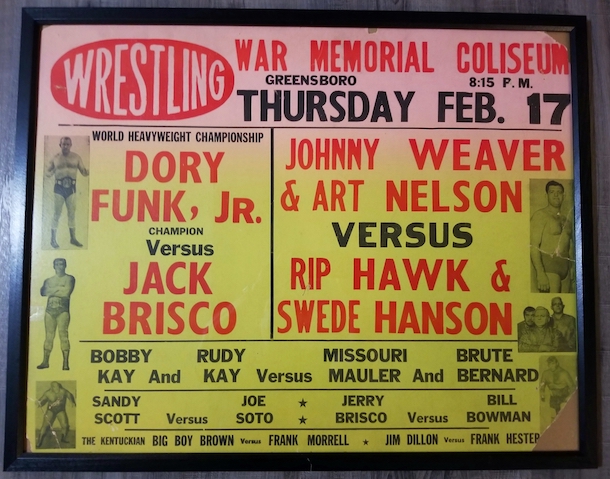
This poster takes us way back to early 1972, February 17th to be exact, and promotes a card held at the Greensboro War Memorial Coliseum.

The NWA World Heavyweight Championship was up for grabs as champion Dory Funk, Jr. defended against perennial foe Jack Brisco. Funk retained his title as this classic match-up ended in a one hour draw and I have no doubt these two men put on a professional wrestling clinic for the fans in Greensboro. 

Johnny Weaver and Art Nelson topped Rip Hawk and Swede Hanson (managed by Gary Hart) in the semi while the undercard featured familiar names like Missouri Mauler, Brute Bernard, Sandy Scott, Jerry Brisco, Jim Dillon, and The Kentuckian Luke Brown.

The poster features a horizontal layout with the two main events listed side by side, black and red print over a two-tone pink and yellow background, and six great wrestler images adorning the sides.

 NO. 46 IN THE BEASLEY POSTER SERIES

Thursday, October 27, 2022

Bob Caudle's Most Dangerous Place

by David Chappell
Mid-Atlantic Gateway


On the Wednesday night April 23, 1975 television taping of the Mid-Atlantic Championship Wrestling TV show, announcer Bob Caudle told the fans that he wasn’t in a comfortable place. The early bouts on the show were dominated by the “bad guys.” Talented Doug Gilbert decisively defeated youngster Kevin Sullivan in the opener, gaining the advantage by feigning to help Sullivan up when Kevin was tangled up in the ropes, but instead Gilbert sucker punched him into oblivion.

The second match on the show featured the newly formed duo of the veteran Art Nelson and Mid-Atlantic newcomer Mr. Fuji easily handling the duo of Don Kernodle and Tio Tio. Fuji put Tio Tio to sleep with his devastating submission hold, the Japanese Cobra. Those three rulebreakers would join Bob for the show’s first interview segment.

Caudle began, “Fans at ringside right now, and I can’t think of any more dangerous place for a person to be than I am right now between three really notorious wrestlers, like Art Nelson here on my left, Doug Gilbert, and then Mr. Fuji.” Nelson gruffly responded, “Well let me say this, not notorious, well-conditioned athletes.”

Art continued, “Let me say this, when you get in that ring then you’d have to be worried. As long as we’re on the floor here, we don’t bother anybody. If you get in that ring, if you’re not in condition, you can’t take it, then you’d have to be worried about it. This is a man’s business, we’re men, and we go in that ring and we don’t fool with babies.”

Nelson added, “Fuji and I were here a few weeks ago and we were talking about wrestling top teams. Where are they? Where’s the Indian [Wahoo McDaniel]? Where’s little boy blue [Paul Jones], the guy with the belts, where’s he at? Where’s the strongman [Ken Patera]? I don’t see them around, I hear them, but I sure can’t see them. But as long as they’re scared to get in the ring with us, nothing we can do about it because we said we would meet all comers, we would wrestle anybody, right Fuji?

The man from Japan answered, “Right! Very, very true Mr. Nelson. You see fans, you see how very devastating, Japanese cobra hold is! Samoan boy [Tio Tio] he paralyzed already; he’s no good, like wrestling an old lady! Right Mr. Gilbert?”

Caudle interjected, “I gotta say Doug Gilbert, you know I thought you were gonna help Kevin Sullivan out, it looked like you were gonna commit an act of sportsmanship in your match and then all of a sudden you hit him. That’s very unsportsmanlike!” Gilbert deadpanned, “I won the match didn’t I?” Bob agreed, “You won the match, right.” Doug continued, “Well, you’re gonna have to realize that when you get in a profession like professional wrestling, sportsmanship doesn’t count very much. What counts is ability. What counts is winning the match, and that’s what happened. I won the match, these gentlemen won their match. That’s what counts…winning!”

Caudle then commented, “Doug Gilbert shows a lot of wrestling ability up there. You got a lot of moves and you use them up there. Why do you have to resort to some of the other type tactics?” Gilbert candidly responded, “It’s a lot easier.” Bob had to do a double take saying, “A lot easier to win that way then, Doug?” Gilbert nodded in the affirmative.

Nelson concluded the segment telling the fans that boiling it all down…making money, and lots of it, was the overriding aspiration in professional wrestling. Art exclaimed, “Green power is what’s important! Green power…that’s the dollar bill, ten dollars, a hundred dollars!” But with that final comment the three “notorious” wrestlers departed the set, making Bob Caudle’s interview area a much less dangerous place!

Monday, December 30, 2019

The Mid-Carders Take Center Stage (April 1975)

by David Chappell
Mid-Atlantic Gateway

Call me strange (and you wouldn't be the first!), but I always enjoyed the extremely rare occurrence on Mid-Atlantic Championship Wrestling television where the grapplers who filled in the middle of the cards for Jim Crockett Promotions actually got slotted for some interview time on TV. One of the first interview segments that featured solely mid-carders that I audio recorded was on the Mid-Atlantic Championship Wrestling television show that was taped on April 23, 1975 in the WRAL TV studios in Raleigh, North Carolina.

The three gentleman (actually bad guys!) from the ranks of the mid-card that were interviewed by announcer Bob Caudle on this occasion were Art Nelson, Mr. Fuji and Doug Gilbert. Nelson had been a main event star for the promotion throughout the early 1970s, but was being de-emphasized at this point in time. Mr. Fiji had recently entered the Mid-Atlantic area from New York where he had been rather high on the WWWF cards, but had become a mid-card performer for Jim Crockett, often teaming with Nelson as a rough tough duo. Gilbert had recently returned to the Carolinas after previous stints in the territory as principally a middle-of-the-card stalwart.

Just prior to the interview segment, Nelson and Fuji defeated the team of Don Kernodle and Tio Tio while Gilbert was also successful in the television ring, besting young Kevin Sullivan in a singles contest. Caudle began the interview by telling the fans, "I can't think of anymore dangerous place for a person to be than I am right now between three really notorious wrestlers, like Art Nelson here on my left, Doug Gilbert and then Mr. Fuji."

Nelson responded, "Let me say, not notorious, well conditioned athletes. Let me say this, when you get in that ring then you'd have to be worried, but as long as we're on the floor here we don't bother anybody. If you get in that ring, and you're not in condition, you can't take it, then you'd have to be worried about it." Art continued, "This is a man's business, we're men, and we go in that ring and we don't fool with babies. Now you know, Fuji and I were here a few weeks ago and we were talking about wrestling top teams. Where are they?"

The burly man from Atlanta then proceeded to call out Mid-Atlantic stars Wahoo McDaniel, Paul Jones and Ken Patera! Art rhetorically asked, "Where's the Indian? Where's little boy blue the guy with the belts...where's he at? Where's the strongman? I don't see them around, I hear 'em, but I sure can't see 'em. But as long as they're scared to get in the ring with us, there's nothin' we can do about it because we said we'd meet all comers, we'd wrestle anybody, right Fuji?"

A chuckling Fuji exclaimed, "Right! Very, very true Mr. Nelson-son, you see fans, you see how devastating Japanese cobra is. Samoan boy he paralyzed already, he no good...like wrestling old lady! Ha-ha-ha...Mr. Gilbert-son." 

Caudle immediately quizzed Gilbert, "I gotta say Doug Gilbert, you know I thought you were gonna help Kevin Sullivan out. It looked like you were going to commit an act of sportsmanship in your match, and then all of a sudden you hit him. That's very unsportsmanlike!" Gilbert deadpanned, "I won the match didn't I?" Caudle conceded, "You won the match, right."

Doug further expounded, "Well, you're going to have to realize that when you get into a profession like professional wrestling, sportsmanship doesn't count very much. What counts is ability, what counts is winning the match. That's what happened, I won the  match. These gentlemen won their match. That's what counts...winning!" Caudle followed up, "Doug Gilbert shows a lot of wrestling ability up there. You got a lot of moves and you use them up there...why do you have to resort to some of the other type tactics?"

Gilbert matter of factly answered, "It's a lot easier." Caudle queried, "It's a lot easier to win that way then, Doug?" To which Gilbert shook his head and Nelson produced some United States currency from his trucks to make a point why he and his two colleagues on the interview set were in the wrestling business. Nelson pontificated, "Green power is what's important. Green power! That's the dollar bill...ten dollars, a hundred dollars."

None of these three took off in the Mid-Atlantic area after this rare opportunity on the TV microphone...Nelson and Fuji were out of the territory before the end of the year and we later found out that Gilbert donned the hood as Spoiler #1 during the fall of 1975 as part of the team of the Masked Spoilers that were primarily an upper mid-card tandem before Gilbert exited the area without the mask in early 1976. But just getting to hear from the solid mid-card wrestlers that provided quality depth to the Crockett roster was noteworthy, and gave an added dimension and a bit of personality to the voiceless talent that was often overlooked and certainly underappreciated.


http://www.midatlanticgateway.com/p/yearbooks.html

Tuesday, November 06, 2018

Wrestling and Election Returns on the bill at Dorton Arena (1972)

by Dick Bourne
Mid-Atlantic Gateway

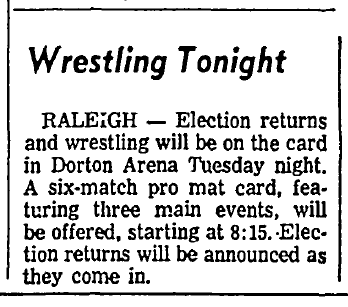
I recently came across this little Raleigh newspaper clipping for a November 1972 card at Dorton Arena. I was struck by the mention that election returns would be announced during the event.

Promoter Joe Murnick assured fans they would be made
aware of local election results at his Dorton Arena show.

__________________________________________
This got me thinking about that presidential election year of 1972 and how differently we follow things like that today with our smart phones, Twitter, and cable news networks. In 1972, there were only three broadcast networks and unless you were glued to the TV in your living room or perhaps to your local AM radio station, you had no idea of how the election was playing out.

But savvy promoter Joe Murnick wanted fans to know that they didn't need to sit around the television at home and wait for local WRAL news anchor Charlie Gaddy to give them election results - - - election results would be announced in the arena!

That's an unusual pitch for a wrestling show. Politics have always been an ugly business, but can you imagine election results being announced at a wrestling event today? The fights in the ring would likely pale in comparison to the brawls that would break out in the stands.

I'm guessing that the local races were what were really of interest to the local crowd. There wasn't much drama in the presidential race that year as Richard Nixon wound up putting a 520-17 electoral college smackdown on George McGovern. But in North Carolina, Republican Jesse Helms was in a tough battle with Democrat Congressman Nick Galifianakis for the open U.S. Senate seat. Galifianakis led early in the race by 20 points, but Helms wound up winning on election night by a solid 8-point margin. It was the first time a Republican had won a U.S. Senate seat in North Carolina in the 20th century and began a long tenure for Helms in the U.S. Senate.

Helms had several connections to wrestling. In the 1980s, Mid-Atlantic Wrestling announcer Bob Caudle, who was a longtime WRAL news personality, worked for Helms in his constituent office. Several wrestlers, including area stalwart Johnny Weaver, did political ads for Helms that aired during the wrestling programs in Helms' re-election bid in 1978. In the 1990 election, Ric Flair campaigned for Helms. 

Here are the match-ups in the three top bouts which all featured members or affiliates of the Minnesota Wrecking Crew:
Ole Anderson vs. Johnny Weaver
The winner of this bout would go on to meet NWA World Champion Dory Funk, Jr. on a future show. The stipulations were that there would be a $1,000 fine to anyone who interferes in the event. We're assuming that was targeted to other wrestlers and not angry fans because their candidate lost.

Gene Anderson vs. Art Nelson
This was billed as "brass knuckles" match.

The Menace vs. Sandy Scott
The Menace was a masked associate of the Anderson Brothers. He wore a maroon colored mask (Anderson colors) and often accompanied Gene and Ole in matches and would occasionally interfere on their behalf. I'm guessing that tendency to  interfere was one of the reasons there was the $1,000 fine stipulation in the Anderson/Weaver main event. 

Late edit: Results of the show - -
  • Johnny Weaver defeated Ole Anderson
  • Gene Anderson defeated Art Nelson
  • Sandy Scott won by DQ over The Menace
  • Freedy Sweetan & Mike "The Judge" Dubois defeated David Finley (Crockett) and Frank Hester
  • Terry Kay defeated George "Two Ton" Harris
  • Bobby Kay defeated Tinker Todd


There were two other Mid-Atlantic cards that evening, one each in the other two states of the territory, as Jim Crockett Promotions often ran three shows a night:

  • In Columbia, SC, Eastern Heavyweight Champion Jerry Brisco defended his title against Rip Hawk, who was being managed for the first time by Homer O'Dell. O'Dell had recently taken over the managerial duties for Hawk and partner Swede Hanson from Gary Hart.
  • In Danville, VA, Thunderbolt Patterson and Ronnie Garvin battled The Royal Kangaroos in a tag team main event. 

I earlier mentioned Charlie Gaddy, who wound up a broadcasting legend in the Raleigh market, hosting the local news anchor desk at WRAL into the 1990s. The national network anchors at that time were John Chancellor on NBC, Walter Cronkite on CBS, and Harry Reasoner on ABC.

***

Special thanks to Mark Eastridge as always for access to his newspaper clippings archive.
Updated with results from the Raleigh show provided by Carroll Hall of the All Star Championship Wrestling website.

http://bookstore.midatlanticgateway.com

Friday, June 29, 2018

Classic Poster Friday: NWA Champion Dory Funk, Jr.

Brack Beasley Collection
by Dick Bourne
Mid-Atlantic Gateway

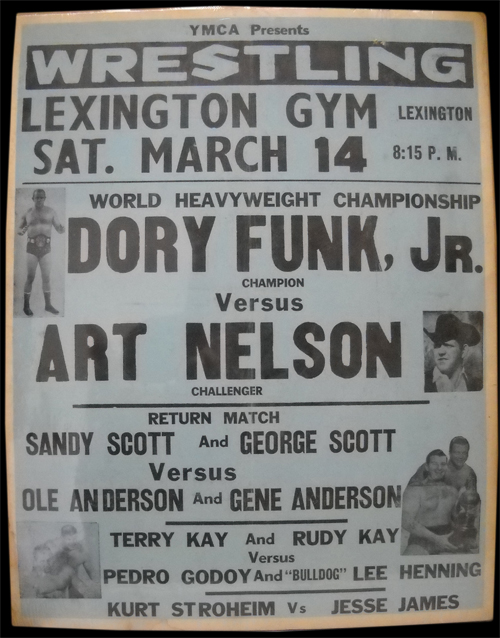
It's "Classic Poster Friday" and we present another rare poster from Lexington, NC, from the collection of Gateway contributor Brack Beasley.

NWA World Heavyweight champion Dory Funk, Jr. was in the main event against veteran Art Nelson on Saturday, March 14, 1970.

It was Funk's first appearance in Lexington, a weekly linchpin in the Crockett Promotions touring schedule in those years. Nelson had made many appearances there, most recently teaming with the hated Kurt Stroheim.

A funny little graphic blooper on this poster - - the person who put it together graphically got his "Nelsons" mixed up, as the poster features a picture of Nelson Royal instead of Art Nelson.

In most cases, fans got behind the local challenger when challenging the reigning World champion. But Dory Funk, Jr. was the decided fan favorite in his title defense against rough and tough veteran Nelson and received somewhat of a hero's welcome at the Lexington YMCA. NWA title matches in Lexington were somewhat rare.

According to newspaper reports at that time, Funk retained the title but had to do so in come-from-behind fashion. Nelson won the first fall with a bear hug, but Funk roared back winning the both the second and third falls with his signature spinning toe hold.

The newspaper also pointed out this nice little bit of trivia: Funk, at 27 years of age, was the second youngest man to have ever held the NWA crown at that time. The only man to have held it at a younger age was the legendary champion Lou Thesz who first won the title at the age of 21, and of course subsequently held it on many occasions.

In the second main event that night in Lexington, the Canadian tandem of George and Sandy Scott (the "Flying Scotts") battled the "Minnesota Wrecking Crew" of Gene and Ole Anderson. The Andersons came out on top in a 2-of-3 falls contest.

Interesting to see three different brother combinations on this card - - the Anderson brothers, Scott brothers, and Kay brothers.

Special thanks to Brack Beasley for sharing his poster and Mark Eastridge for the newspaper research.

Check out other Classic Posters featured on Classic Poster Friday.


http://bookstore.midatlanticgateway.com

Wednesday, April 20, 2016

Hearing Art Nelson for the Final Time...Sort Of

by David Chappell
Mid-Atlantic Gateway

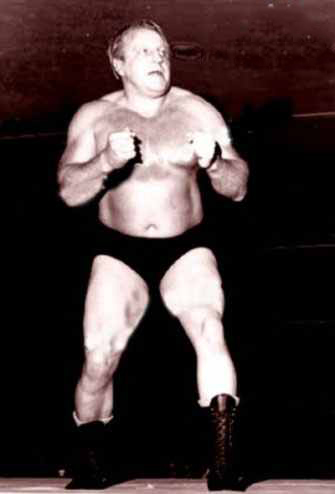
When I started to follow wrestling in Jim Crockett Promotions semi-regularly in the early 1970s, Art Nelson was one of my favorite grapplers. Barrel-chested and rock solid at 250 pounds and in terrific shape, Nelson was truly a rugged competitor. His “ground and pound” style in the ring was very Anderson Brothers-like. And the Atlanta, Georgia native was demonstrably noisy in the squared circle, with his growling and grunting being unmistakable! On interviews, Art was very believable in a straight forward style, with a rough and gravelly voice that was very distinctive.

Art was a stalwart for Jim Crockett Promotions in the early 70s, whether he was a “good guy” or a “bad guy.” I recall the infamous Gary Hart, the one-time manager of Rip Hawk and Swede Hanson, always refer to Art as Art Neilson, which was Nelson’s real name. I particularly remember a vicious feud in the middle of 1973, when Johnny Weaver and Art battled the notorious Royal Kangaroos over the Brass Knuckles Tag Team Title. Nelson remained a main event performer for Jim Crockett Promotions through January of 1974, when he took about a six month hiatus from the Mid-Atlantic area. When he returned to the Mid-Atlantic territory in mid July of 1974, Nelson was still a good guy, but soon turned on his partner Johnny Weaver in a television match.

At this juncture, much like a number of other older Jim Crockett Promotions’ veterans, Nelson’s role was deemphasized by booker George Scott. Art and Johnny Weaver had a short upper-mid card program after Nelson double-crossed Weaver on TV, and then Nelson settled into a mid card slot that continued into the spring of 1975.

By April of 1975, I started getting addicted to Mid-Atlantic Championship Wrestling to the point that I began recording the audio from the TV shows on my cassette recorder. The first complete Mid-Atlantic Championship Wrestling television show I recorded was taped at the WRAL TV studios in Raleigh, North Carolina on April 23, 1975. Coincidentally, this show happened to be the last Mid-Atlantic TV show that Art Nelson was interviewed on, as by this time Nelson had slipped far enough down the pecking order that he was deemed not to require any mic time.

Nelson’s final Mid-Atlantic TV interview was conducted by announcer Bob Caudle, and included Nelson’s semi-regular tag team partner at the time, the devious Mr. Fuji. Also included in the interview segment was mid-carder Doug Gilbert.

Caudle began the interview, “Fans at ringside right now, and I can’t think of any more dangerous place for a person to be than I am right now, between three really notorious wrestlers, like Art Nelson here on my left, Doug Gilbert, and then Mr. Fuji.” Nelson responded, “Let me say, not notorious, well conditioned athletes. Let me say this, when you get in that ring, then you would have to be worried. As long as we’re on the floor here, we don’t bother anybody. When you get in that ring, if you’re not in condition, you can’t take it, then you’d have to be worried about it.”

Nelson continued, “This is a man’s business, we’re men, and we go in that ring and we don’t fool with babies. You know, Fuji and I were here a few weeks ago and we were talking about wrestling top talent. Where are they? Where’s the Indian? Where’s little boy blue, the guy with the belt…where’s he at? Where’s the strong man? I don’t see them around.  I hear ‘em, but I sure can’t see ‘em. But as long as they’re scared to get in the ring with us, nothing we can do about it. Because we said we’d meet all comers; we would wrestle anybody.”

After Bob Caudle talked with Mr. Fuji, he questioned Doug Gilbert on his lack of sportsmanship in his win earlier in the program over young Kevin Sullivan. Gilbert responded that sportsmanship wasn’t important, what was important was that he won his match, and that Nelson and Fuji won their match. Nelson chimed in to end the interview, “Green power is what’s important; green power. That’s the dollar bill; ten dollars, a hundred dollars…”

Nelson continued to wrestle in the Mid-Atlantic area into the fall of 1975, slowly dropping into the lower card ranks. Towards the end of his tenure with Jim Crockett Promotions, he was wrestling preliminary matches in the territory’s arenas, and putting over the main eventers on television. Art’s last match in the Mid-Atlantic area was participating in a Battle Royal in Spartanburg, South Carolina on November 1, 1975.

Art Nelson’s last Mid-Atlantic TV interview in April of 1975 wasn’t significant to me at that moment, but it grew to be so with the passing of time. Initially so, as the months passed and it became clear he wasn’t going to be a featured performer for Jim Crockett Promotions any longer, and I knew there wouldn’t be any more interviews from him.

Art would pass away less than eight years after his last Mid-Atlantic match. It then dawned on me that my first audio recording of a full Mid-Atlantic TV show, by sheer happenstance, was the same show that featured Art’s last Mid-Atlantic interview. How fortunate I was to have an audio clip of a grappler that began his professional wrestling career in another era, back in the late 1940s, and was a legendary bad-ass in the squared circle. And, selfishly by having that fortuitously captured audio clip of Art Nelson, I can still hear that rough and gravelly voice I grew up hearing for as long as the tape will play.