Showing posts with label United States Championship. Show all posts

Thursday, March 02, 2023

Mooneyham Reviews "United States Championship" (2015)

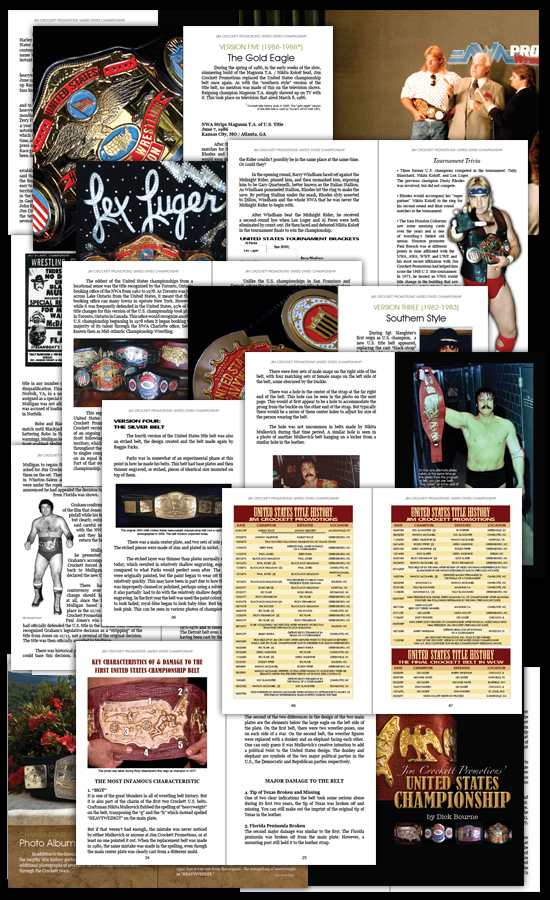
Another special thanks to Mike Mooneyham for his great 2015 review of "United States Championship", our book on the history of the Jim Crockett Promotions version of the U.S. title and the five belts that represented it. The review was posted on the Charleston Post & Courier website.

The book is available via links in the Mid-Atlantic Gateway Book Store or go directly to Amazon.com.


Bourne strikes gold with new book on U.S. wrestling title
Oct 25 2015
by Mike Mooneyham, Charleston Post & Courier

Dick Bourne has done it again.

Bourne, who runs the popular Mid-Atlantic Gateway site, has followed up his “Ten Pounds of Gold” and “Big Gold” books with an informative and entertaining volume on “Jim Crockett Promotions’ United States Heavyweight Championship.”

The book, which takes a comprehensive look at one of pro wrestling’s most revered titles, just might be Bourne’s best effort yet.

A lifelong follower of Mid-Atlantic wrestling, Bourne explores the five classic U.S. title belts that were worn by some of the profession’s greatest performers over a 13-year period.

Just the images — more than 100 photographs of both the champs and the belts — are worth the price of admission....

Read the full review on postandcourier.com >>>
(Cont.)

Just the images — more than 100 photographs of both the champs and the belts — are worth the price of admission.

Examined are every title change, the stories behind the angles, and even every scratch and dent on the various championship belts and replicas.

“The book focuses on two main areas,” notes Bourne. “First, it looks at the five different physical belts that represented the Crockett championship from 1975 until 1988 (when the company was sold to Ted Turner.) Secondly, it chronicles the long title history of the championship, exploring every title change and tournament during those years, and all of the exciting angles and storylines.”

Bourne’s fascination with the territory — and the title — prompted him to write the book.

“The United States title was the main title for Crockett Promotions in the 1970s and 1980s, and was my favorite championship as a young fan of Mid-Atlantic wrestling. I also loved the belts. But what makes it relevant today is how it is the sole survivor from the territory days. This is the only championship from that great era to still be recognized today.”

While there were other regional U.S. championships under the NWA banner, the version recognized by the Charlotte-based Crockett Promotions was the biggest and most widely recognized of them all, and it served as the historical foundation for the U.S. championship recognized by WWE today.

“The WWE U.S. title traces its lineage all the way back to the beginning of Crockett’s U.S. title in 1975 — exactly 40 years ago this year,” says Bourne. “When you factor in that over 60 percent of the guys that held it are WWE Hall of Famers today, it makes the title — and its history — very relevant to fans today.

Credit for the formation of the Crockett U.S. title goes to George Scott, a longtime main-eventer-turned-booker who helped transform the Mid-Atlantic area from a tag-team territory to one built around singles competition.

With Scott bringing in some of the top talent in the country during the mid-’70s, he wanted a singles title that would be seen as the biggest prize in the territory and a nationally recognized one as well.

To that end, Scott brought in former NWA world champion Harley Race and billed him as the U.S. heavyweight champion, having defeated longtime Mid-Atlantic favorite Johnny Weaver in a phantom title change in Florida.

Johnny Valentine, at the time the territory’s most recognized national name and the Mid-Atlantic heavyweight champion, was tabbed as Race’s first challenger on July 3, 1975, at the Greensboro Coliseum. Valentine would defeat Race in a classic encounter, and the Crockett version of the U.S. heavyweight championship would begin its remarkable journey.

Twenty-one different men held the Crockett U.S. championship. Thirteen of them are current members of the WWE Hall of Fame.

The illustrious list of titleholders includes Terry Funk, Ric Flair, Ricky Steamboat, Mr. Wrestling (Tim Woods), Wahoo McDaniel, Roddy Piper, Paul Jones, Blackjack Mulligan, Magnum T.A.,Tully Blanchard and Lex Luger.

Flair would hold the record for longest combined reigns with five over 651 days, closely followed by Mulligan’s 541 days (four reigns) and Greg Valentine’s 541 days (three reigns).

Longest U.S. title reign would go to Nikita Koloff, who held the belt 329 days, from Aug. 16, 1986, to July 11, 1987.

Shortest? That dubious distinction would go to “No. 1” Paul Jones with a six-day run in 1976.

The belt continues to evoke memories, as Bourne discovered when he showed “Superfly” Jimmy Snuka a replica of the U.S. belt he won from Flair in 1979. 

“Bruddah, this is old days!” Snuka said with a huge grin on his face. “Good times! Me and the Nature Boy!”

Bourne says Snuka likely hadn’t thought about the belt in 30 years, but the memories seemed to be flooding back.

“Mr. Gene Anderson, bruddah! Good times!” exclaimed Snuka, referring to his manaher at the time.

“I think he was surprised to see this because I’m guessing that most fans want to talk about his time in the WWF,” says Bourne. “But the sight of that distinctive-looking center plate on the belt from his Mid-Atlantic wrestling days definitely connected with him. He seemed almost nostalgic. He posed for a photo holding the belt, a genuinely happy smile on his face. ‘Very nice, bruddah,’ he said as he handed the belt back to me. ‘Very nice.’”

The book, says Bourne, was a learning experience.

“I thought I had a good memory on most of the title history, but it was amazing all the little details I had forgotten over the years. It was fun to piece that all together again.

“As a young fan, I didn’t realize that there were many other United States championships recognized in other territories. I wanted to put the Crockett U.S. title in context with the rest of those titles. It was very interesting researching those titles and looking at their histories for comparative purposes. I summarize the other titles in the book.

“I also didn’t realize how many times the Crockett title was defended outside the Mid-Atlantic territory, particularly in Georgia. During the 1970s both Ric Flair and Blackjack Mulligan were booked on a number of occasions out of other offices with the belt. Promoter Paul Boesch recognized the title in Houston on several occasions in 1984 and 1988.”

There isn’t much about Mid-Atlantic wrestling titles that Bourne, a longtime resident of Mount Airy, N.C., doesn’t know.

“Dick Bourne is the Indiana Jones of belt archaeology,” wrote Mike Johnson of PWInsider.

A mystery Bourne admits he didn’t solve: “What happened to the original belt (1975-1980 version)? Where is it today? Greg Valentine claims to have once had possession of it, which makes sense because he was the last person to hold it. But when I contacted him, he claimed to longer have it and couldn’t recall what happened to it. I still hope to find that original belt one day, it’s a holy grail for me.”

Oct 25 2015
by Mike Mooneyham, Charleston Post & Courier


Originally published October 2015

Friday, February 03, 2023

U.S. Champion Terry Funk

Edited from Original NWA Promotional Photograph
 

If you are looking at this photograph and thinking to yourself, "Wow, I've never seen a photo of Funk with the old Crockett U.S. title belt," well - - you still haven't.

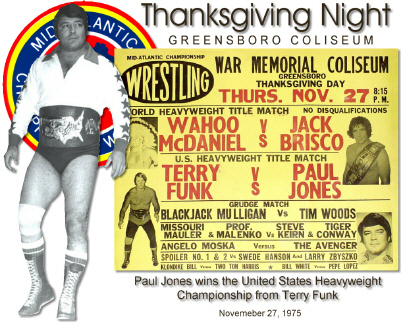
You see, even to this day as of this writing, there has never been a legitimate photo to surface of Terry Funk wearing the Crockett/Mid-Atlantic Wrestling version of the U.S. title belt. The night he won the championship in a tournament in Greensboro in 1975, the actual belt wasn't present and they used a stand-in (a WWWF tag belt of all things.) Funk then only wore the original belt to the ring one time, in his first defense on Thanksgiving night against Paul Jones, the man he beat in the finals of the aforementioned tournament. While there certainly had to have been a photo taken by the wrestling media that night, one has never surfaced, and believe me  - - we have searched long and hard. One may show up one day.

The above photo is a well done photoshopped image originally from a mid-1970s promotional photograph when Terry Funk was NWA World Heavyweight Champion. In the original, Terry is wearing the "domed-globe" NWA title belt. Longtime Mid-Atlantic Wrestling fan Steven Chandler (aka Jesse Santana in his wrestling persona) did a great job in modifying the photo to have Terry wearing the Crockett version of the U.S. title belt from that same era. It gives us all a great idea of what Terry would have looked like wearing that classic cast U.S. title belt.

Funk briefly held that U.S. title in November 1975, in the weeks leading up to his historic win over Jack Brisco for the NWA World title in Miami Beach, FL in December 1975. It was all part of classic booking from that era to simultaneously build Funk up as top world title contender as well as establish Paul Jones as U.S. champion and the #1 contender for Funk's world title when he would later win it. 

You can read more about the famous tournament Funk won in Greensboro to win the U.S. title, as well as the aftermath that Thanksgiving, in our feature on its 40th Anniversary published back in 2015. You can also read about my brief interaction with Funk at the NWA Wrestling Legends Fanfest in Charlotte in 2010 where he posed for a photo with a cast replica of the U.S. belt. 

Monday, November 07, 2022

"Jim Crockett's All-American Legacy" Looks at U.S. Title Book

Originally Published November 2015

Josh Watko over at JW's Wrestling Memorabilia web site wrote the nicest review for our book "United States Championship."

In the review, titled "Jim Crockett's All-American Legacy" he also said some very nice things about the Mid-Atlantic Gateway website, which is always appreciated, and we're glad he enjoys spending time here.

Josh's website is actually a blog where he regularly spotlights items from his incredible collection of wrestling memorabilia. One of the things I particularly like about his site is that he will post memorabilia related to current events. An example is a recent post about the passing of wrestling legend Nick Bockwinkle that features magazine covers and an action figure from several decades ago, as well as Watko's thoughts and memories of one of wrestling all-time great champions. He also often links his posts to anniversaries of big events from yesteryear such as Starrcade, Wrestlemania, or the Great American Bash.

He also posts about recent books on wrestling, and I am pleased he wrote about "United States Championship."

His review begins:
November 27, 1975. Greensboro, North Carolina. A night of wrestling presented by Jim Crockett Promotions. Terry Funk. Paul Jones. All the ingredients needed for what we would now look upon as a classic night of professional wrestling. Traditional wrestling. Wrestling the way that many still remember as the greatest era in the history of the sport. The one element that I failed to mention? The Funker and Number One were battling over the United States Championship. Funk had just won a tournament for the vacant title while Jones, an icon of Carolina wrestling, was the other wrestler who had made it to the finals. Who won the epic Thanksgiving night rematch? You could go look it up and simply see the result, but I have a better idea. How about learning each nuance of the match. Why it happened, what happened during, and what the ramifications were. This is where a brand new book comes into the picture.

The complete article "Jim Crockett's All-American Legacy" takes a look at the special aspects of the book and serves as a sneak-peak inside the book as well.

Watko wrote this about the Gateway:

The Gateway is a site that I'm sometimes too scared to surf over to. The reason is that I know I'm about to lose an hour or two getting absorbed into the great content covering anything and everything that you ever would want to know about Jim Crockett Promotions and the rich Carolina wrestling history. ... The writing and photography pulls you in and actually almost transports you back to the era that's being described.

I love that. It's what David Chappell and I envisioned when we started the website back in 2000. We hope you just get lost in here.


TO ORDER YOUR COPY OF THIS NEW BOOK:

The book on the U.S. title is available on Amazon.com as well as through the Mid-Atlantic Gateway. Click here for more details.


Friday, June 24, 2022

Mid-Atlantic Wrestling in Niagara Falls, ONT (1980)

by Dick Bourne
Mid-Atlantic Gateway

Poster image submitted by Andrew Calvert and Barry Hatchet
MapleLeafWrestling.com

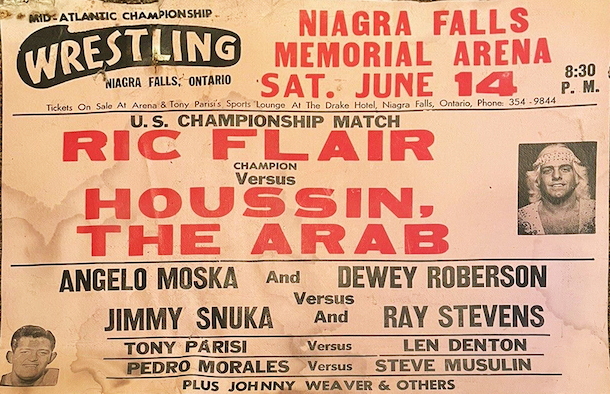
This is a very rare and somewhat unusual poster from June of 1980 for a show in Niagara Falls, Ontario. It features a United States title defense by Ric Flair against Great Hossein Arab, better known to fans in the traditional Mid-Atlantic territory as the Iron Sheik. The card took place at Niagara Falls Memorial Arena, which was just across the Canadian - U.S. border in Ontario.

The show was promoted by Tony Parisi as an extension of Frank Tunney's Toronto booking office. This was during the roughly 5-year period that Tunney was booking the majority of his talent for Toronto from Jim Crockett Promotions in partnership with Crockett and booker George Scott. One of the unusual things that makes this poster so rare is that it says "Mid-Atlantic Championship Wrestling" instead of Maple Leaf Wrestling. Andrew Calvert from Toronto told us that posters were generally pretty scarce to begin with up his way, but the ones they did have were almost always billed as Maple Leaf Wrestling. 

The Iron Sheik was generally billed in Toronto as Hossein the Arab or Great Hossein Arab. (His name was badly misspelled on the poster.) When he first arrived in the Mid-Atlantic area in early 1980, he was referred to on television by Bob Caudle and Rich Landrum as  "Hossein the Arab, the Iron Sheik." Later, it was simply shortened to the Iron Sheik. But in Toronto, it was usually Hossein the Arab.

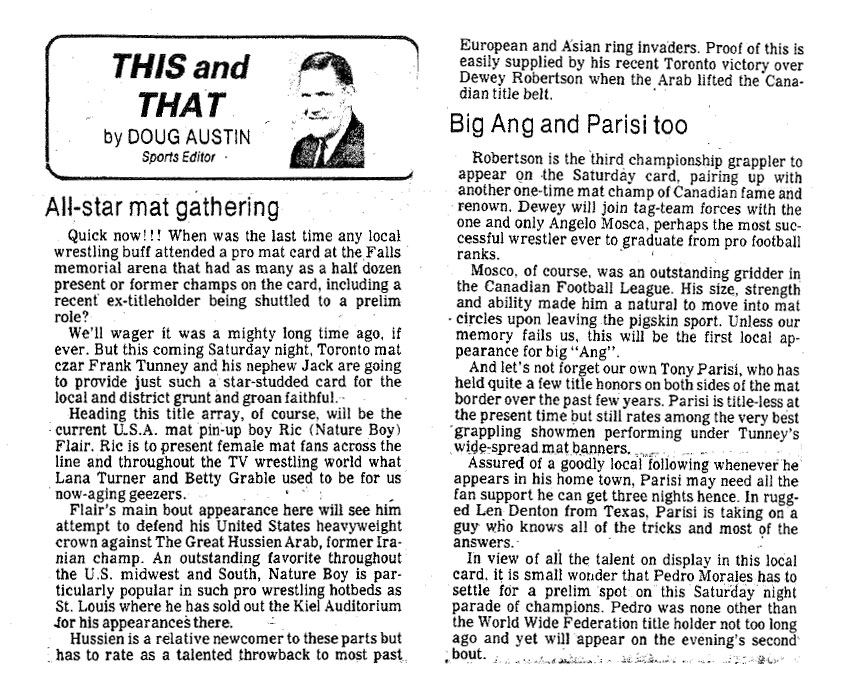
At the time of this card, the Sheik was Canadian Heavyweight Champion, having defeated Dewey Robertson for the gold belt back in May in Maple Leaf Gardens in Toronto. Oddly he is not billed as such on this poster, although newspaper articles in advance of this show mention he is champion. It appears Flair's United States title was the only championship on the line that night at the Falls arena. The Canadian title was mainly defended in Toronto, but it would seem a missed opportunity to not have a title-vs-title match, especially given that the finish of the match was reportedly a double count-out. 

Sheik was also the reigning Mid-Atlantic Heavyweight champion at this time. He is billed with neither title on this poster.

Others featured on the poster were local favorites (and former Canadian champions) Angelo "King Kong" Mosca and Dewey Robertson, teaming up to face the top heel team for Jim Crockett Promotions, Jimmy "Superfly" Snuka and Ray "The Crippler" Stevens. Snuka and Stevens won the NWA World Tag Team titles just three weeks earlier from Ricky Steamboat and Jay Youngblood in Greensboro, NC, although they are not billed as champions on the poster. Neither is their manager Gene Anderson, and it isn't clear if Anderson appeared with them on this show in Niagara Falls. Again, it seems like a missed opportunity for promoter Parisi to not bill Snuka and Stevens as tag champs and make the match a title match.

Parisi's office was spelling-challenged on this particular poster, too: they even botched local football and wrestling legend Angelo Mosca's name!

One other thing that seemed odd (and this was mentioned in the local paper, too) was the low placement on the card of Pedro Morales. To be sure, Morales was wrestling low-to-mid card for Jim Crockett Promotions during this era, even doing jobs on TV, but he had not so long ago been WWWF Heavyweight Champion, and was still occasionally a headliner in the WWWF during this era. With the WWWF television being seen in this area, and the history of the WWWF title being defended in Toronto, you would think that even being booked out of JCP, Morales would have had a more featured spot on the card here.

As seen in this image, the poster is in really rough shape, worn and torn, and with a lot of apparent water damage. It was recently sold on eBay, which is where Barry Hatchet noticed it and the image wound up making its way to us, via our mutual friend Andrew at MapleLeafWrestling.com.

 
 Book Store:

Wednesday, February 16, 2022

Poster: Mr. Wrestling defends the U.S. Title against Ric Flair

by Brack Beasley
Mid-Atlantic Gateway Contributor

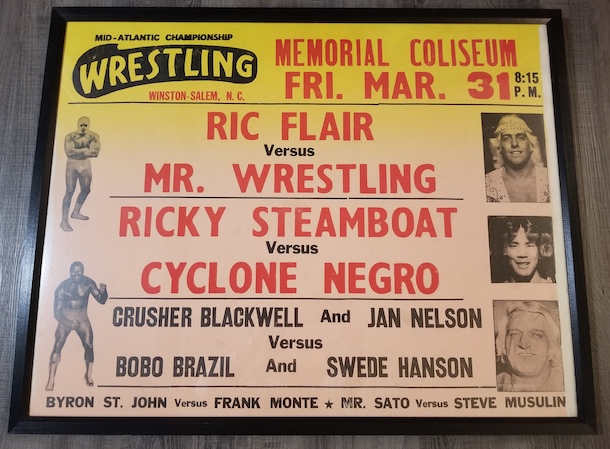
For personal reasons this is one of my all time favorite posters. It promotes a card held at the old Winston Salem Memorial Coliseum on Friday, March 31st, 1978. 

First and foremost, I was fortunate enough to be in attendance that night and acquired this poster from the box office where it was taped to the outside of the window. You can see where the tape was removed along both sides. 

Just like most young boys growing up, I had heroes and idols that I aspired to be or be like. First there was Superman, then Batman, but once I saw Mr. Wrestling (Tim Woods under the hood of course) on TV for the first time, he was my new superhero. 

This hero was even better because I could see him in person on occasion, reach out and touch him, and get his autograph. He was indeed real unlike the others before. I wish my memory was better but I do recall going home with my best friend from school that day in Mt. Airy, NC and my father picked us up when he got off work. Then down Highway 52 to Winston-Salem we went. Dad even splurged on the ringside seats, probably all of 4 or 5 dollars each at the time, and a current copy of Mid-Atlantic Wrestling Magazine was mandatory for a dollar.

The main event of the evening was a match I had dreamed of seeing as Mr. Wrestling defended his newly won United States Heavyweight Title belt against the Nature Boy Ric Flair. Although the poster doesn't mention it being a title match, Mr. Wrestling won the prized championship from Blackjack Mulligan almost two weeks earlier in Greensboro, NC. 

Ricky Steamboat collided with the always tough Cyclone Negro in the semi while the lone tag team event of the evening had Bobo Brazil and Swede Hanson against Crusher Blackwell and Jan Nelson. The undercard consisted of Byron St. John versus Frank Monte and Mr. Sato versus Steve Musulin.

Much to my delight, and to the delight of the many fans in the Coliseum that night, Mr. Wrestling successfully retained his title. Although I don't remember many details of this match, the sight of Mr. Wrestling pinning Flair in the middle of the ring with his trademark standing head cradle as the crowd erupted has never left my mind. What a celebration it was seeing him get his hand raised in victory and being handed back his U.S. belt. Unfortunately, his U.S. title run was brief as Flair eventually won the belt in Charlotte only nine days later.

The horizontal poster layout features full body images of Mr. Wrestling and Brazil on the left and images of Flair, Steamboat, and Hanson on the right with the "Wrestling" splash in the upper left corner. The two tone bright yellow over pink background is eye-catching as well with the main-eventers, date, and locale in high impact red print.

This wasn't the first time I saw Mr. Wrestling in person, nor was it the last, but it was definitely the most memorable and satisfying. I am thankful to have this poster as it is a memento and reminder of such a great night many years ago. 

NO. 27 IN A SERIES

* * * * * * * 

See also: The Gateway Museum: Mr. Wrestling Tim Woods

Monday, January 24, 2022

Title History of the United States Championship

It was the top championship in the Mid-Atlantic territory for Jim Crockett Promotions in the 1970s and 1980s and was held by some of the greatest names to ever step into a pro wrestling ring. 

Now this book lays out every champion and the detailed story behind every championship title change from the title's introduction in 1975 until the sale of the family business to Ted Turner in 1988. 

It was a glorious time.

Order your copy of "Jim Crockett Promotions' United States Championship" today!


Monday, November 29, 2021

U.S. Title Book Review: Jim Crockett's All-American Legacy

Edited from a post originally published in November of 2015 on the Mid-Atlantic Gateway.

Josh Watko over at JW's Wrestling Memorabilia web site wrote the nicest review for our  book "United States Championship."

In the review, titled "Jim Crockett's All-American Legacy" he also said some very nice things about the Mid-Atlantic Gateway website, which is always appreciated, and we're glad he enjoys spending time here.

Josh's website is actually a blog where he regularly spotlights items from his incredible collection of wrestling memorabilia. One of the things I particularly like about his site is that he will post memorabilia related to current events. An example is a recent post about the passing of wrestling legend Nick Bockwinkel that features magazine covers and an action figure from several decades ago, as well as Watko's thoughts and memories of one of wrestling all-time great champions. He also often links his posts to anniversaries of big events from yesteryear such as Starrcade, Wrestlemania, or the Great American Bash.

He also posts about recent books on wrestling, and I am pleased he wrote about "United States Championship."

His review begins:

November 27, 1975. Greensboro, North Carolina. A night of wrestling presented by Jim Crockett Promotions. Terry Funk. Paul Jones. All the ingredients needed for what we would now look upon as a classic night of professional wrestling. Traditional wrestling. Wrestling the way that many still remember as the greatest era in the history of the sport. The one element that I failed to mention? The Funker and Number One were battling over the United States Championship. Funk had just won a tournament for the vacant title while Jones, an icon of Carolina wrestling, was the other wrestler who had made it to the finals. Who won the epic Thanksgiving night rematch? You could go look it up and simply see the result, but I have a better idea. How about learning each nuance of the match. Why it happened, what happened during, and what the ramifications were. This is where a brand new book comes into the picture.
The complete article "Jim Crockett's All-American Legacy" takes a look at the special aspects of the book and serves as a sneak-peak inside the book as well.

Watko wrote this about the Gateway:

The Gateway is a site that I'm sometimes too scared to surf over to. The reason is that I know I'm about to lose an hour or two getting absorbed into the great content covering anything and everything that you ever would want to know about Jim Crockett Promotions and the rich Carolina wrestling history. ... The writing and photography pulls you in and actually almost transports you back to the era that's being described.

I love that. It's what David Chappell and I envisioned when we started the website back in 2000. We hope you just get lost in here.


TO ORDER YOUR COPY OF THIS BOOK:

The book on the U.S. title is available on Amazon.com as well as through the Mid-Atlantic Gateway. Click here for more details.

Saturday, January 09, 2021

Father and Fighter: Roddy Piper Delivers the Ultimate Babyface Promo

by Dick Bourne
Mid-Atlantic Gateway


"You take a look at me, man. I'm just like James Dean, the only difference is the wrapping is a little different, jack."  - Roddy Piper


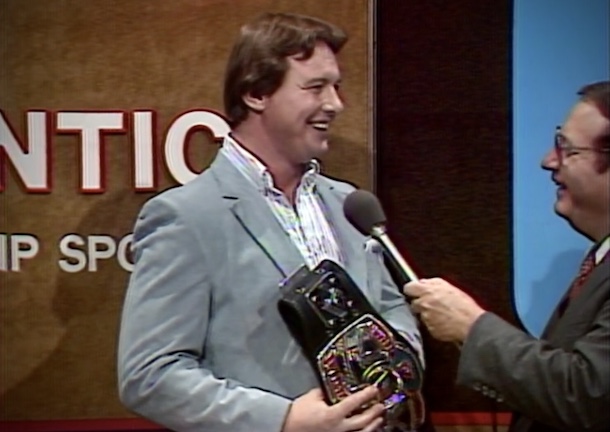
On the April 23, 1983 episode of Mid-Atlantic Championship Wrestling, the show's first interview is with the new United States Heavyweight Champion Roddy Piper, who has the belt and speaks with show host Bob Caudle. 

Piper had just a week earlier defeated Greg Valentine in Greensboro for the title. It was his second time around holding the belt, the area's most prestigious championship. Valentine was stinging from the loss, promising Piper he would make him the shortest lived U.S. champion ever, and hurt him in the process.

Piper gave the ultimate rebuttal. If you were to look up "perfect babyface interview" in a online digital dictionary, this interview would be the example used to illustrate it. Piper just nails it on every level. He is humble and happy, funny yet serious, but most of all he is real. Not only was Piper celebrating his win over Valentine, he was celebrating some personal landmarks in his life outside of the ring, and he expertly wove them into his interview with Caudle. These were real events and not part of the wrestling storyline, but like so many of the wrestlers of that era, he used part of his real life and his real personality to augment his work. The result was one of the strongest babyface promos you'll ever see.

"I had a week you wouldn't believe, man," Piper told Caudle with a big grin on his face. "On April the 15th you see, I won the United States Heavyweight Championship from Greg Valentine in Greensboro. On April the 17th, I had a birthday." Then looking over at the TV studio audience in attendance, he said, "And on April the 19th I became the father of a 7.9 pound baby girl!"

The crowd exploded with cheers, like it was someone in their family that had just given them this great news. There was this sudden and organic moment of bonding with the fans as Piper grinned ear to ear looking over Bob Caudle's shoulder at them seated on the bleachers in the cramped studio. "That's not a bad week, huh?" he giggled, "Not a bad week at all."

Piper had just connected with his audience in a way few babyfaces could. It was real. And it set the stage for what was next. Piper wasn't grinning anymore; he became deadly serious, and it was his delivery during all of this that added the proper emphasis.

"You see, I got a whole change of thought happening here, Valentine, I'm probably meaner now than I've been in my whole life," Piper said, looking down at the floor. "Because you see, when I first started to fight, I used to fight to feed myself, and it was positively I should win." Piper then looked straight into the camera. "And now it's kind of a necessity, you see, because I'm fighting for others now."

This wasn't someone pretending to be a babyface, this was a real babyface, a guy ready to man up and fight for his family, become a provider, a father, and likely a better husband. Then Piper brings it back around, stepping away from hearth and home, and gets back to the business of selling tickets. 

"I'm fighting for others now, and if you want to beat me Valentine, you're going to have to kill me for this belt." 

Wrestling's James Dean left the interview position shortly after, clearly a man on a mission to defend his title and to take care of his family. 

Valentine, however, made good on his earlier promises to Piper. Just a little over one week later on May 1, back in the ring in Greensboro, Valentine regained the championship, badly injuring Piper's ear in the process. But the people were behind their hero. And now the chase was on.

That angle would serve as the beginning of what Piper would call "the year of the ear" and would lead to climactic dog-collar match seven months later on Thanksgiving night as part of the very first Starrcade. But it was this interview by Piper that first gave the whole program with Valentine a sense of realism and consequence on a level not always achieved in a pro-wrestling storyline. 

You can watch this interview on the 4/23/83 episode of Mid-Atlantic Championship Wrestling on the WWE Network. It takes place at the 4:27 mark of the show

* * * * *

For you title history buffs out there, Piper mentions in this interview that he defeated Greg Valentine for the U.S. title on April 15, but it was actually Saturday April 16, 1983.


Sunday, November 22, 2020

Follow-up: Roddy Piper and the U.S. Championship in Oregon (1981)

by Dick Bourne
Mid-Atlantic Gateway


Earlier I published a story on Roddy Piper defending the United States Heavyweight championship in Salem, Oregon for promoter Don Owen in 1981. It was part of a week-long tour for Roddy of the Pacific Northwest territory (Portland.) Piper was the reigning U. S. champion for Jim Crockett Promotions, having defeated Ric Flair earlier that year.

Following that article's solicitation for more information from longtime Portland fans, I received an email from a nice fellow named Steven in Seattle who filled in some gaps for us on the previous story, as well as some terrific information on Roddy's appearance two nights earlier in Portland.


Classic Portland Wrestling (Instagram)


On Tuesday June 16, Piper also defended the U.S. title against arch-rival "Playboy" Buddy Rose, who was the top heel in the Portland territory. (The special referee was former NWA World Champion Lou Thesz.) In this amazing photo from the Classic Portland Wrestling page on Instagram, Rose is seen squatting down in front of a prone Piper, holding the United States championship belt. It isn't clear in this photo whether Rose is taunting Piper (likely) or in a show of respect handing him the belt (less likely) following a grueling match. I wish we knew more about that match and its outcome, but obviously Piper retained the title that night. He also defended the title against Rose the following night in Seattle, Washington. (See a great photo of Piper signing autographs on this same Pacific Northwest tour with the Crockett United States Championship belt on Classic Portland Wrestling.)

Piper's return to the Portland territory in 1981 was a really big deal, and he was received as the returning hero. Piper was one of the biggest stars ever there, and so his return really meant something to fans there. The promotion took advantage of Piper's status as United States champion, and even though the Crockett U.S. title was actually a territory title in and of itself (the top singles title in the Mid-Atlantic territory), it was occasionally seen on the nationally cablecast Superstation WTBS for Georgia Championship Wrestling, and was regularly featured in national newsstand wrestling magazines as one of the stepping stones to the NWA World Heavyweight championship. 

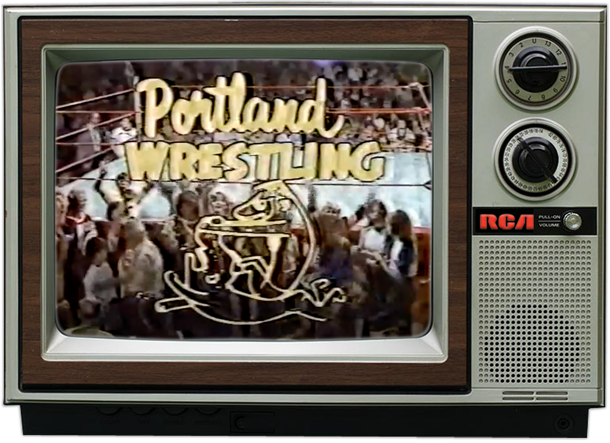
Months after Piper had left Portland for the Mid-Atlantic area, Steven told us about the cool moment on the KPTV channel-12 "Portland Wrestling" television broadcast when legendary Portland host Frank Bonnema announced that there was a new United States Heavyweight wrestling champion and his name was Roddy Piper. This surely got a nice reaction from the Portland faithful. Bonnema told the TV audience that they had received a telegram that Piper had won the title "back east in North Carolina." Piper indeed had defeated Ric Flair for the belt in Raleigh, NC, on 1/27/81.

As I reported in the preceding article about Piper's 1981 Pacific Northwest appearances, Piper's opponent  in Salem, OR on 6/18/81 was The Destroyer, but we had no idea who might have been working under the mask there as the Destroyer at that time. Steven let us know that it was David Patterson, who was better known in later years as Dave Sierra as well as the Cuban Assassin. Patterson is a Mid-Atlantic alumnus, who worked in lower card matches and as enhancement on TV matches for JCP in the early 80s, and always demonstrated the potential he had through his time here, but never got a break in the Mid-Atlantic area.  

If haven't seen the article on Piper returning to Oregon that preceded this one (including the 6/18/81 newspaper ad for Salem), check it out here:

Roddy Piper Defends the Crockett U.S. Title in Oregon (1981)
http://www.midatlanticgateway.com/2020/11/piper-us-title-oregon.html

Visit the excellent Classic Portland Wrestling Instagram page for more Portland wrestling memorabilia. (Direct link to the Buddy Rose/Roddy Piper photo above.) (Piper wearing the U.S. belt, back turned.)

(See a great photo of Piper signing autographs on this same Pacific Northwest tour with the Crockett United States Championship belt on Classic Portland Wrestling)


Thursday, November 12, 2020

Roddy Piper Defends the Crockett U.S. Title in Oregon (1981)

by Dick Bourne
Mid-Atlantic Gateway

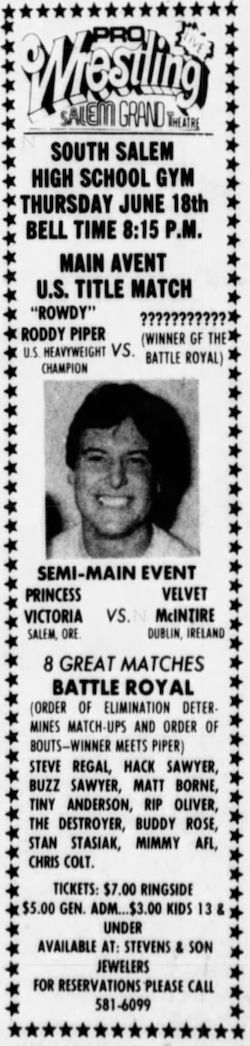
Salem, Oregon, June 18, 1981
Clipping from the Mark Eastridge Collection


One of my favorite scavenger hunts in wrestling research is tracking down defenses of Crockett's championships in other territories. There were many times during the territory days in the late 1970s and early 1980s that the World Tag Team and United States championships traveled to Georgia, Florida, Texas (San Antonio and Houston territories), Mid-South and elsewhere.

Now add Portland to that list. Mark Eastridge, a Mid-Atlantic Gateway contributor for many years and an amazing collector of newspaper ads and results from around the world, recently sent me this clipping from the Portland territory. I was thrilled to see it because it documented a "Rowdy" Roddy Piper defense of the United States Championship in the NWA's Pacific Northwest. 

The card featured here is from June 18, 1981 in Salem, Oregon, roughly 30 miles south of Portland, and features Piper scheduled to defend the title in an open challenge to the winner of a battle royal earlier that same night.  Salem was just one stop on a near week-long tour Piper made in the territory that June, with other stops including Portland and Eugene, Oregon, and Seattle, Washington. 

Piper wound up successfully defending his belt against The Destroyer that night, who came out on top in the earlier battle royal. We don't have information on who was under the mask as the Destroyer, but we'd love for any longtime Portland fans to let us know.

Just before leaving on this short tour of the Oregon territory, Piper challenged Harley Race for the NWA World Heavyweight Championship in Charlotte, NC. Piper won that match by DQ, but not the title of course. Race was only a week away from losing the NWA title to Dusty Rhodes in Atlanta.

Piper was in the middle of his first reign as United States champion for Jim Crockett Promotions having defeated Ric Flair for the title in January of that year in Raleigh NC's Dorton Arena. Piper had become the most hated heel in the area at that point and he and Flair went round and round for the title. Piper also had other memorable feuds over the U.S. title from 1981-1983 including with Wahoo McDaniel, and Greg Valentine. He was a 2-time U.S. Champion, and also held the other singles titles in the area including the NWA TV championship and the Mid-Atlantic Heavyweight Championship.

Piper never lost it back to Flair, though, and their feud continued on after Flair won the NWA World Heavyweight Championship in September of 1981. Piper was Flair's early number one challenger for the title whenever Flair came back to his home territory to defend the world championship.

Piper was a very big deal in the business during those years. Not only was he one of the top wrestling stars for JCP, he would become a top TV color commentator on both Mid-Atlantic Championship Wrestling (with Bob Caudle) and the nationally televised Georgia Championship Wrestling (with Gordon Solie.) After being stabbed by a fan in the summer of 1982 in Raleigh, Piper turned good-guy (in both Georgia and the Mid-Atlantic) and instantly became one of the most popular wrestlers in the country. After wrestling in the famous Dog Collar match on Thanksgiving night at Starrcade '83, Piper left for the WWF in early 1984, becoming one of the top heels there, and wrestling in the main event at the first Wrestlemania in 1985. 

Although Piper was a top heel as U.S. Champion in June of 1981, he was the returning hero in Oregon, where he had been one of the top draws for Portland promoter Don Owen in the years before coming to the Mid-Atlantic area. Piper had a great deal of affection and loyalty for Owen, and made many returns there, even once when he was working for the WWF. 

Piper joins Ric Flair and Wahoo McDaniel during that era as U.S. champions for Jim Crockett Promotions who took the title on the road outside of the Mid-Atlantic area.

Thanks to Mark Eastridge for providing the newspaper clipping.  

For a detailed history of the United States Championship and the five different belts that represented it from 1975-1988, check out our deluxe full-color U.S. title history book in the Mid-Atlantic Gateway Book Store through the link below.


Saturday, September 12, 2020

The Very First U.S. Title Switch in the Greensboro Coliseum

by Dick Bourne
Mid-Atlantic Gateway

It's often said that the night Johnny Valentine beat Harley Race for the United States Heavyweight Championship in 1975 was the first time the U.S. title changed hands in Greensboro. But that would be wrong. It actually happened in 1962 when Hans Schmidt defeated then U.S. champ Pat O'Connor for the honors in front of 5,800 fans in the Greensboro Coliseum. O'Connor regained the title in the same building about 5 weeks later.

Anyone could be forgiven for not knowing about two such events 13 years apart. I never knew about that title change until I began research for my book on Jim Crockett Promotions' United States Championship. I was not even a year old when the 1962 matches happened. But additional research by Carroll Hall and Mark Eastridge shed light on this historic switch during an earlier era.

Carroll Hall recently posted both newspaper clippings from those two cards on his All Star Championship Wrestling blog. You can take a close look at those here:

The First U.S. Title Switch in the Greensboro Coliseum
Post by Carroll Hall
All Star Championship Wrestling

As an additional reference point about this time in history, O'Connor had been awarded the United States championship by the National Wrestling Alliance after Buddy Rogers had defeated him for NWA world heavyweight championship. It was during a brief time when the NWA board actually recognized a U.S. title in that era.

It's fun to take a look at who else was on that card:
  • Long time area veteran George Becker teamed with national sensation Argentina Rocca. 
  • Even in 1962 Johnny Weaver was already battling Rip Hawk. 
  • Abe Jacobs was a perennial star in the area over two decades.
  • Women wrestlers were prominent on the cards, as Johnny Weaver's wife Penny Banner was on the July card wrestling Ann LaVerne. She would become one of the biggest names in women's wrestling. The August card featured a women's tag match with four African-American women wrestlers, a rare such booking in wrestling during the era of segregation.  They were Babs Wingo, Fuzzy Robinson (replacing Marva Scott), Ethel Johnson, and Virginia Franklin. 
  • Ringside seats were only $2.50 in 1962!


A blooper alert - - We noticed in the results clipping for the August 16th card where O'Connor regained the U.S. title, Johnny Weaver beat Luis Tillett on the undercard with a dreaded SWEEPER hold!


Originally posted on the Mid-Atlantic Gateway on September 25, 2015.
 

Sunday, August 16, 2020

An Embarrasement of Riches for Paul Jones in 1975

by David Chappell
Mid-Atlantic Gateway

In the illustrious Jim Crockett Promotions career of “Number 1” Paul Jones, a career that spanned from the late 1960s through the late 1980s, Paul experienced an untold number of high water marks. But there was probably no higher high for Paul than in the late autumn of 1975, immediately after Jones defeated Terry Funk for the United States Heavyweight Championship on November 27, 1975 in the Greensboro Coliseum.

Paul’s first interview as the new United States Champion on Mid-Atlantic Championship Wrestling television was conducted on December 3, 1975. Having just aced the U.S. belt, Jones was considered the number one contender for the NWA World Heavyweight Title in many circles. And at that time, Paul was also the reigning Mid-Atlantic Television Champion. Truly, an embarrassment of riches for Mr. #1!

Announcer Bob Caudle began the show, telling the fans, “First of all, we have a guest right here with a new championship belt…the new U.S. Heavyweight Champion Paul Jones, and Paul, you defeated Terry Funk.” Jones slipped onto the set and emotionally replied, “Well, that’s right. I’m so proud of this belt, I’m lost for words. But I want to say, I want to thank the people that stood behind me, the long fight to get this belt, and finally I won it, and I just feel great all over.”

However, not all of Paul’s news was good. Jones continued:

“But I also have some bad news tonight. You know, this Mid-Atlantic TV belt here…I’ve won this belt three times. It’s real close to me, and I feel like…the U.S. belt, I’m going to have to travel all over the United States to defend this belt in every city every state, so I feel like I won’t be able to do justice to the TV belt, which I have a lot of respect for and I’m real proud of it.” Paul then broke the bad news about his TV belt, explaining, “But what I’m going to have to do; I’m going to have to put it up for grabs. As much as I hate to, with all the hard matches I’ve had to win this belt. So I hate to do it, but I feel like I wouldn’t be doing the TV belt any justice by keeping it and carrying it around the country with me, and I’m just going to put it up for grabs.”


http://midatlanticwrestling.net/yearbooks.htm


Caudle commiserated with Jones, commenting, “Well Paul, I know you hate to do that, like you say you’ve had it for a long, long time and it’s a beautiful belt.” Jones replied, “It really is, and I hate to part with it, but this belt here, I have to defend it all over the United States…and I just don’t have time.” Caudle countered, “Well, Paul, you’re going to be a great champion, a great U.S. Heavyweight Champion, I’m sure of that, and congratulations to you again.” Jones answered, “Thank you Bob,” as he exited the interview area.

Before running down the television card, Caudle interjected, “So Paul Jones, the new U.S. Heavyweight Champion, and David, he is relinquishing this TV championship belt.” Color commentator David Crockett offered, “And one thing, Paul has made this Mid-Atlantic TV championship belt mean more than any other TV championship belt in the whole United States.” Caudle added, “No doubt.” Crockett continued, “And also, when Paul Jones won the United States Heavyweight Championship from Terry Funk, he had to go through the whole Funk family, so that’s a great accomplishment, because Terry Funk is one of the greatest wrestlers in the world, and Paul Jones has the right to win that belt…he’s something else.”

‘Something else’ was the right way to phrase it, as Paul Jones was unquestionably on top of the wrestling heap in December of 1975, to the point he gave up an excess title! An embarrassment of riches for sure, but wrestling wealth that was well-earned and well-deserved in the minds of his legions of Mid-Atlantic fans.

 
Originally published February 23, 2017 on the Mid-Atlantic Gateway
 
http://www.midatlanticgateway.com/p/us-title-book.html

Wednesday, July 15, 2020

Detailed History of the United States Championship

Check out our full color book reliving all the history of Jim Crockett's United States Heavyweight Championship and the five classic championship belts that represented it. All the champions, all the belts, all the tournament brackets and title history. Details on every title change over 13 years and all that led up to them.

Order your copy of "Jim Crockett Promotions' United States Championship" today!

http://www.midatlanticgateway.com/p/us-title-book.html 
http://bookstore.midatlanticgateway.com

Friday, May 01, 2020

The 1984 U.S. Title Tournament: Vindication for Wahoo McDaniel

The Story of the Heel Turn of Chief Wahoo McDaniel (Part 4)
The Finale: Part Four in a Four-Part Series
by Dick Bourne
Mid-Atlantic Gateway

Catch up on the earlier parts of this series:
PART ONE: Wahoo's Black Saturday
PART TWO: The Conspiracy
PART THREE: The Awesome Twosome

As summer turned to autumn in 1984, the "Awesome Twosome" of Wahoo McDaniel and Tully Blanchard were blazing a trail of terror through the Mid-Atlantic area, but it became clear that Wahoo wasn't interested in long term tag team action. He wanted his U.S. title back. The NWA held up the belt back in August and Jim Crockett Promotions had been dragging its feet on figuring out how the whole situation between Wahoo and Ricky Steamboat would be settled. Each wrestler made a credible claim to the title.

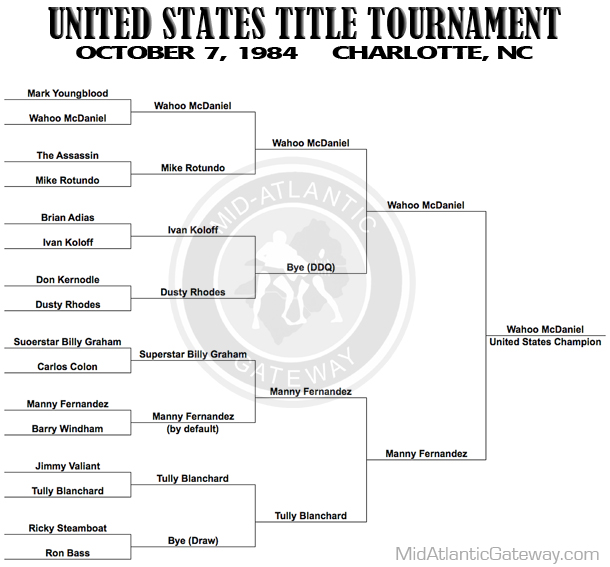
Eventually, the decision was made not return the title to either Wahoo or Steamboat, and the issue would be resolved in a tournament to be held in Charlotte, NC on October 7, 1984.

Charlotte had hosted a United States title tournament once before, back in October of 1981 when Jimmy Snuka won the honors after, interestingly enough, Wahoo McDaniel had been stripped of the same title under questionable circumstances in a wild feud with Roddy Piper that involved Abdullah the Butcher. The fact that the title had been taken from him again and put in a tournament obviously angered and frustrated the Chief, and he made that point abundantly clear to David Crockett and Bob Caudle on the two JCP television programs.


THE TOURNAMENT
Initially sixteen wrestlers were entered in the tournament. Barry Windham, one of the original 16,  defaulted by no-showing the event, having left days earlier to enter the World Wrestling Federation.

The tournament featured three wrestlers from outside of the territory. Superstar Billy Graham came in from Florida and Carlos Colon flew in from Puerto Rico. The third outsider was Manny Fernandez, who had arrived full-time a few weeks earlier and who would stay with the promotion for the next several years.

The Charlotte card was part of a huge weekend for Jim Crockett Promotions. The night before in Greensboro was the big “Starrcade Rally” show, with a concert and autograph signings, and where announcements of the big matches would take place for the upcoming mega-event Starrcade ’84. Originally, the card was to have been the launching point for a big push for Barry Windham, who had recently arrived to the territory from Florida. Instead, Barry and his father, Blackjack Mulligan, jumped ship to the World Wrestling Federation. The defection left a big hole in Jim Crockett’s long-term plans moving forward.

History will never know for sure what the original plans for the tournament were and how the departure of Barry Windham might have affected them. There seems little doubt that the finals would have come down to Windham and Wahoo McDaniel, building toward a title match between the two at Starrcade ’84. However, it’s less certain who would have won that final match in the tournament had Windham stayed with Crockett.

The likelihood is that Wahoo McDaniel would still have won this tournament, which would have set up Windham winning the U.S. title from him at Starrcade ‘84. Windham had been introduced on television in early August as having signed the most lucrative contract in pro-wrestling history (!) with Jim Crockett giving him the keys to a brand new sports car as well. He was clearly in line for the huge push, and would have no doubt been the top contender in the area for Ric Flair’s NWA world championship, just as he had been in Florida over the last couple of years. The other less likely possibility was to put Barry over strong by having him win this tournament and then defeat Wahoo again at Starrcade.

Manny Fernandez assumed Barry Windham’s spot in the tournament. He defeated Superstar Billy Graham and reigning TV champion Tully Blanchard before eventually losing to McDaniel in the  finals.

Wahoo defeated former tag-team partner Mark Youngblood, as well as Mike Rotundo, and  finally Fernandez on his way to his 5th United States championship.


 First Round Matches
• Wahoo McDaniel defeated Mark Youngblood
• Mike Rotundo defeated The Assassin #1 (Jody Hammilton) by DQ
• Ivan Koloff defeated Brian Adias
• Dusty Rhodes defeated Don Kernodle
• Superstar Billy Graham defeated Carlos Colon by count-out
• Manny Fernandez received a bye when Barry Windham defaults
• Tully Blanchard defeated Jimmy Valiant
• Ricky Steamboat and Ron Bass wrestled to a draw – Both eliminated

Second Round Matches - Quarter Finals
• Wahoo McDaniel defeated Mike Rotundo
• Dusty Rhodes and Ivan Koloff double-DQ – Both Eliminated
• Manny Fernandez defeated Superstar Billy Graham via DQ
• Tully Blanchard received a bye due to Steamboat/Bass draw.

Third Round Matches – Semi Finals
• Wahoo McDaniel received a bye due to the Rhodes/Koloff double DQ
• Manny Fernandez defeated Tully Blanchard

Final Round – Tournament Championship
• Wahoo McDaniel defeated Manny Fernandez to win the U.S. Championship


Needless to say, after Wahoo had regained the title by winning the tournament, he was on cloud nine and cocky as ever. But you really couldn't blame him. It had been a long, hot, controversial summer, and he had finally been vindicated.

Wahoo went on to defend the U.S. title Thanksgiving night at Starrcade '84, soundly defeating Superstar Billy Graham. As 1984 came to a close, a new challenger appeared on the horizon.  Magnum T.A., having just arrived from the Mid-South territory, quickly established himself as the number one contender for the United States Championship and eventually defeated Wahoo for the title in a dramatic moment on "World Wide Wrestling" taped March 23, 1985 in Charlotte.

THE SUNSHINE STATE
Wahoo immediately left the Mid-Atlantic area after the loss to Magnum, and became the booker for the Florida territory, as well as its number one popular star. When he entered the sunshine state, he left his "bad guy" days behind him.

Later that summer, Dusty Rhodes would recruit Wahoo to return to the Mid-Atlantic area for a few select appearances over the next months. He asked Wahoo to be his partner against Tully Blanchard and his paid henchman Abdullah the Butcher.  Wahoo sent in a tape from the set of "Championship Wrestling from Florida" asking Dusty for his forgiveness and his trust, and telling him he would be there if he needed him. Wahoo received a heroes welcome when he did return.

In the early fall, Wahoo returned once more to team with Dusty and Magnum in their battles with Tully Blanchard and the Andersons, only a few months before the latter would join NWA Champion Ric Flair and form the Four Horsemen.

Also republished 8/25/2020

 
* * * * * * * * * * * * * * * * * * * * * * * *

For more on the history of the United States title, check out our book "Jim Crockett Promotions' United States Championship."

* * * * * * * * * * * * * * * * * * * * * * * * 

Series Breakdown:
Part Three: The Awesome Twosome
Part Four: Vindication (This Article)
* * * * * * * * * * * *

http://bookstore.midatlanticgateway.com

Friday, March 27, 2020

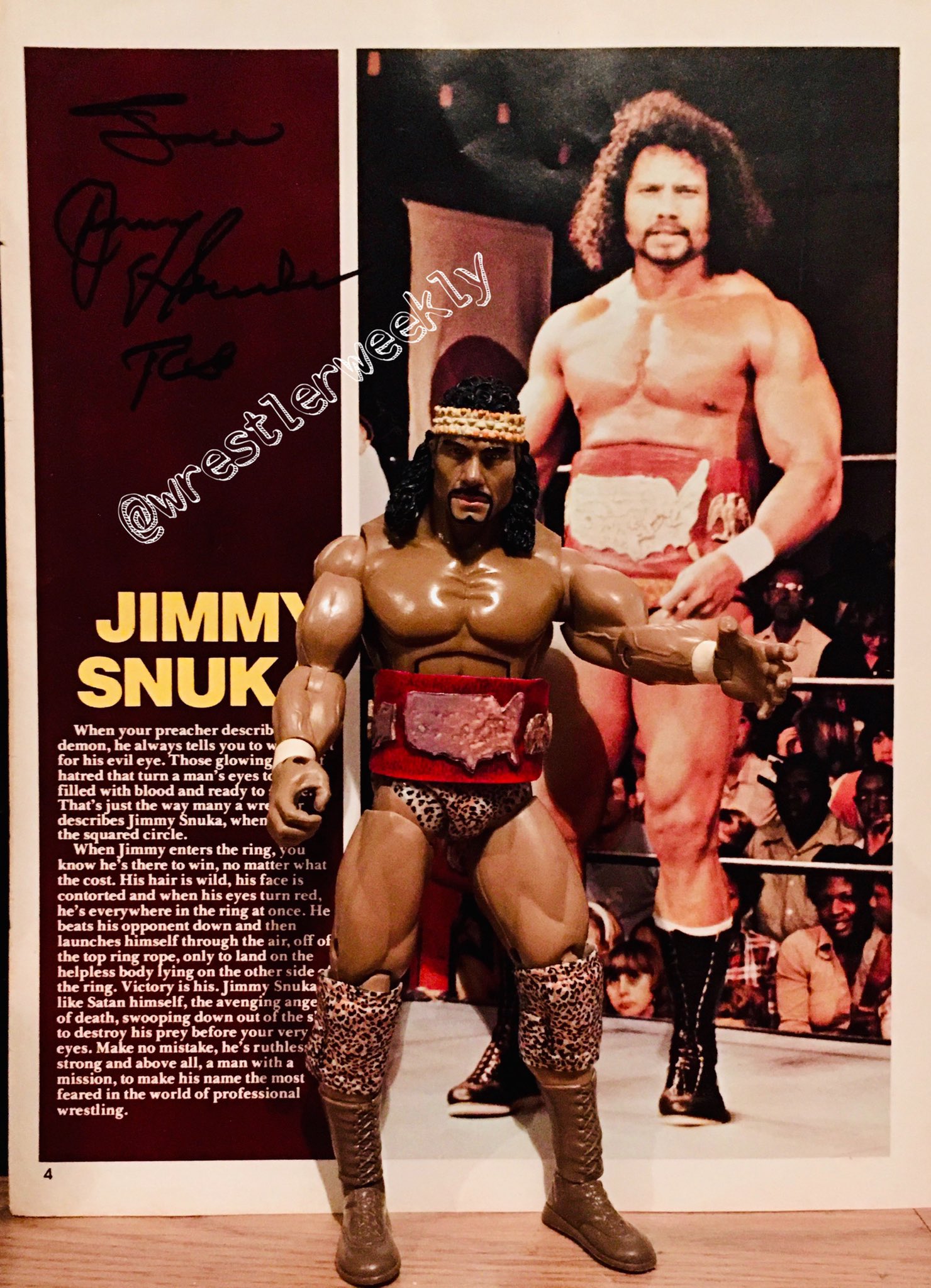
Action Figures Friday: U.S. Champion Jimmy Snuka!


Very cool customization of "Superfly" Jimmy Snuka with a custom U.S. title belt, presented by our friends at @wrestlerweekly.

Snuka was United States champion in 1979 and 1980 and had a memorable, long, bloody feud with "Nature Boy" Ric Flair over that title belt. You can read all about Snuka's run as United States champion (as well as the entire history of that championship) in our full-color book "Jim Crockett Promotions' United States Championship", available on Amazon and via the Mid-Atlantic Gateway bookstore.  

Republished in September of 2022 on the Mid-Atlantic Gateway.

https://www.amazon.com/dp/1517463386/

Monday, March 23, 2020

Georgia Learns of New World Tag Champions ... Before The Titles Actually Change Hands

PART FOUR
by Dick Bourne and Mark Eastridge
Mid-Atlantic Gateway

It is certainly one of the most fascinating cases of a kayfabe violation in the territory wrestling days that you can imagine.

Our ongoing series about the 1977 Mid-Atlantic Wrestling/Georgia Wrestling talent exchange continues with this look at a big card of wrestling at the Bell Auditorium in Augusta, GA on May 9, 1977.

As we've described earlier in this series, Augusta was ground zero for some of the most interesting "mixed cards" of Mid-Atlantic and Georgia Championship Wrestling. The week before on the May 2nd card, all of the challengers for all three Georgia championships were from the Mid-Atlantic territory. So a week later, Augusta gets another treat: Mid-Atlantic area championships go on the line against Georgia challengers in Augusta.


UNITED STATES TITLE MATCH: 
BLACKJACK MULLIGAN vs. MR. WRESTLING II

Blackjack Mulligan brought his United States Heavyweight championship to Georgia for this one night to defend against Mr. Wrestling II, one of the most popular stars ever in the Georgia territory. As we discussed earlier in Part Two of this series, Mulligan was a big part of the talent exchange in defending the U.S. title on several occasions against Georgia's Thunderbolt Patterson when T-bolt made several visits to the Mid-Atlantic area over the spring of 1977.


NWA WORLD TAG TEAM TITLE MATCH: 
GENE AND OLE ANDERSON vs. DINO BRAVO AND "MR. WRESTLING" TIM WOODS

The other main event that night saw the new NWA world tag team champions Gene and Ole Anderson, bringing those tag team titles back to Georgia from the Mid-Atlantic area, and defending their newly won belts against the mixed Mid-Atlantic/Georgia combination of visiting Dino Bravo and "Mr. Wrestling" Tim Woods.

There was only one problem: when the Augusta Chronicle newspaper ad announcing the new champions ran in the Sunday morning newspaper, the Anderson Brothers hadn't won the titles yet.

The Andersons would defeat Ric Flair and Greg Valentine for the NWA world tag titles that Sunday night, May, 8, 1977 in Charlotte, NC in a cage match with special referee Wahoo McDaniel. But the Augusta newspaper ad announcing the Andersons as new champs ran that Sunday morning.

If you believe in historical conspiracies, this ranks right up there with newspapers in the far east reporting Lyndon Johnson sworn in as president after John Kennedy's assassination before it happened. And they say wrestling is fixed. But I digress.

This was a relatively rare occurrence in wrestling, but sometimes the office inadvertently gave away results. But usually the mistake was made within the same territory. Rarely did one territory give away another territory's major title change.

It didn't really matter as no one in Augusta would have known that the Andersons were scheduled to face Flair and Valentine that Sunday night in Charlotte, unless they had just spent the weekend in the Charlotte area and might have seen local Charlotte TV wrestling. Who knows. It's an interesting little twist, though.

Bravo and Woods reunited their former championship combination that Monday night in Augusta. The two defeated the Andersons on television in 1976 for the world titles. It was on that night that Tim Woods put the white mask back on to become "Mr. Wrestling" once again. Bravo was in Georgia for only this one night to team with Woods, and was back in the Mid-Atlantic the next night in Columbia, SC challenging Blackjack Mulligan for the U.S. Title. However, Bravo, would move to Georgia full-time in another month or so.


Other tidbits:

● The Richard Blood in the opening match of the Augusta card was not Ricky Steamboat. It was Merced Solis, the wrestler later to be known to fans as Tito Santana. Solis wrestled under the ring name Richard Blood in both the Mid-Altlantic and Georgia areas in 1977 and 1978. Steamboat was in the middle of making history by upsetting Ric Flair during this general timeframe for the Mid-Atlantic TV title.

● The NWA world tag team titles themselves were in a way a part of a broader long-term exchange between the two territories. The title was created in early 1975 and the first champions were the Anderson Brothers. They left with the titles to work Georgia full-time in the fall of 1976, and during the balance of 1976, all of 1977, and early 1978 were engaged with Ric Flair and Greg Valentine back in the Mid-Atlantic area, and the two teams traded the titles back and forth. The Andersons put a little Georgia history on those belts, however, when Dusty Rhodes and Dick Slater won the belts for roughly a month in 1977.

● Quick recovery: In the Mid-Atlantic storyline, Ole Anderson is badly injured after the 5/8/77 Charlotte cage match when he is "stuff pile-drived" by Greg Valentine and Ric Flair. Ole sells the injury big time, having to be stretchered out of the ring, and the injury is used to explain why the Andersons aren't seen in the area for awhile. But of course, the next night, Ole is fully recovered in Augusta for the title defense against Mr. Wrestling and Dino Bravo. Ahh, you have to love the territory wrestling days.


In Part Five of this series, we'll take a look at #1 Paul Jones and his role in the Mid-Atlantic/Georgia talent exchange, which was taking place right at the same time of these Augusta shows. See you next time, and until then, so long for now.

* * * * * * * * * * * * *

SUMMARY

Part One: 
Paul Jones and the Hollywood Blondes (Jerry Brown and Buddy Roberts) visit Augusta, GA on Valentine's Day night. It is the first in a series of Augusta cards to feature Mid-Atlantic talent in the coming months. 

Part Two: 
T-bolt travels from Georgia Championship Wrestling to make several challenges for the U.S. title and the NWA world tag team titles in the Mid-Atlantic area over several months.

Part Three: 
The Masked Superstar, Johnny Weaver, Tiger Conway, Jr. and "Professor" Boris Malenko come to Augusta to challenge all the Georgia title holders.

Part Four:
Georgia Learns of New World Tag Champs before the Titles Change Hands (5/9/77)
Augusta, Georgia fans learn that Gene and Ole Anderson are the new world tag team champions...before it happens! Blackjack Mulligan and Dino Bravo are also in for one night only. 

Part Five:
Paul Jones surprises Charlotte During Mid-Atlantic/Georgia Title Exchange (5/8 and 5/16/77)
While a regular in Georgia for the spring and summer of 1977, Paul Jones makes a surprise appearance in Charlotte on a historic night.

Part Six:
Wahoo McDaniel returns a favor to Thunderbolt Patterson in Augusta (5/16/77)
After Thunderbolt came to the Mid-Atlantic area to team with Wahoo against Flair and Valentine, Wahoo returned the favor to help T-blot battle the Andersons.

Part Seven:
Ric Flair Comes to Georgia (July - December 1977)
Ric Flair made nearly a dozen appearances in Georgia in 1977 while a Mid-Atlantic regular. He often times would bring the United States championship with him.

Part Eight:
Rhodes and Slater Defend the World Tag Team Titles in the Mid-Atlantic Area - - Almost (10/30/77)
Dusty Rhodes and Dick Slater were scheduled to defend their NWA World Tag Team Championships in Greensboro after having defeated the Andersons for the titles in Atlanta. But the Andersons had other ideas.

BONUS SECTIONS: 1981 AND 1982

OLE ANDERSON BOOKING BOTH TERRITORIES
In the fall of 1981 through the spring of 1982, Ole Anderson served as booker for both Mid-Atlantic Championship Wrestling and Georgia Championship Wrestling. Check out this complete Georgia wrestling program from November 14, 1981 featuring a large amount of talent appearing on Superstation TBS from the Mid-Atlantic area.

TOMMY RICH IN 1981
In 1981, Georgia Championship Wrestling's Tommy Rich made several appearances in the Mid-Atlantic territory, including this one in Columbia SC where local promoter Henry Marcus made clear that one of cable TV's top stars was on his Township Auditorium card.

1982 NWA WORLD TAG TEAM TOURNAMENT
The 1982 Atlanta Regional in the NWA World Tag Team Tournament
The tournament played out in the Mid-Atlantic and Georgia territories, and included Florida as well.

Friday, February 07, 2020

The Awesome Twosome is Born

The Story of the Heel Turn of Chief Wahoo McDaniel (Part 3)
Part Three in a Four-Part Series
by Dick Bourne
Mid-Atlantic Gateway

Catch up on the earlier parts of this series:
PART ONE: Wahoo's Black Saturday
PART TWO: The Conspiracy


"Bob Caudle, I think the wrestling world is in for the biggest surprise they have ever seen."   - Tully Blanchard

Even though Wahoo McDaniel was no longer the automatic #1 contender for the NWA World title after being stripped of the U.S. belt, Ric Flair made good on the promise he made in Raleigh's Dorton Arena back in June when the two of them had their memorable confrontation. "You want a title shot," Flair asked? "You got it!"

The match took place in the Convention Center in Myrtle Beach, SC. It was on the same night that Wahoo McDaniel had been notified that the the NWA was stripping him of the United States title and holding up the United States belt.

Fans were still somewhat torn over who they supported in the match. Wahoo still had his share of fans, despite his apparent recent change in attitude. But as the match wore on, fans seemed to firmly settle on the side of the Nature Boy. Wahoo was ferocious in his attack, likely still furious over being stripped of his U.S. title just hours earlier. Flair had been battered by Wahoo's trademark tomahawk chops, and seemed exhausted.

At one point Wahoo had the champion pinned cleanly, but Flair was able to put his foot on the bottom rope to break the count. Tully Blanchard, who was at ringside, came past quickly and knocked Flair's foot off the rope. Referee Tommy Young saw this and immediately disqualified Wahoo for the outside interference of Blanchard.

Wahoo looked very angry at that moment, glaring at Blanchard. His interference had just cost him his shot at Flair's title. Flair was furious as well, and attacked Blanchard and the two of them slugged it out in a wild brawl.

For several moments, Wahoo stood aside and just watched as the two went at it, similar in some ways to when he stood back and let Flair and Blanchard fight that night on the TV stage in Raleigh. Fans screamed at Wahoo to go over and help Flair. But just as it appeared Flair might be gaining the advantage, pummeling Blanchard in the corner, Wahoo walked over, paused for a brief moment, and then grabbed Flair's arms from behind.

Fans were shocked. It was one thing when Wahoo hadn't taken sides in the earlier disputes between Blanchard and Flair. It was another thing all together to actually see Wahoo helping Blanchard against Flair.

Wahoo held Flair as Blanchard removed a shoe and blasted Flair with the heel, knocking him to the mat. He then tossed the shoe to Wahoo, grabbed Flair, and held him as Wahoo continuously whacked Flair with the shoe, too. The blows opened Flair up, and he was soon a bloody mess. Fans were furious that Wahoo had now aligned himself with the hated Tully Blanchard.

Dusty Rhodes and Bob Caudle reviewed the tape of the match on TV the next week, and Dusty observed how Wahoo had turned to the dark side. "It's clear to me now, Chief," Dusty said, "that you ain't nothing but a yellow, no good, rotten dog!"


A GROWING FRIENDSHIP
At first, in the weeks that followed, Wahoo and Tully didn't make much out of their new association, neither one making much of a big deal out of it. They hadn't appeared together in interviews yet. But there was no denying that where you saw one, the other was close by.

There were increasing indicators of their growing affection and respect for each other. Tully pointed out how Wahoo was one of the toughest men he had ever been in the ring with, and what a great pro-football player he was in the NFL. Wahoo bragged about Tully being a star quarterback at West texas State, a breeding ground for great champions.

Wahoo also mentioned how, just as he had been involved in training Ric Flair in his early career, he had also been instrumental in training Blanchard early on, calling back to the days the two of them worked together for Southwest Championship Wrestling out of San Antonio, Texas. Indeed, it was Tully's father Joe Blanchard who operated that promotion and who booked Wahoo against his son almost every night for months in hopes Tully would gain great experience and toughness as a result.
 
However, the biggest indicator of their growing friendship, especially to the fans, was when Wahoo beat Sam Houston in a TV match using Tully's signature "slingshot suplex", which Tully chuckled over and seemed delighted with as he observed it while doing commentary with Bob Caudle.

"Tully Blanchard, that sure is a surprise right there," Bob Caudle told him. "Bob Caudle," Tully replied, "I think the wrestling world is in for the biggest surprise they have ever seen."


AN AWESOME TEAM
Fans now really hated Wahoo. For his part, Wahoo no longer seemed to have much respect for the fans anymore, either. He told Bob Caudle he had tried all his life to make the fans happy, but you can't make them happy. "If I lost all my fans in one night," he said, "then they weren't that great of fans to begin with."

While Wahoo and Tully seemed to always be talking about each other, they hadn't really appeared together on TV yet. That all changed in mid-August when the two appeared together for the first time in a TV interview. And there was a noticeable change in Wahoo's appearance - - he was wearing a suit! From that point forward over the next many months, if Wahoo wasn't dressed in his ring gear, he wore a suit. It was a very tangible change that the fans could see. Wahoo certainly had changed, in more ways than one.

Tully called him the "Super Chief" and Wahoo announced they had formed "the most awesome tag team wrestling has ever seen."

The "Awesome Twosome" was born.

They began a reign of terror as a tag team. Wahoo and Tully even jumped Flair after a match in Charlotte and gave Flair a "stuff-piledriver."  Flair was stretchered out of the building. It was reminiscent of (and certainly a call-back to) the same move Bob Orton, Jr. and Dick Slater did to Flair a year earlier, nearly putting him out of wrestling.

Flair clearly needed help to battle the Awesome Twosome. He decided to travel to the swamps of Florida and recruit his old friend and partner Blackjack Mulligan to come back to the Mid-Atlantic area and team up with him. He also teamed with longtime rival Ricky Steamboat, and even formed the unlikely alliance with Dusty Rhodes. Between the four of them, they did battle with the Awesome Twosome over the next weeks.

Wahoo liked pointing out that they could take on any and all of them. "Looks like everybody is after us. Steamboat goes and gets Flair, Flair goes and gets Mulligan. They all go get Dusty Rhodes," he laughed. "Well, it's just me and Tully right here."

The summer of 1984 finished out with lots of crazy tag team battles, with Wahoo and Tully battling the various combinations of Flair, Steamboat, Mulligan, and Rhodes.

But as fall approached, there was still the matter of the held-up U.S. championship. And Wahoo wanted his title back. Jim Crockett and the NWA were about to finally make a decision on how the whole matter would be resolved.


TO BE CONTINUED IN PART FOUR
Wahoo wants his title back. In the final installment in this series, we'll look at the tournament to name a new United States Champion, plans for Starrcade, and how those plans all eventually changed.

* * * * * * * * * * * * * * * * * * * * * * * *

BONUS CONTENT


"David Crockett, you've been making mistakes for so long, it's almost irreputable how your brother can keep putting you on television. 
The Awesome Twosome!  Awesome.  Twosome." 
- Tully Blanchard

"You said "gruesome." I guess it is a little gruesome when they are layin' down lookin' up and we're pounding on them."
- Wahoo McDaniel 

* * * * * * * * * * * *
Series Breakdown:
Part Three: The Awesome Twosome (This Article)
* * * * * * * * * * * *

http://bookstore.midatlanticgateway.com