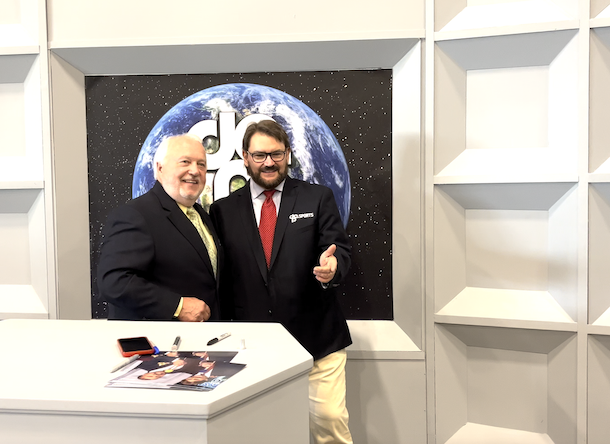
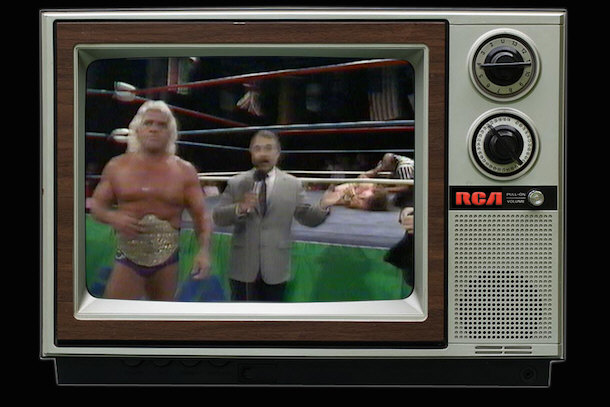
Starrcast promoter Conrad Thompson had a replica built of the World Championship Wrestling television production set, nearly identical to the one used in the Techwood Drive studios of WTBS in Atlanta during the Crockett TBS years of 1985-1988.
The replica set was used for photo-ops involving Crockett, Schiavone, and the Four Horsemen, as well as the backdrop for Crockett and Schiavone to call the big PPV event "Ric Flair's Last Match."
Nobody adds the special nostalgic Mid-Atlantic/JCP touches to events quite like Conrad Thompson. I wonder if this would fit in my basement??
The following story from Kyra Quinn was originally posted in 2017 on the Mid-Atlantic Gateway.
1985 Calling: Tony Schiavone, George South, and One Magical Phone Call
About a year ago I got a phone call. But it was more than that. It was a link to a cherished part of my past, a connection to my youth and to one of the men who helped make wrestling real to me.
It was Sunday morning, August 7, 2016. I was getting ready for church and almost didn’t answer my ringing phone. But then I looked and saw that the caller was my friend, Mr. No. 1 George South. It was the Sunday of Fanfest weekend in Charlotte, and George knew I was sorely disappointed that I was unable to attend. I knew George was there, and I also knew that one never quite knows what Mr. No. 1 has up his sleeve. So I answered.
I was hailed with an excited, “Hey baby! How are you?” which is a pretty typical greeting from George. I could tell he was pumped to be there, spending the weekend amongst his friends and heroes – guys he has wrestled with and against for several decades. Quickly, George let me know he had someone who wanted to say hello to me. He told me to hold on.
The next voice I heard took my breath away: “Hi Kyra, this is Tony Schiavone.”
Of course, he needn’t have introduced himself. I would recognize that voice anywhere. It was one of the primary voices of my youth, the voice that conveyed magical moments with the perfect blend of exuberance, enthusiasm and realism. My heart pounding, my mind racing, I babbled some sort of ‘hello.’ As usually happens when I meet my wrestling heroes, I was awestruck. Initially, all I could think of was that he had said my name. Tony Schiavone said my name! Immediately I attempted to capture that moment in my mind forever so that I would always be able to recall it.
The conversation lasted a few minutes, and my excitement was such that I honestly don’t recall half of what I said. But I do remember the most important thing: I thanked Tony for helping to make it all so real to me. I discovered Crockett wrestling on Pittsburgh’s WPGH-53 one late summer morning in 1985 at the age of 8, with my introduction being the exhilarating title win of the Rock ‘n’ Roll Express over the Russians. I was hooked from then on, mesmerized by the athleticism, excitement, and the struggle between the good guys and the bad guys. From that first Saturday morning, Tony’s voice was an integral part of the spectacle, and of the realism that was the hallmark of Jim Crockett Promotions. Tony’s love for wrestling came though, but so did his professionalism, in the way he called matches and handled interviews. He was, for me, a huge part of Jim Crockett Promotions, and when he left, some of the magic left with him.
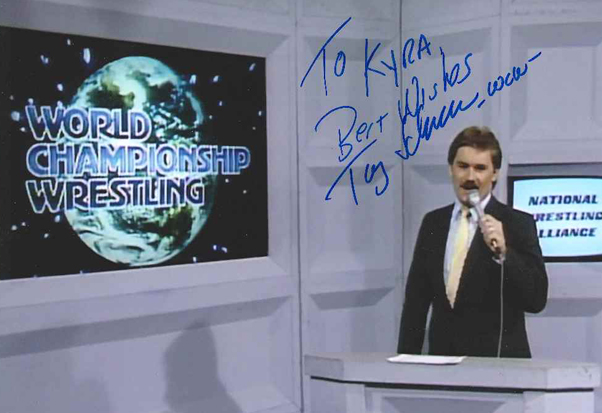
My friends at the Mid-Atlantic Gateway had Tony sign this for me that August in Charlotte.
It was a Fanfest I hated to miss.
Of course, Tony’s departure in early 1989 was only one of a slew of big changes around that time. My favorites, Ricky and Robert, were long gone; the Horsemen had disbanded; the whole talent roster had experienced upheaval; and the look and feel of the shows had changed. But Tony’s leaving was especially upsetting to me. He had been a constant – he had provided the soundtrack – and now he was gone. I was delighted when Tony eventually returned to what had become WCW, and I was always happy when past favorite wrestlers of mine found their way back to the promotion. But too much had changed. Wrestling was never quite the same for me.
When I thanked Tony for being such a big part of helping to make it real, he seemed genuinely grateful. Maybe it’s not a comment he hears very often, but he should. He was so good at what he did, and yet is so underrated. For those too young to remember, those who have simply forgotten, and those who can be critical, I’d suggest a visit to YouTube and a trip back to Jim Crockett Promotions in 1985 or 1986. Those shows have retained their magic. Watch the amazing talent in the ring, listen to the pops of the red-hot crowds, and pay special attention to the professional yet boyishly enthusiastic voice delivering the play-by-play. It doesn’t get much better.
Originally published in August of 2017 on the Mid-Atlantic Gateway.
Also don't miss our huge feature with Tony looking back on his days as a fan of Mid-Atlantic Championship Wrestling. It was a multi-part series called "Sunday's With Schiavone" and can be found in its entirety by clicking here.
What a reunion! David Crockett, Bob Caudle, and Tony Schiavone get together in Raleigh, NC.
David and Tony made the special effort to visit Bob during the afternoon on January 12, hours before the big All Elite Wrestling (AEW) show that night in Raleigh. Jim Ross had hoped to join them, too, but travel arrangements prevented it.
Bob and David hosted Mid-Atlantic Championship Wrestling together in the 1970s. David then moved over to host World Wide Wrestling in 1982, and Tony joined him as co-host in early 1984. Bob continued as host of NWA Pro Wrestling throughout the 1980s. Tony and David also hosted World Championship Wrestling together on Superstation WTBS in the mid-to-late 1980s. All three were part of big national television and pay-per-view specials for Jim Crockett Promotions and later Ted Turner's WCW.
What a special photograph! Thanks to both Tony and David for sharing this great reunion.
* * * * *
Late edit (1/17/22): We posted this same photo on Twitter as well, and it went viral (at least viral for us), garnering over 139,000 twitter impressions in the days after. A big surge of that occurred after Good Ol' J.R. Jim Ross retweeted it. A lot of fans from the 70s, 80s, and 90s were happy to see Bob again, and delighted to see all three of these guys together in the same special photograph.
Originally published in our 30th Anniversary salute to Starrcade '85 in 2015.
Noted Charlotte orthopedist recalls his experiences treating the wrestlers of Jim Crockett Promotions, marvels at their toughness and athleticism by Kyra Quinn Special for the Mid-Atlantic Gateway
“Let people know how great these athletes were,” said Dr. Joseph Estwanik, referring to the wrestlers of Jim Crockett Promotions in the 1980s. Dr. Estwanik said this at the close of our recent telephone interview, which he had graciously agreed to after I reached out to him with questions about his involvement with professional wrestling decades ago.
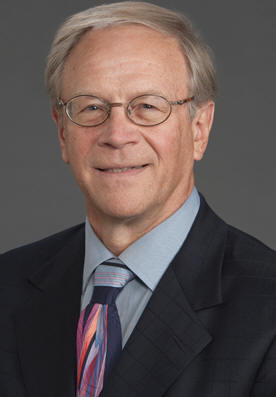
Dr. Joseph Estwanik
Not Just a Doctor on TV
After recently discovering that Dr. Estwanik was still practicing medicine in Charlotte some 30 years after his initial appearance on Crockett television, I became curious about how he had become associated with the Crocketts, and about the extent of his involvement with the wrestlers. Estwanik had appeared on television as part of two highly memorable and now-classic angles: the ankle injury to Dusty Rhodes at the hands of Ric Flair and the Andersons in the buildup to Starrcade ’85, and the neck injury suffered by Ric Flair as the result of being piledriven on a ringside table by Terry Funk in 1989. But I wondered: were those two TV appearances all there was, or was there perhaps more to his story?
As I found out, there was much more. Joe Estwanik treated many of Crockett’s wrestlers throughout the 1980s. They were his patients and his friends, and his respect for them, even after all these years, remains profound and undiminished.
The Wrestling Connection
Dr. Estwanik’s association with professional wrestling developed as a result of the geographic location of his practice as well as his own background in and involvement with athletics, including Greco-Roman wrestling. Estwanik moved to Charlotte in 1978 after graduating from medical school at Wake Forest University and completing his residency. At that time he was one of the few doctors in the Charlotte area with an interest in sports medicine, which resulted in, as Dr. Estwanik put it, “sort of a natural hook-up with the Crocketts. Plus,” he added, “I was an avid weightlifter and bodybuilder, so I actually was in the gym with many of the athletes anyway… so I think I gained the, if I can say, respect for my knowledge base of wrestling [and] of weight training.”
“Tough as Nails”
Though he treated numerous Crockett wrestlers over the years, Dr. Estwanik actually had no professional relationship with Jim Crockett Promotions. “I think I felt better that way,” he explained, “that I was able to maintain a doctor-patient relationship. But because we had so many athletes in common I couldn’t help but at times meet the Crocketts or serve a need for them if I could.
Dr. Estwanik maintains an incredibly high regard for the wrestlers he treated, telling me, with amazement in his voice, “their athletic ability was superb, and… their toughness was insanely crazy!” Few people would know more about that toughness than Joe Estwanik. As the doctor to so many of the wrestlers, Dr. Estwanik was privy to injury knowledge that remained well-hidden from fans at the time. “I had their x-rays,” he explained, “and I knew the battering that they were taking, and I had performed some of their surgeries.” Estwanik continued, “It was even amazing what they sacrificed in the normal post-operative expected recovery, to get back on the road and perform in some capacity, somewhat shielding or protecting an injury or an operated area.” Dr. Estwanik even gave an example of seeing a wrestler in the ring on television still wearing the post-operative dressing Estwanik had applied at the completion of his surgery.
During those days, as part of his research for an academic paper that he later presented, Dr. Estwanik also surveyed over 100 professional wrestlers regarding injuries they had sustained throughout their careers; that paper, he says, documented the serious reality of the injuries the wrestlers were living and competing with. His succinct summary of the results of his research and observation: “They were always, always injured. They were tough as nails. And finally, they never got a day off.”
Patients and Friends
Joe Estwanik did not require any prompting when asked if he had any specific recollections of the wrestlers he worked with during the 80s. Immediately the memories started to flow. “Chief Wahoo McDaniel,” Estwanik recalled, “what a character and an extraordinary guy. I got to know him very well and operate on him.” Estwanik marveled at Wahoo’s toughness in continuing to wrestle into his 50s even though, as Estwanik put it, “anybody who was not a physician could see the significant arthritic changes” by simply looking at Wahoo’s x-rays.
Other wrestlers who Joe Estwanik counted as both patients and friends include Magnum T.A., Jimmy Garvin, and Ivan and Nikita Koloff. “So many of [the wrestlers] were so pleasant to work with,” Estwanik shared, “and just genuine guys from the gym, compared to a persona they got paid to play.”
Estwanik also recalled being there with his friends during some difficult times; he was one of the few visitors Magnum requested to see in the hospital after his career-ending auto accident in 1986, and he was there as a friend to Nikita Koloff as Nikita’s first wife, Mandy, died of cancer in 1989.
Agony at the Omni and Dusty’s “Hard Times”
When Dr. Estwanik finally did appear on-screen for Jim Crockett Promotions, he did so in the middle of one of the hottest angles and well-crafted stories in wrestling history: the ankle injury to Dusty Rhodes which set the stage for the Flair-Rhodes main event at Starrcade ’85 – one of the key moments in the legendary feud between the “Nature Boy” and the “American Dream”. As most fans of that era will recall, the injury occurred at the Omni in Atlanta on September 29, 1985, when Ric Flair turned full heel in grand and nefarious fashion, gleefully joining the Andersons in a brutal three-on-one attack in a cage against Dusty Rhodes. It was the ultimate betrayal, with Dusty having just single-handedly rescued Flair from a beating by the Russian trio of Ivan and Nikita Koloff and Krusher Khruschev.
Dr. Estwanik talks about Dusty's injury.
The attack resulted in a serious injury to Dusty which Flair had inflicted by landing a knee drop off the top rope onto Rhodes’ ankle. In the aftermath, Rhodes lay in clear agony on the mat, tended to by the Rock and Roll Express, announcer David Crockett and several others. As the house lights were brought up, the stunned Omni crowd watched with grave concern as one side of the cage was removed, the ring ropes were loosened, and the “American Dream” was carried to the dressing room with a huge bag of ice tied around his ankle.
On the following week’s “Mid-Atlantic Championship Wrestling” the angle was recapped, with Tony Schiavone informing fans that Dusty was put on a private plane and flown to Charlotte, North Carolina, where he was examined by Dr. Joseph Estwanik. Subsequently, David Crockett conducted an interview with Estwanik in which the doctor explained the diagnosis of a third degree ankle sprain and addressed Dusty’s time frame for recovery. (Estwanik also appeared in a later interview with Dusty to discuss his rehab progress). Rhodes was put in a cast and was out of action for over a month, during which time the feud only became hotter as Dusty gave inspired interviews, including “Hard Times,” one of the most well-known and beloved promos ever. To go back and re-watch the events leading to Starrcade ‘85 is to be reminded of why people believed: incredible athletes, charismatic personalities, and storytelling that was compelling and realistic.
Revelation
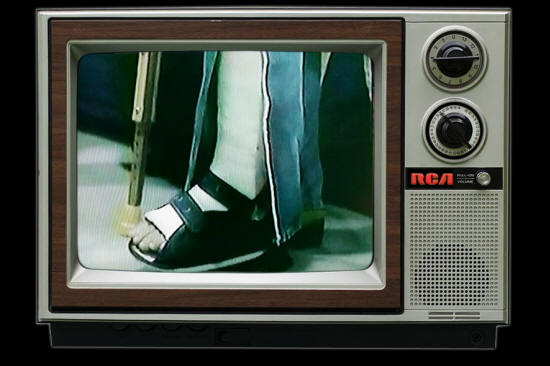
Dusty Rhodes in the cast.
When I asked Dr. Estwanik about his interview with David Crockett all those years ago, he chuckled and had to confess that he didn’t remember it among all the other interviews he has given. But he did reveal something that is likely to surprise and possibly intrigue many fans: Dusty did have an actual injury. We can’t know for certain when the injury occurred; we can speculate that it may have been something that had been bothering Dusty and was then worked into the story at the perfect time. But regardless of timing, Estwanik stated: “There was an injury. TV exaggerates everything… but it was an injury requiring some immobilization and he elected to go with a cast… it’s the same cast on him that I would put on anybody.”
Dr. Estwanik took it in stride when I suggested to him that, during that era, there may have been a number of skeptical wrestling fans who did not believe he was a real doctor. “The fact is,” he laughed, “my enduring signature is suture lines, healed scars from surgeries.” He continued, assuring us, “I was really performing ACL surgeries and all the other things.”
These Days
In addition to his very successful Charlotte orthopedic practice, Dr. Estwanik continues his three-plus decades of work as a ringside physician for the sport of boxing and has also served in that same capacity for numerous years in Mixed Martial Arts. His extensive list of professional experience includes serving as the team physician for USA Boxing at multiple international events, and having served as the President of the Association of Ringside Physicians. In addition, Dr. Estwanik, along with Ken Shamrock and others, was instrumental in developing the original Boxergenics Grappling Glove used by MMA fighters; he developed the glove in the early days of MMA when the sport was in danger of being banned. That basic glove, says Estwanik, in still in use today, and he now jokingly refers to himself as the “idiot that didn’t patent it.”
Joe Estwanik’s favorite sports are the combat arts (which include wrestling, boxing, martial arts and MMA), in which he has decades of experience as both a treating physician and a fan. But he does seem to hold a special place in his heart for the professional wrestlers he knew and treated in the 1980s. When asked if he had become a fan of wrestling during that era, Estwanik responded, “You can’t help but watch your buddies.” Estwanik missed those buddies when Jim Crockett sold the business and the wrestlers left town. He still keeps up with some of them, though, and very fondly recalls that special era, telling us: “It was a great time of my life. I loved it.”
Originally published November 2015 on the Mid-Atlantic Gateway
November 28, 2015 was the 30th Anniversary of Starrcade '85. The event took place on Thanksgiving night in the cities of Atlanta, GA and Greensboro, NC.
Back in February of 2017, the Gateway conducted an interview with longtime JCP/NWA/WCW announcer and broadcaster Tony Schiavone.
The multi-part interview covered Tony's time as a Mid-Atlantic Wrestling fan growing up as well as his early career with Jim Crockett Promotions in Charlotte, both in baseball and wrestling.
Check out the entire seven-part interview on the Mid-Atlantic Gateway.
Tony talks Blackjack Mulligan, Paul Jones, the Andersons, Dick Murdoch, Wahoo McDaniel, Ric Flair, the Hat and Robe, I Broke Wahoo's Leg, road trips to Greensboro, Big Bill Ward, Charlotte O's baseball and Frances Crockett, David Crockett, Bob Caudle, Uncle John, Harrisonburg, VA, Truckin' Tom Miller, Paul Orndorf and Jimmy Snuka, The Baron, Joe Murnick, and the early days of his new podcast with Conrad Thompson. Much, much more about the great days of Mid-Atlantic Championship Wrestling.
Complete interview as one post originally posted Sept. 2019. Interview originally published in Feb. 2017.
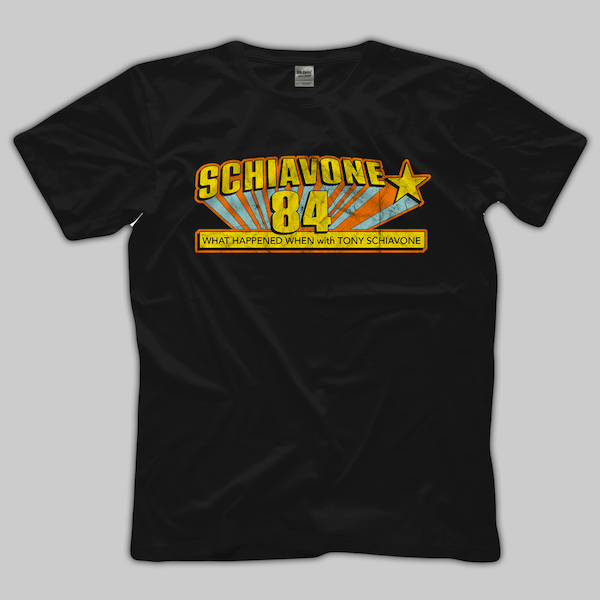
Tony Schiavone has a new t-shirt on Pro Wrestling Tees. Well, I think it's new, it may have been around awhile, but I just came across it. But I marked out a little bit for this. It's a take-off on an old historic, but largely forgotten, classic Jim Crockett Promotions t-shirt sold at the Starrcade '84 event.
Whoever created this design nailed the homage to the original. Bravo.
The original design has a bit of a story to it, as it was the first (and only to my knowledge) "Mid-Atlantic Championship Wrestling" t-shirt produced by Jim Crockett Promotions.
Let's be honest, merchandising was never Jim Crockett Promotions' strong suit. The list of marketing and merchandising missed-opportunities makes for a pretty long list.
There had been wrestling programs (Mid-Atlantic Wrestling Magazine) and a few posters (Wahoo, Blackjack, Steamboat to name a few) in the 1970s, but those were only sold at the arenas and were never marketed on TV.
In 1983, Crockett made a short-lived attempt to capitalize on the success of their first huge closed-circuit event Starrcade '83 by offering the Starrcade '83 photo album and a t-shirt through mail order.
In 1984 came the very first t-shirt sold at the arenas that bared the words of Mid-Atlantic Championship Wrestling. And it was the last as far as we know. It was a simple design bearing the name of their follow-up closed-circuit extravaganza, Starrcade '84, with the Mid-Atlantic Wrestling moniker stretched below.
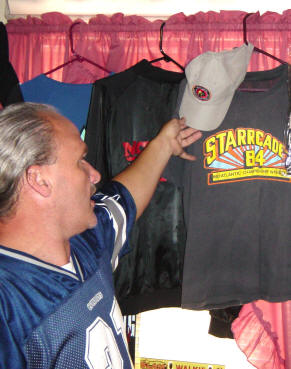
The shirt is very rare, there weren't many made. George South has one in his collection, hanging in his museum. You can occasionaly come across one on Ebay, sometimes going for a high asking price, depending on what shape the t-shirt is in.
Following this 1984 shirt, JCP would introduce their first line of slogan/logo t-shirts featuring their top stars in 1985. The logos were also available on hats, jackets, and bandanas. "I Do It With Flair" is the best remembered of that series, and spurred
on a similar t-shirt design for Ric Flair's daughter in the WWE in 2015.
In 1986, a second line of designs were released featuring artistic renderings of their top stars, a trend which continued until the sale of JCP to Ted Turner in 1988.
The Schiavone t-shirt is a very cool item indeed, and we hope to see more things like this that call back to the glory years of Mid-Atlantic Wrestling.
Late edit: Kudos to the artist who created this shirt, Ryan D (@highonryan), the creative genius who handles merchandise for Conrad Thompson's wildly popular Ad Free Shows (@adfreeshows) podcasts.
A Look Back at the Promoters and Television History of Jim Crockett Promotions by Dick Bourne Mid-Atlantic Gateway
Professional wrestling has been one of the most popular live events in the Carolinas and Virginia since the early/mid-1900s. Several key players were responsible for making pro wrestling an institution here, some familiar to fans, others perhaps not so familiar.
The company known for promoting wrestling across Virginia and the Carolinas for decades was Jim Crockett Promotions. Jim Crockett, Sr. started promoting wrestling in our area when he bought an old warehouse in Greensboro, NC, in December of 1933, named it the “Sportrena”, and held his first matches there. With that first card, the company that later grew to be known as Jim Crockett Promotions was born.
Crockett established his base of operations in Charlotte a year later in 1934, moving in on a chaotic promotional scene at that time. In 1939 he and successful Richmond promoter Bill Lewis bought out the interests of promoter Pete Moore who had been in partnership with Crockett for nearly 10 years going back to their days headquartered out of Bristol, VA. Moore’s promotional interests spanned the width and breadth of the area that we think of now as the Mid-Atlantic territory. After buying Moore out, Lewis based his operations out of Richmond, and Crockett based his out of Charlotte. Together they brought top pro-wrestlers from around the country to the halls, armories, and small arenas throughout the Carolinas and Virginia.
As the companies evolved, Crockett had become the main promoter, with Lerwis booking all of his talent through the Crockett's Charlotte office. Lewis died in 1961, and Crockett sent Joe Murnick, his top lieutenant in Charlotte, to replace him. Murnick would headquarter out of Raleigh, but assumed all of Lewis's territoy to the east, including Fayetteville, Richmond, Hampton, and Norfolk and all points in between.
Over the years, Crockett had many local promoters like Murnick working for him within the various regions of the main territory including such men as Henry Marcus (central and lower South Carolina), Paul Winkhaus (Western North Carolina and Upstate South Carolina) and Pete Apostolou (Central and Southwest Virginia.). These promoters coordinated the local promotion of Crockett’s wrestling events. However, it was Murnick who became Crockett’s largest and most trusted partner.
In April of 1973, Jim Crockett, Sr. passed away and his son in law, John Ringley, took over the operations of the company. He was soon followed by Crockett's oldest son, Jim Crockett, Jr., who during his tenure expanded the reach of the company outside of the traditional territorial boundaries that had existed for years within the pro wrestling industry, and wound up being one of the two top players nationally.
Crockett Jr.'s lieutenants included Joe Murnick and his sons Elliot and Carl, along with longtime wrestlers Sandy Scott, Johnny Weaver, and Gene Anderson, who transitioned to regional promoters at the ground level, working with and later slowly replacing those listed earlier.
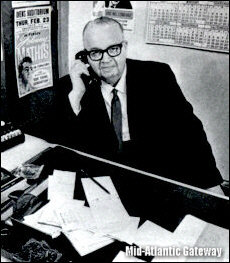
The territory was always known within the business as the “Charlotte territory” because that is where the Crocketts were based. Until the mid-1970s, fans simply knew it as “All-Star Wrestling” or “Championship Wrestling.” Around the time of Jim Sr.’s passing, the promotion began to brand its wrestling business as “Mid-Atlantic Championship Wrestling”, which also became the name of their television program. Prior to this time, television wrestling had been taped out of multiple locations each week including Charlotte, High Point, Roanoke, and Raleigh. In 1974, the company consolidated its weekly television production to one location - - the studios of WRAL in Raleigh, NC. There had been many hosts of the local programs over the years including Nick Pond, Charlie Harville, Hal Grant, Bill Ward, and Bob Caudle. After the 1974 consolidation, Caudle became the main voice of the company, and would serve in that capacity until the company was sold to Ted Turner in 1988.
But it was from the WRAL studio that the magic we saw unfold each week
on our TV screens originally took place. In 1975, Crockett Promotions
added a second studio program eventually known as “World Wide Wrestling” which
was hosted at different times by Ed Capral, Rich Landrum, David
Crockett, and Tony Schiavone.
Eventually finding itself on the losing side of a wrestling war in the late-1980s, the 53-year old family business was sold to Ted Turner in late 1988. Turner had been a partner in Crockett's national expansion, enthusiastically providing four hours of weekly television on his nationally cable-cast Superstation WTBS out of Atlanta. This eventually included quarterly prime-time TV specials as well.
The syndicated "Mid-Atlantic Championship Wrestling" (later renamed "NWA Pro Wrestling") and "World Wide Wrestling", along with the national WTBS "World Championship Wrestling" battleship, drove hundreds of thousands of fans to the arenas each month. For a short time anyway, the once small Mid-Atlantic territory one of the largest and most successful wrestling promotions in the country.
This article was based on a shorter limited piece originally posted June 28, 2017 on the Mid-Atlantic Gateway.
Before Tony Schiavone joined ringside partners Bob Caudle, David
Crockett, and Johnny Weaver as one of the voices of Mid-Atlantic and
World Wide Wrestling in the early 1980s, he was the radio voice of the
Charlotte O's baseball franchise, the AA affiliate of the Baltimore
Orioles.
Both the wrestling organization and the baseball club were part of the Jim Crockett Promotions empire.
Ric Flair told listeners on episode #26 of his podcast "WOOOOO! Nation" that after meeting Tony and hearing him call O's baseball, he suggested to the Crockett family that Schiavone get a chance to join the wrestling part of the company.
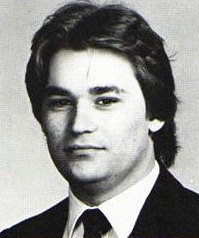
Not long after Flair's suggestion, Schiavone was asked to interview Ric Flair at his home in Charlotte for a feature that aired prior to Flair's NWA World Title match against Harley Race at Starrcade '83. That went well, and he was tabbed with the opportunity to follow the legendary Charlotte wrestling announcer "Big" Bill Ward as host of the localized promo segments that were inserted into the wrestling shows. He eventually wound up getting his big shot co-hosting "World Wide Wrestling" alongside David Crockett in 1984. The rest, as they say, is history.
But before all that took place, the following short profile on Tony appeared in a 1982 Charlotte O's baseball program....
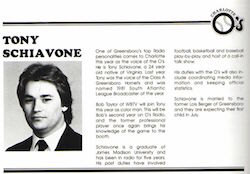
VOICE OF THE CHARLOTTE O's TONY SCHIAVONE (1982)
One of Greensboro's top radio personalities comes to Charlotte this year as the voice of the O's. He is Tony Schiavone, a 24 year old native of Virginia. Last year Tony was the voice of the Class A Greensboro Hornets and was named 1981 South Atlantic League Broadcaster of the Year.
Bob Taylor of WBTV will join Tony this year as color man. This will be Bob's second year on O's Radio, and the former professional player once again brings his knowledge of the game to the booth.
Schiavone is a graduate of James Madison University and has been in radio for five years. His past duties have involved football, basketball, and baseball play-by-play, and host of a call-in talk show.
His duties with the O's will also include coordinating media information and keeping official statistics.
Schiavone is married to the former Lois Berger of Greensboro and they are expecting their first child in July.
*******************************************
The following is a profile of Frances Crockett, then the general manager of the successful Charlotte O's baseball club. The O's were the AA affiliate of the Baltimore Orioles.
Both the Charlotte O's baseball club and the Mid-Atlantic Wrestling organization were part of Jim Crockett Promotions, Inc.
Frances is the oldest child of Jim and Elizabeth Crockett. She was the
first woman General Manager of a professional baseball team and as
reported on the Crockett Foundation website she has been profiled in Sports
Illustrated, Sporting News and the Wall Street Journal. She serves as a special adviser to the board of the Crockett Foundation.
This appeared in a 1982 Charlotte O's program sold at ballgames held at Crockett Park.
General Manager Frances Crockett
She sits back watching and listening never missing what is happening. Formulating and piecing together where she wants to go and what she wants for herself and the Charlotte O's. Basically shy and uncomfortable in the lime light, she nos taken the city of Charlotte by storm.
Since she took charge of the O's in 1977, Frances Crockett has developed a rare combination of energy and imagination to the job with spectacular results. In 1981 an all time Charlotte sports attendance record was set of 211,761. Crockett Park has become the place to be every spring and summer with promotions and give-aways every night of the season.
Frances' philosophy is that "The fans are what it is all about." This philosophy often throws her into conflict but she never falters. An old-fashioned girl who runs the team like any other business with old fashioned principles.
Her father, "Big" Jim Crockett, taught Frances everything she knows. Few knew more about managing and promotion than her father. She began in 1977 with no previous background in business or baseball. Many people thought of her as only a publicity stunt, but her natural charms with the team coupled with her shrewd business head has led her to the top of her profession.
"There are a lot of people who are responsible for the O's success. Our staff, both full-time and part-time, have to get a lot of credit. And I can't say enough about our loyal fans and advertisers. All these people, they are the ones that make this thing go."
For more information on the mission of the Crockett Foundation and the good work they do, please visit their website.
This post was combined and edited from two earlier posts from December of 2015 on the Mid-Atlantic Gateway.
On a recent edition of the "What Happened When" podcast, Tony Schiavone revealed some previously undisclosed history regarding the origins of the iconic Jim Crockett, Sr. Memorial Cup tournament trophy that was presented to the winners of the annual event during it's all-to-short three year history.
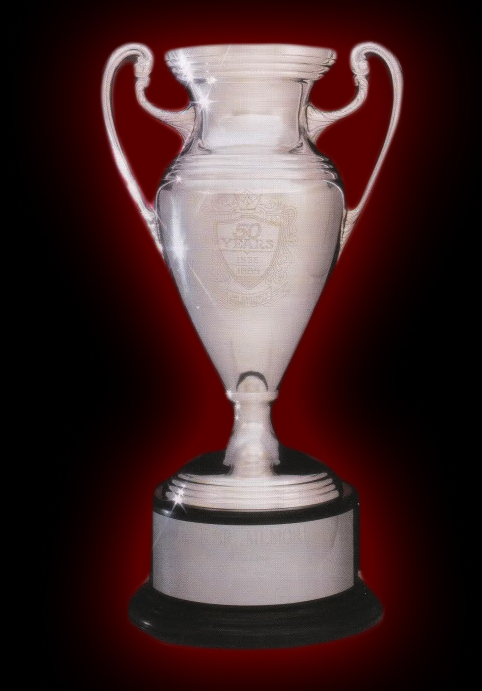
During the "Superstars on the Superstation" primetime special from February 7, 1986, Jim Crockett Promotions announced that the NWA would dedicate a new annual tag team tournament to his late father, naming it the Jim Crockett Sr. Memorial Cup. At that point in the time, the site of the first annual event had not been announced, but Crockett announced he hoped it would be in their hometown of Charlotte. Of course, the NWA part of this was just part of the storyline; this was all a Jim Crockett Promotions event, part of the Crockett's follow-up to the 50th anniversary celebrations that had taken all during the year before.
A photograph of the trophy was shown on the screen.
Tony Schiavone and Conrad Thompson were reviewing the program in watch-along fashion on Tony's "What Happened When" podcast, when Tony took a moment to explain the little-known history of that actual trophy.
"That cup had been with the Crocketts for a number of years," Tony told Conrad. "It was just a big silver cup, no inscription on it."
Tony knew this history well because his earliest work for the Crockett family was as a radio play-by-play announcer for the Charlotte O's, the minor league farm team of the Baltimore Orioles that the Crockett family owned.
"The Charlotte O's won the Southern League championship, Doug Dellinger walked out with that cup and presented it to our manager, John Hart," Tony laughed. "I remember the report from Tom Sorenson said, 'The Charlotte O's won it, they celebrated, and a big ol' policeman with a big ol' cup came out and gave them their championship.'"
In fine pro-wrestling tradition, though, that presentation was a bit of a swerve.
"That was not the Southern League championship [trophy], that was Frances Crockett being a promoter," Schiavone explained. "And the fans popped!"
Souvenir Program from the 1984 Championship Season (funwhileitlasted.net)
The Crockett's bought the Asheville Orioles in 1976 and renamed the team the Charlotte Orioles, which would popularly become known as the Charlotte O's. The family then bought historic old Griffith Park, an old ballpark that had been home to the Charlotte Hornets which disbanded after the 1972 season, and they renamed it Jim Crockett Memorial Park (fondly known to the locals as simply Crockett Park) in 1977. Jim Crockett, Jr. promoted wrestling shows their in the summer for several years, too.
Frances Crockett became the manager of the team, becoming the first woman to hold that role in professional baseball. Under her stewardship, and led on the field by future Hall of Famer Cal Ripkin, the O's won the Southern League Championship in 1980 after which she was named General Manager of the Year by The Sporting News. They won again in 1984. Although Tony didn't mention which year Doug Dellinger brought out the big cup, we're guessing it had to have been 1984 since Tony didn't begin work for the Crocketts until 1981.
Crockett Park burned to the ground in 1985, but the big silver cup apparently was not stored in the storage bunkers under the bleachers, or it would have been destroyed like lots of other wrestling and baseball memorabilia was with the fire.
As plans were formulated for the first Crockett Cup, someone in the family remembered the big silver trophy. It would soon be engraved with the Crockett Promotions 50th anniversary logo and presented to the winning team of the tournament each year.
The tournament only lasted three years (1986-1988), ending after the family sold the business to Ted Turner in November of 1988. New Orleans, Baltimore, and Greensboro were the only three cities to see that trophy presented to the tournament champions. Sadly, Charlotte never got the cup as Jim Crockett had hoped for in 1986.
Here at the Mid-Atlantic Gateway, it's often the little details we love learning the most. Thanks to Tony for sharing this bit of history on his podcast that otherwise would be lost to the sands of time.
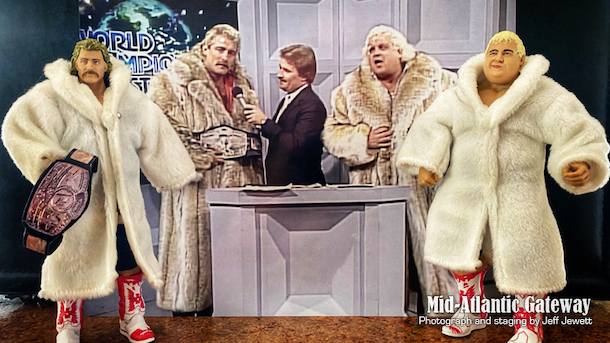
Who can forget Dusty Rhodes and Magnum T.A. walking out on Superstation WTBS to interview with Tony Schiavone wearing those big fur coats? It was on World Championship Wrestling back on December 14, 1985, and that nutty moment is still talked about today (and lives on the WWE Network.)
"I don't believe there is any explanation for this right here," Dusty said to Schiavone. "We was on the JCP private sports plane...I mean, you can go all over the world and not see nuthin' as bad as this."
From the creative mind of Jeff Jewett comes this action figures staging of America's Team with custom made min-furs. Excellent job, and great memories!
"Action Figures Friday" makes random appearances here on the Gateway. It all began with Mike Simmerman's amazing collection of custom figures staged in an even more amazing custom mini-studio based on WRAL in Raleigh in the 1970s and early 1980s. There have been other contributors including Jeff Jewett, Scottie Richardson, Matty Montcalm, Barry Hatchet, and others.
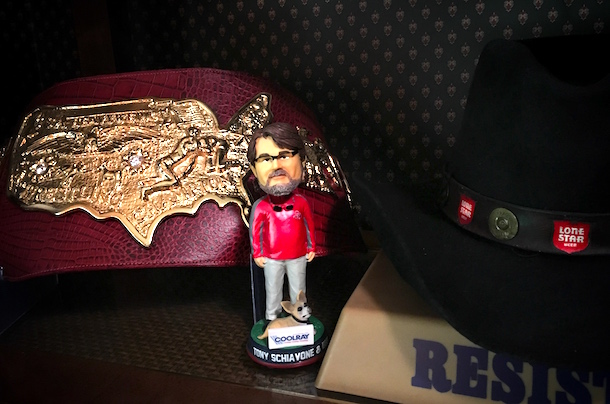
Tony & Bug take their place in the Mid-Atlantic Gateway Museum, safely ensconced
between the United States Championship belt and Blackjack Mulligan's famous cowboy hat.
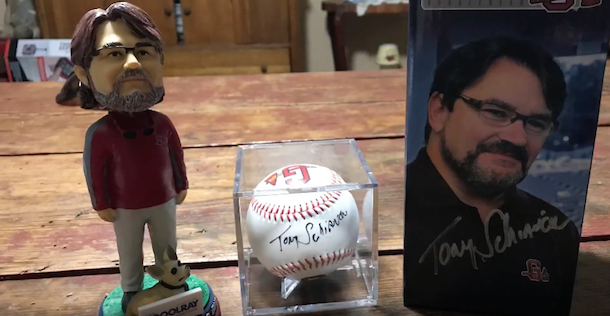
Back in August of 2017, the Gwinnett Braves baseball team honored Tony Schiavone and his dog Bug with their very own bobblehead doll, given away to the first 2,500 fans that attended the Gwinnett Braves baseball game at Coolray Field on August 26. It was part of a "National Dog Day" at the park where fans could bring their pets to the game as well.
Schiavone was at that time the play-by-play radio voice of the Gwinnett Braves, the triple-A club of the Atlanta Braves, and a bit of a celebrity in the Atlanta area not only because of his association with G-Braves baseball, but also for his long history as the voice of World Championship Wrestling on WTBS and TNT in the 1980s and 1990s.
Tony was also a producer for the University of Georgia Bulldogs radio network at that time, and a barista at Starbucks! He currently is the star of one of the most popular pro-wrestling podcasts in the country (along with co-host Conrad Thompson) and, along with Jim Ross, is currently part of the top broadcast team for AEW Wrestling each Wednesday on the TNT Network. A true renaissance man if there ever was one!
Like us, Tony was a big fan of Mid-Atlantic Wrestling growing up and so we've given his baseball bobblehead its special spot in the Mid-Atlantic Gateway Museum, even though he's not wearing that sweet navy blazer with the "JCP Sports" emblem on it.
A Tony Schiavone bobblehead. Who would have thunk it?
Coolest. Bobblehead. Ever.
Edited and expanded from an original post on the Mid-Atlantic Gateway in September of 2017.
Image from Jared Wallis/YouTube https://youtu.be/LZZILH-fZOI
Check out Tony's huge interview about his days as a fan of Mid-Atlantic Wrestling.
"We will let the fans know what the disposition of this title will be very soon." - Jim Crockett, Jr., 12/27/86
Those words still echo with me all these years later. I'm still waiting for someone to tell me what would become of my beloved Mid-Atlantic Heavyweight championship.
The sequence of images above from "World Championship Wrestling" on 12/27/86 show Ronnie Garvin handing over the Mid-Atlantic Heavyweight championship belt to Jim Crockett, Jr. in the studios of WTBS in Atlanta.
Garvin forfeited the title after he and Barry Windham had won the United States Tag Team championships. He is wearing the US Tag Team title belt. Jim Crockett told Ronnie he couldn't hold both titles, and he had to decide which one to forfeit.
"Well you know, it's a big disappointment to me ... it's a lot of work behind this belt and it represents the Mid-Atlantic area. And I don't mean no disrespect for it, because parting with this means a whole lot to me. But I don't want to disappoint my partner Barry Windham" - Ronnie Garvin, 12/27/86
While Jim Crockett told Tony Schiavone that he would announce later what would be done with the title (we assumed a tournament), the belt and the championship were never seen or mentioned again.
Click to enlarge.
It was a sad day for long time fans of Mid-Atlantic Wrestling who had
witnessed such great wrestlers hold that title including Danny Miller, Ole Anderson, Jerry Brisco,
Johnny Valentine, Wahoo McDaniel, Ric Flair, Paul Jones, Jack Brisco,
Roddy Piper, Greg Valentine, Ricky Steamboat, Ray Stevens, and so many others.
Earlier that same year, the name of the flagship syndicated program for Jim Crockett Promotions was changed from "Mid-Atlantic Championship Wrestling" to "NWA Pro Wrestling." With that name change and the disappearance of the championship, the great era known as "Mid-Atlantic Championship Wrestling" had quietly come to an end.
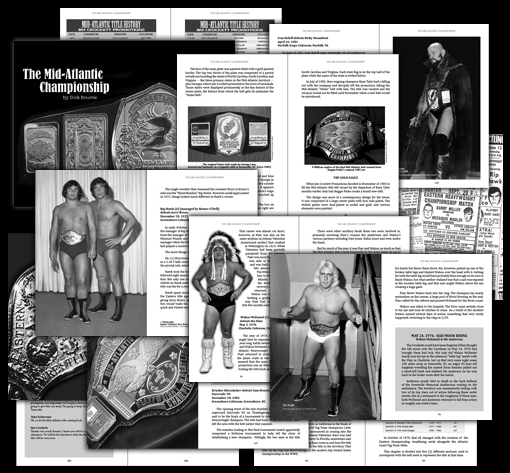
For more on the origin and history of the Mid-Atlantic championship, check out our book "Mid-Atlantic Championship," a detailed title history with over 50 photographs of the champions and the belts, as well as dozens of newspaper clippings.And the story of each and every title change, over 60 of them in a period of 13 years.
This story was originally published May 12, 2018 on the Mid-Atlantic Gateway.
Starrcast IV, Baltimore MD Friday, November 8, 2019 7:00pm - 8:00pm Ram's Head Live!
Jim Crockett Promotions took the war to Vince McMahon in the 1980s and its legacy remains mighty in the hearts and souls of diehard professional wrestling fans. Tony Schiavone, who went from fan to one of the voices of JCP, sits down with Jim and David Crockett, who publicly discuss, for the first time ever, the highs and lows and legacy of their family, their battle to keep the flame of true pro wrestling lit and the promotion that defined greatness for many, many decades. A Starrcast exclusive like no other!!
Taking place on the Pro Wrestling Tees stage at Ram's Head Live Friday night, November 8, at 7 PM. Available to stream live & on demand on FITE.TV.
Information from the Starrcast schedule page. Visit the Starrcast website for more details.
I've written before about all the stories that George South has told me over the many years we've been good friends, and usually I find myself not believing half of them. I mean, come on - - wrestlers tend to tell tall tales, am I right? And George loves to tell a good story. But then someone comes along that was involved in one of those stories and says something that confirms his story and I wind up calling him and confessing - - "You were right!"
Such was the case awhile back on an episode of the "WOOOO! Nation" podcast, when Ric Flair and co-host Conrad Thompson were taking questions sent in by fans. One question dealt with wrestler Mike Jackson and why he never quite got a break to move up the cards back in the day. Jackson was thought of at the time (and still to this day) as one of the best underneath workers in the business and all the main event guys liked working with him.
But Flair moved on quickly from Jackson and said this, which confirmed part of a story George had told me long ago:
"You know who was actually the best worker back then, was George South .... I got in the ring with him one time and I said, 'Buddy, today you're Ricky Steamboat'. And we tore it down." - Ric Flair, WOOOO! Nation, December 9, 2015
The audio of this is embedded at the bottom of this post.
About ten years ago, George told me the story about his November 12, 1988 match with Ric Flair on Superstation WTBS, a match that went nearly 15 minutes, much longer than the usual WTBS TV match at the time. We were making a 22-hour round trip in a rented truck to visit the great Blackjack Mulligan at his home in Florida. That's right, I had 22 hours of listening to George South tell stories with the same Journey CD playing in the background the whole time. (And that part about Journey is a shoot!)
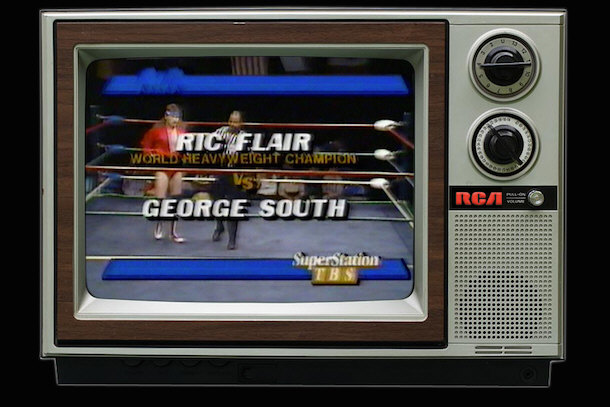
World Championship Wrestling on Superstation WTBS, November 12, 1988
George told me on that trip that before they walked through the curtain that morning in the WTBS studio, Ric had uttered those same words to him: Today you're Ricky Steamboat. Now, I never knew if I really believed that or not. I mean, I knew George loved Ricky Steamboat, and at times thought he was Ricky Steamboat, so it seemed plausible that in the context of the story this was George's wishful thinking. That is until last week when I heard Ric Flair say those very same words.
So having once again called George to acknowledge he had indeed told me the truth, I asked him to tell me whole story again. He quickly reminded me that it was a match Ric didn't want to have to begin with.
"When you got to TV, you found out who would actually work," George told me. "Ric was scheduled to work for the first time in awhile, but he really didn't want to. He had just gotten in from Pittsburgh after being up all night and he had to catch an early plane to Ohio after the taping. That studio was so cold and he didn't want to work and then have to shower and have that wet hair and rush to the airport."
Indeed, a quick review of notes from those Saturday night shows in the fall of 1988 showed that Ric didn't wrestle on any WTBS studio taping that late summer or fall until that Nov. 12th show. He did lots of those classic interviews, but didn't work in the ring.
"He and Dusty sort of got into it right there in front of everyone, and Dusty told him he was going to have to wrestle," George told me. "So Ric threw his bag on a chair and said, 'Well then I want South.'"
I asked George if he remembered who he was originally scheduled to work, or if he remembered who Flair was scheduled to work, but he could not recall. "All I know is Ric changed it and I was now working with him."
George had wrestled Flair on several occasions on different Crockett TV shows going back to 1985, but this time the circumstances were different. Flair was in a horrible mood and George figured he might be in for a tough, stiff, short match.
"Ric got dressed," George told me, "and as we were at the curtain about to go out, he looked at me and said, 'Buddy, today you're Ricky Steamboat."
George's heart skipped a beat. "I about peed in my pants!"
He entered the ring alone during the long break set aside for the "College Football Scoreboard" segment that aired on WTBS during fall Saturday afternoons in those years. Ric didn't follow right away and it seemed like an eternity waiting for him, even though it was only a few minutes. George had time to ponder what was to come.
When they came out of the break and back on air, Ric came through the curtain and entered the ring wearing one of his beautiful white robes. He removed the "Big Gold" NWA world heavyweight title belt and handed it to his manager James J. Dillon at ringside. George told me he thought to himself, "OK, buddy, here we go," and then they locked up.
But George wasn't prepared for what happened next.
"Ric started calling all these spots," George told me, "and I was going a hundred miles an hour. I was having the time of my life, but I was rushing."
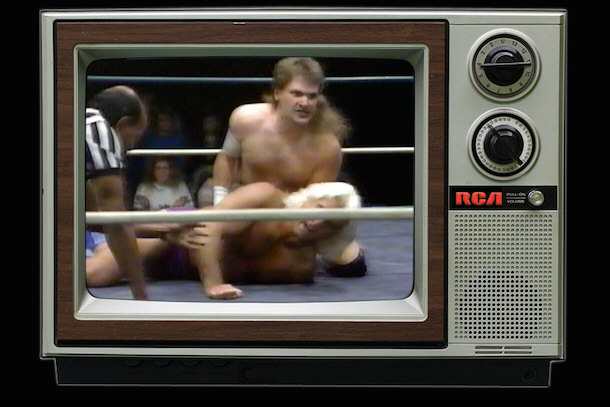
Indeed, Ric was giving a great deal to George early on. George was reversing holds, working a lot of drop-downs, trading chops, and even throwing drop-kicks.
Suddenly, he was aware that he wasn't pacing himself. And there was no finish in sight.
"I got so blowed up in there," George said. "I was really hurting."
I asked George if he and Ric had discussed the match before hand. "No, not at all," he told me. "Back in those days, he called it in the ring. I didn't know anything. And I didn't know if we were going 2 minutes or 20 minutes. I was just going so fast. Ric did this every night, but I didn't!"
Given that Ric didn't want to work to begin with, it was surprising the match was going the way it was. "Honestly, I think he was doing it just to tick Dusty off," George told me. He laughed as he thought back on it. "He was so annoyed with Dusty, I think he would have let me win the NWA belt just to get back at him."
"Dusty
was hollering at me 'What are you doing?' and I said, you know, I'm not
gong to beat a guy like George South in one minute. Sorry."
- Ric Flair, WOOOO! Nation, December 9, 2015
George thought he might have a chance to rest when they went to a commercial break during the match, but no such luck. "Ric just kept going," he said.
By the time they were back from commercial, they were over eight minutes into the match, with still no end in sight.
"If there ever was a clinic in pro-wrestling, we're watching it. The world champion Nature Boy Ric Flair against George South, showing us a variety of moves during the break." - Tony Schiavone, World Championship Wrestling, November 12, 1988
Back in those days, unlike today, commercial breaks during matches were relatively rare except in longer main event matches. The fact Ric went two segments with George made the match seem all the more special. Ric was calling all the signature spots that he would normally do with main event guys like Harley Race, Sting, Lex Luger, and yes, certainly with Ricky Steamboat.
"He had me shoot him out of the corner and he did his flip into the turnbuckles," George said." I couldn't believe what was happening. Then he went to the top turnbuckle and told me to throw him off. Brother, I was about to die in there! I think he just flipped off the turnbuckle himself!"
When George finally threw Ric from the top, Ric's feet hit the lights, and debris fell into the ring. It was a surreal moment for George, and Ric kept giving him a comeback.
Finally, Ric called for the finish. He lifted George high in the air and held him for a few moments before delivering the vertical suplex.
"Now, we go to school!" Flair shouted, as he applied the figure four leglock. It didn't take long for George to submit.
George lay prone on the mat, exhausted. As TV aired the instant replay of the figure four, Ric hopped out of the ring to do a ringside post-match interview with David Crockett.
Referee Teddy Long knelt down on one knee beside George. They were right behind Flair, who would soon be joined in the interview segment by Barry Windham and J.J. Dillon.
"I thought Teddy was checking on me, making sure I was OK. So I whispered, 'I'm OK, Teddy.' He said right back to me, 'Brother, you've got to get out of this ring! I've got to get you out of the shot.' I could barely move, so he just rolled me like a big log out of the ring."
David Crockett prepares to interview Ric Flair after the match. Teddy Long tries to usher George South out of the ring behind them.
If you carefully watch this back on tape, you can see this happening. "Oh, it's funny now," George said, "but it wasn't funny then. I had never been so blowed up in all my life."
To make matters worse, George observed that Ric was barely breathing hard. "He was just so in shape, it was amazing. You couldn't blow him up. He was what he said he was - - a 60-minute man."
Still exhausted, George made his way back to the dressing room and then collapsed on his hands and knees and crawled to his chair.
"Kevin Sullivan was sitting in a chair right inside the door watching the monitor," George said. "He just looked down at me crawling on the floor and laughed. Not so much laughing to be mean, just laughing as if to say 'brother, we have all been there.' I don't think there was a wrestler in that locker room who hadn't been blown up at one time or another by Ric Flair."
George looks back on that match with fondness. It is without a doubt the longest and most competitive match he ever had on TV, and it is a memory he will hang on to forever. Nice to know Ric remembers it, too, all these many years later.
Edited from an original post on the Mid-Atlantic Gateway, from December 18, 2015.
Listen as Ric Flair talks about George South on WOOOOO! Nation
December 9, 2015
You can probably find the whole match if you do a little searching on YouTube. Otherwise, enjoy this one-minute music video of a few highlights from the match.
Check out MapleLeafWrestling.com's new book on the history of the
Canadian Heavyweight Championship, now available on Amazon and our book store.