Showing posts with label Ed Capral. Show all posts

Saturday, July 16, 2022

Theme Music: Wide World Wrestling (1975-1978)

by Dick Bourne
Mid-Atlantic Gateway
Includes rare, exclusive audio tracks embedded below.
 

When I first got "hooked" on Mid-Atlantic Wrestling, one of the things (other than the great wrestling) that I liked most about both Crockett shows was the great theme music.

I'm not talking about wrestler's theme music. This was in 1975 and almost a decade before every wrestler had their own theme music.

I'm talking about the opening theme music that started off each show. It was a signature element of each of the two programs that Jim Crockett Promotions produced, and is today as much of the sentimental or nostalgic aspect of those shows. That's something long ago lost as it regards pro-wrestling on TV today.
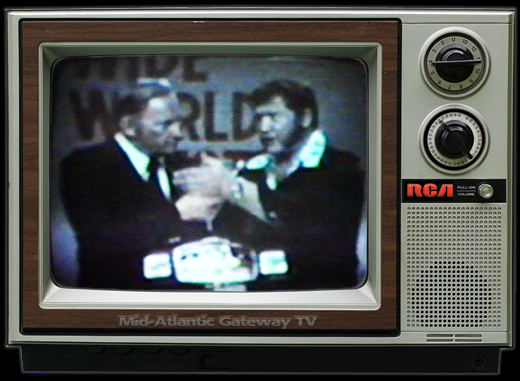
Ed Capral with NWA champion Harley Race
on the set of "Wide World Wrestling" in 1977

Over the many years, I've enjoyed collecting theme music from the various wrestling shows I watched in the 1970s and 1980s. Some used edited versions of popular commercial music, some used "production" music written especially for that use.

My favorite wrestling TV-show theme of them all was the music for "Wide World Wrestling" in 1975-1978. "Wide World Wrestling" was Jim Crockett's "B" show. If a TV market only featured one of Crockett's TV shows, it would always be the "Mid-Atlantic Championship Wrestling" show, which was the "A" show. If a traditional Crockett TV market featured both Crockett shows, then "Wide World" would be added as the second show in that market, or the "B" show.

The show began in October of 1975 and was hosted by longtime Atlanta wrestling broadcaster Ed Capral. When Capral left in 1977, he was succeeded by hosts Russ Dubuc and then Tom Miller and George Scott. In 1978, Crockett changed the name of the program to "World Wide Wrestling" as host Rich Landrum took over the show, and by the early 1980s, this was the show that started going into Crockett's expansion markets, as well as remaining the "B" show in Crockett's home markets.

"Truckin'" Tom Miller, host of "Wide World Wrestling"
for roughly 6 months in 1978

The opening theme music for this show was awesome! The opening video package that ran under the music was a quick montage of various wrestlers doing various wrestling maneuvers that flew by at quick pace that matched the upbeat tempo of the music. The music and video open had sort of a "Wide World of Sports" feel to it. ABC's "Wide World of Sports" was one of the most popular sports programs of the era and as much a part of Saturday afternoons as wrestling was.

Recently our friend Craig at Wrestling Media (wrestlingmedia.ws) was kind enough to send us the original recording of the music used for "Wide World Wrestling." I got his very nice email on Thanksgiving Day - - what a wonderful gift on Thanksgiving! I was thankful indeed for his generosity and for remembering at all that this was something I had been looking for for years. He was able to identify it solely by the low-resolution recording I had of it on the Mid-Atlantic Gateway Archive site.

The music, titled "Diamond Head" was written and recorded by Walter Murphy, who had a #1 pop hit back in 1976 called "A Fifth of Beethoven." Murphy has an extensive resume of production music and there are several vinyl recordings of his still floating around. The album that has "Diamond Head" was titled "Major Production Music", Vinyl 6088 on Major Records (now known as Valentino.) It is track 3 on side B of the record and was recorded and released in 1975 (the same year "Wide World Wrestling" debuted.

The "Wide World Wrestling" theme was created by taking various segments of the original 1:30 recording and piecing them together to make the final 25 sec. version you heard each week to open the show. The tempo of the wrestling version was also a little faster than the original, although at the same pitch.

I took Murphy's original recording and edited a version together that is nearly identical (in arrangement and speed) to the classic 1975 wrestling theme, and happily present it here.

There are no known video recordings of the 1975-1978 "Wide World Wrestling" show, which is a very sad thing. The theme hasn't been heard in this arrangement since 1978, so only fans who are roughly in their mid-40s or later would even remember it. But for those that watched "Wide World Wrestling" every single weekend without fail as I did each week, this will be a wonderful trip down memory lane and a nostalgic reminder of a great era in Mid-Atlantic Wrestling. And for those hearing it for the first time, this is what a real wrestling theme sounds like.


Wide World Wrestling - Opening Theme (1975-1978)


Wide World Wrestling - Closing Theme (1975-1978)


More on this album of production music on the Discogs website:
https://www.discogs.com/Walter-Murphy-Production-Music/release/3544026

Thanks to Craig at Wrestling Media (wrestlingmedia.ws) for his forwarding this information and for providing me the original track that resulted in my favorite wrestling theme music of them all.


Originally published December 2016 on the Mid-Atlantic Gateway.
Wednesday, May 19, 2021

In the Tiger's Den: Paul Jones confronts NWA Champion Terry Funk


"In the Tiger's Den"

On the February 14, 1976 episode of Jim Crockett Promotions' "Wide World Wrestling" television show, host Ed Capral interviews NWA world champion Terry Funk. Funk was frustrated with the fact that Paul Jones held a victory over him which took place only a few weeks before Funk won the NWA title from Jack Brisco.

That victory was on the annual Thanksgiving night show at the Greensboro Coliseum when Jones pinned Funk to win the United States Heavyweight Championship. Jones' win paired with the title made him the undisputed number one contender for Terry Funk's NWA World Championship.

In this vintage audio recording, Funk calls out Paul Jones and a brief confrontation occurs. It takes place during the 2-minute "halftime" interview segment of the program. This is a classic Terry Funk promo during his reign as champion.

Originally published October 2012 on our sister website The Domed Globe.

Wednesday, March 24, 2021

A Brief History of Wrestling in the Mid-Atlantic Area

A Look Back at the Promoters and Television History of Jim Crockett Promotions
by Dick Bourne

Mid-Atlantic Gateway

Professional wrestling has been one of the most popular live events in the Carolinas and Virginia since the early/mid-1900s. Several key players were responsible for making pro wrestling an institution here, some familiar to fans, others perhaps not so familiar.

The company known for promoting wrestling across Virginia and the Carolinas for decades was Jim Crockett Promotions. Jim Crockett, Sr. started promoting wrestling in our area when he bought an old warehouse in Greensboro, NC, in December of 1933, named it the “Sportrena”, and held his first matches there. With that first card, the company that later grew to be known as Jim Crockett Promotions was born.

Crockett established his base of operations in Charlotte a year later in 1934, moving in on a chaotic promotional scene at that time. In 1939 he and successful Richmond promoter Bill Lewis bought out the interests of promoter Pete Moore who had been in partnership with Crockett for nearly 10 years going back to their days headquartered out of Bristol, VA. Moore’s promotional interests spanned the width and breadth of the area that we think of now as the Mid-Atlantic territory.  After buying Moore out, Lewis based his operations out of Richmond, and Crockett based his out of Charlotte. Together they brought top pro-wrestlers from around the country to the halls, armories, and small arenas throughout the Carolinas and Virginia.

As the companies evolved, Crockett had become the main promoter, with Lerwis booking all of his talent through the Crockett's Charlotte office. Lewis died in 1961, and Crockett sent Joe Murnick, his top lieutenant in Charlotte, to replace him. Murnick would headquarter out of Raleigh, but assumed all of Lewis's territoy to the east, including Fayetteville, Richmond, Hampton, and Norfolk and all points in between.

Over the years, Crockett had many local promoters like Murnick working for him within the various regions of the main territory including such men as Henry Marcus (central and lower South Carolina), Paul Winkhaus (Western North Carolina and Upstate South Carolina) and Pete Apostolou (Central and Southwest Virginia.). These promoters coordinated the local promotion of Crockett’s wrestling events. However, it was Murnick who became Crockett’s largest and most trusted partner.

In April of 1973, Jim Crockett, Sr. passed away and his son in law, John Ringley, took over the operations of the company. He was soon followed by Crockett's oldest son, Jim Crockett, Jr., who during his tenure expanded the reach of the company outside of the traditional territorial boundaries that had existed for years within the pro wrestling industry, and wound up being one of the two top players nationally. 

Crockett Jr.'s lieutenants included Joe Murnick and his sons Elliot and Carl, along with longtime wrestlers Sandy Scott, Johnny Weaver, and Gene Anderson, who transitioned to regional promoters at the ground level, working with and later slowly replacing those listed earlier.

The territory was always known within the business as the “Charlotte territory” because that is where the Crocketts were based. Until the mid-1970s, fans simply knew it as “All-Star Wrestling” or “Championship Wrestling.” Around the time of Jim Sr.’s passing, the promotion began to brand its wrestling business as “Mid-Atlantic Championship Wrestling”, which also became the name of their television program. Prior to this time, television wrestling had been taped out of multiple locations each week including Charlotte, High Point, Roanoke, and Raleigh. In 1974, the company consolidated its weekly television production to one location - - the studios of WRAL in Raleigh, NC. There had been many hosts of the local programs over the years including Nick Pond, Charlie Harville, Hal Grant, Bill Ward, and Bob Caudle. After the 1974 consolidation, Caudle became the main voice of the company, and would serve in that capacity until the company was sold to Ted Turner in 1988.

But it was from the WRAL studio that the magic we saw unfold each week on our TV screens originally took place. In 1975, Crockett Promotions added a second studio program eventually known as “World Wide Wrestling” which was hosted at different times by Ed Capral, Rich Landrum, David Crockett, and Tony Schiavone.

Eventually finding itself on the losing side of a wrestling war in the late-1980s, the 53-year old family business was sold to Ted Turner in late 1988. Turner had been a partner in Crockett's national expansion, enthusiastically providing four hours of weekly television on his nationally cable-cast Superstation WTBS out of Atlanta. This eventually included quarterly prime-time TV specials as well.

The syndicated "Mid-Atlantic Championship Wrestling" (later renamed "NWA Pro Wrestling") and "World Wide Wrestling", along with the national WTBS "World Championship Wrestling" battleship, drove hundreds of thousands of fans to the arenas each month. For a short time anyway, the once small Mid-Atlantic territory one of the largest and most successful wrestling promotions in the country.

This article was based on a shorter limited piece originally posted June 28, 2017 on the Mid-Atlantic Gateway.

http://www.midatlanticgateway.com/p/book-store.html

Tuesday, February 16, 2021

Ed Capral Signs Off Wide World Wrestling (Audio Recording)

Originally posted on our Studio Wrestling website.

by Dick Bourne
Mid-Atlantic Gateway

From 1975-1978, legendary wrestling announcer Ed Capral hosted Wide World Wrestling, a brand new program at that time for Jim Crockett Promotions.

Capral was the longtime host for pro wrestling in Atlanta on channel 11 until the Atlanta wrestling wars of the mid-1970s, when he jumped ship to the upstart All South Wrestling promotion run by Ann Gunkle, the widow of the late Ray Gunkle, an amateur and pro wrestler who was a major star in the southeast. All South lost the war to the stalwart NWA wrestling promotion and Capral found himself without an announcing job.

Jim Crockett hired him to host their brand new program, and Capral brought his classic old-school announcing style to TV stations across the Mid-Atlantic area.

Ed Capral with NWA World Champion Harley Race on the set of
Wide World Wrestling.


We present here a vintage audio clip from of Ed signing off an episode of Wide World Wrestling in 1977 and previewing the matches that would be seen on the show the following week. That line-up, by the way, was loaded with talent including a young Tully Blanchard going up against NWA World Champion Harley Race.

For the record, here is match list Capral announced:

  • Harley Race vs. Tully Blanchard
  • Ric Flair & Greg Valentine vs. Roberto Soto & Jimmy Garvin
  • Dick Murdoch vs. Danny Miller
  • Ricky Steamboat & Paul Jones vs. Scott Irwin & Ricky Ferrara
  • Wahoo McDaniel vs. Charlie Fulton

And of course the familiar barter announcement and the classic Wide World Wrestling theme music plays along, one of my favorite TV wrestling themes of all time. (More on that music here.)

Enjoy this little audio blast from the past!


ED CAPRAL SIGNS OFF WIDE WORLD WRESTLING


Audio is courtesy of the collection of Gary Wray. Originally posted in February 2021 on the Studio Wrestling website, part of the Mid-Atlantic Gateway family of websites.  

Monday, January 27, 2020

Pro Wrestling's Distant Signals


by Dick Bourne
Mid-Atlantic Gateway

Some of you old folks out there (like us!) will remember the days when you stayed up late at night and tried to maneuver your set-top or aerial antenna to pull in some distant station that had wrestling.

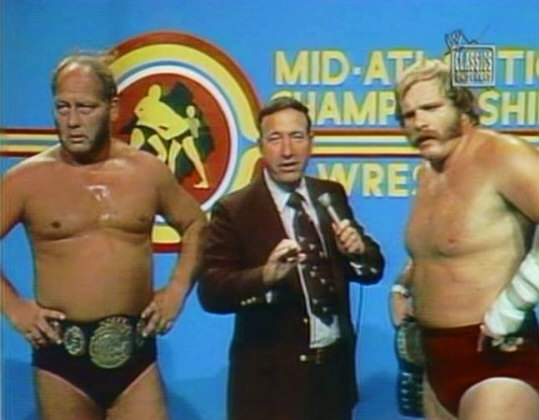
In this rough image, Mid-Atlantic champion Ric Flair and Blackjack Mulligan talk with Ed Capral on Wide World Wrestling from the WRAL television studios in December 1975. Ric wasn't back to wrestling yet at this point, still recovering from injuries suffered in the October 1975 Wilmington NC plane crash. But he was back doing interviews and color commentary by the end of December.

Kids born in the cable generation don't have any idea what the excitement was like when you manipulated those "rabbit ears" on top of the TV and were able to pick up a distant VHF or UHF signal from some other city. It was a great adventure! Sometimes it was more snow than picture, but you could still listen to the audio.

Folks that were lucky enough to have an outdoor rooftop aerial antenna could sometimes pull in distant signals from hundreds of miles away, depending on the time of day, the weather, and the elevation of the antenna. The only problem was having to run outside and turn the antenna pole so that the antenna would face the right direction. That was later solved with the advent of a motorized rotor that would turn the pole using a control box from inside the house, usually sitting right on top of the television set.

*****

Edit: It sometimes surprises us what reaction little memories like this get on our social media pages at the Mid-Atlantic Gateway. This little graphic at the top of this post seemed to stir up lots of memories about rabbit ears, wire hangers, and "tin foil" from our friends on Facebook and Twitter.

Tuesday, December 05, 2017

Texas Connections Part 5: Sound Clips!


by Dick Bourne
Mid-Atlantic Gateway

In this final PART FIVE of our "Texas Connections" series, we travel back in time and hear some vintage audio clips from some of the great Texan stars that were part of Mid-Atlantic Wrestling including Terry Funk, Bobby Duncum, Dick Murdoch, and of course Blackjack Mulligan. Along the way you'll hear some other voices including Bob Caudle, Tom Miller, Joe Murnick, Ed Capral, and even Ric Flair!


Here is a summary of what you'll hear on this special Mid-Atlantic Gateway audio montage:
(1) Joe Murnick introduces Blackjack Mulligan
(2) West Texas Bar (Bob Caudle and Tom Miller)
(3) Joe Murnick introduces Paul Jones
(4) Blackjack Mulligan on Paul Jones
(5) Terry Funk: Texas Athlete of the Year
(6) Bob Duncum: 4-Time Texas Champ (with Bob Caudle)
(7) The Murdoch Shuffle (Bob Caudle and Dick Murdoch)
(8) West Texas Style (Blackjack Mulligan)
(9) Big Bad Texan (Bob Caudle)
(10) Blackjack Will Never Let You Down (Ed Capral and Ric Flair)


Some of our favorite quotes:

"Two of the baddest of the bad. If you put Flair and Mulligan in a west Texas bar on a Saturday night, you'd have to call out the national guard to clean out the place." - Tom Miller, Mid-Atlantic Championship Wrestling 

“The Cowboys might let you down, the Oilers might let you down, the great University of Texas might let you down. But Blackjack Mulligan never lets anybody down.” - Ric Flair, Wide World Wrestling

"I'm a 4-time Texas champion. I travel all around this high world representing the great state of Texas which is one of the biggest honors you can really have." - Bobby Duncum, Mid-Atlantic Championship Wrestling  


Miss any of our earlier "Texas Connections" installments?
Here are links to all of them:

TEXAS CONNECTIONS
in the Mid-Atlantic Area
Part 1: Hailing from the Great State of Texas
Part 2: Crockett's Connections with Joe Blanchard's Southwest Wrestling
Part 3: Crockett TV in Texas (1977-1978)
Part 4: Terry Funk Takes Crockett's U.S. Title Back to Texas
Part 5: Audio Clips!


http://www.midatlanticgateway.com/p/us-title-book.html

Tuesday, September 12, 2017

Ric Flair's Original Challenge to the Anderson Brothers


by Dick Bourne
Mid-Atlantic Gateway
Originally published August 22, 2016
INCLUDES VINTAGE CLASSIC AUDIO 

We've spent some time recently looking in-depth at the story of Mid-Atlantic Wrestling's "Dream Team" of the 1970s, Ric Flair and Greg Valentine. One of the main storylines for that team involved an almost two-year feud with the "Minnesota Wrecking Crew" Gene and Ole Anderson. The Anderson brothers were NWA world tag team champions and had held those belts for the better part of the two previous years before Ric and Greg were able to take them away in late 1976. A big part of this story was the "family feud" between Flair and his cousins.

While you might think this family feud first originated when Flair broke away from the Andersons to team with Valentine in late 1976, you would be overlooking a brief exchange that took place almost a year earlier when Ric and Blackjack Mulligan were first forming their alliance.

"You know what, Cuz?  We might even remove you from those belts."   -Ric Flair

It was early December of 1975 and Ric was still recovering from the broken back that he suffered in the October 1975 airplane crash. While he was still roughly two months away from getting back in the ring, he was already back on television doing interviews and occasionally sitting in as a color commentator with Bob Caudle or Ed Capral.

The first sign that the cocky, brash, younger cousin of the Andersons might actually be thinking about challenging them for their world tag team titles took place on TV in December 1975 and early January of 1976. Flair announced in an interview with Ed Capral on "Wide World Wrestling" that he would be forming a team with Blackjack Mulligan (who had entered the area not long after Flair was injured in the plane crash) and that they would challenge anyone and everyone, including the world tag team champions.

Ole later responded to Capral:

 "Ric Flair is family. And I hate to get any kind of discussion going about family here on the television, I don't believe in airing your linen. But Ric, Ric is full of a little bit of vim and vigor, and he sometimes gets carried away, he sometimes just doesn't think. But, uh...ah, let's just leave it alone right now, I don't want to get into that family kind of discussion."


But the following week on "Mid-Atlantic Championship Wrestling", Flair made his intentions known directly to Ole during an interview that followed a particularly brutal Anderson match on TV. The interview was the closing interview of the program, and featured all four guys: Ric Flair. Blackjack Mulligan, Gene and Ole Anderson.

For full context of the following audio clip: the Andersons had just fought Tony Rocca and Roberto Soto in the final match of the program, and really put a beating on Tony Rocca's arm and injured Roberto Soto after the match. Host Bob Caudle was incredulous about the tactics of the Andersons. Notice Ric Flair early on was complimentary of his cousins, but moments later would make a quick challenge. Transcript follows, so you can read along. (And the conclusion follows the transcript.)


- - - - - - TRANSCRIPT - - - - - -

Bob Caudle: And here come the Andersons, and again...again, Ole...

Ric Flair: Have you ever seen anything like my great cousins the Andersons? In your life, ever?!

Bob Caudle: ... this was completely uncalled for!

Ole Anderson: These two guys, they shouldn't even get in the ring with us, because we're just too good for 'em. You got a couple of young guys like this that think they are pretty great. They are going to use us for a stepping stone, they think that just by getting in the ring with us that they are going to get a little bit of a reputation. Will maybe they will, but it won't be at our expense. It's going to be at theirs once you see what we've done to these guys, it's a sample of what we're going to do for the new year of '76.

Bob Caudle: Alright...

Blackjack Mulligan:  Let me tell you something, you are looking at right now two of the top rasslers in the world, the Mid-Atlantic Champion Ric Flair and none other than Blackjack Mullgian. And look at what I say: any combination with Flair and Blackjack Mulligan together, or in singles, we're gonna do it! 1976 is gonna be the big year, the big year...I'm gonna tell you right now, if we ever come to your arena, as a tag team, I don't believe there is a building big enough to handle it, Ric Flair.

Ric Flair: ... there is excitement in the air with Mulligan and Flair...everybody knows, individual or as a team, we're the greatest wrestlers in the world. We can go anywhere in the world and beat anybody, and let me tell you something: it gets down to me, I just came to the realization that the Blackjack and I are gonna be tagging up a lot in the future, and you know what, Cuz? We might even remove you from those belts, there.

Bob Caudle: Oooo! Uh oh! What about that, Ole? [Flair and Mulligan leave.] Hey, why did you walk away, Ric?

Ole Anderson: You know they've got enough to do, and uh.... he must be a little bit sick, he comes back...well that's family, and I don't want to get into that kind of stuff.

Bob Caudle: No, no...

Ole Anderson: ...I guess everybody has their days. But right now what I'm concerned about is not Flair and not Mulligan. I'm concerned about these promoters down here that keep putting these ringers against us. They bring in these young guys, they know that they are full of vim and vinegar, they know that they have a lot of endurance and everything else. And they also know, like I've said once before that we're on the road alot and they're hoping that one of these days we're gonna come in really tired and they're gonna get some team out here to beat us, to embarrass us right on television. And Gene and I are just as determined to see that that doesn't happen. And the best way...the best way that we can think of to see that something like that doesn't happen is to make sure  every time we get in the ring, we do something so damaging, so miserable to our opponents, so devastating, that the word is gonna get around, and pretty soon people are going to say "Well, now, we'll wrestle, but we don't want to wrestle the Anderson Brothers."

Bob Caudle: You can't, you can't do that every time. You can't go in and just maim somebody every time they get in the ring...

Ole Anderson: You wanna bet? You wanna watch us? Well then you and all these other people that are watching right now, you tune in and you watch us. Because every time we're on television, we're going to do the same thing that we just did here to this Mr. Soto and "Mr. Wrestler" or whatever his name happens to be. And what we really want to see is guys like Wahoo McDaniel, Paul Jones, Rufus R. Jones, Ken Patera, Tim Woods...we want to see those boys...we want to see their knees start to shake. We want to see them get a little bit scared. We want to see them back out maybe of a few of the contracts that they've got set up for us. And we'll rule as kings forever. The world tag team champions.

Bob Caulde: All right, that's it from the Andersons, fans, and we'll see you next week, until then, so long for now.

- - - - - - END TRANSCRIPT - - - - - -
 
* * * * * * *

The Aftermath:

In the end, it was all much ado about nothing, at least for the time being. Flair returned to action in late January and immediately began teaming with the Andersons against various combinations involving Johnny Weaver, Paul Jones, Rufus R. Jones, and Wahoo McDaniel. Whatever friction had developed between Flair and the Andersons over the holidays had been smoothed over by the time of Flair's return. Flair maintained a tight relationship with his cousins throughout the majority of 1976 until another young and brash blond bomber named Greg Valentine hit the Mid-Atlantic scene late in the year. And that's when Ric finally made his move to separate himself from his family and formed the team with Valentine.

To learn more about the dynamic duo of Flair and Valentine and the path of destruction they cut across the Mid-Atlantic area, check out David Chappell's mammouth 8-part series on the "Dream Team" which is currently ongoing on the Mid-Atlantic Gateway.

And for a look at the entire story of Ric Flair's tumultuous relationship with the Anderson family (including the 1980s with younger cousin Arn Anderson), check out the timeline history book of the Andersons in wrestling titled "Minnesota Wrecking Crew." Click the ad below for more information!

http://midatlanticwrestling.net/andersons.htm

Tuesday, March 28, 2017

Blackjack Mulligan is Back--With a Vengance (Part 2)

by David Chappell
Mid-Atlantic Gateway 

This is a continuation of the post Blackjack is Back--With a Vengance (Part 1) 

PART TWO  (Catch up with Part 1)

After giving the fans on the October 15, 1975 Mid-Atlantic Championship Wrestling television show a dominating victory over young Kevin Sullivan, a clearly energized returning Blackjack Mulligan spelled out to announcer Bob Caudle his vendetta against Wahoo McDaniel and his plans going forward.

Ed Capral with Blackjack Mulligan and Ric Flair
When the television tapings continued later that night at the WRAL studios in Raleigh, Mulligan continued to be in rare form! On the Wide World Wrestling TV show, Blackjack thoroughly demolished the up-and-comer Ron Starr, and then turned his attention to the fans and announcer Ed Capral. Before Capral could barely utter a word, Mulligan interrupted and exclaimed, “Let me ask you one question Mr. Announcer. What do you do, what can you say when you give a man your best punch? You hit ‘em with everything you’ve got? You have your best day, you give your heart and soul…you hit ‘em and he goes down and he gets back up. What do you do?” Of course, the hyped-up Mulligan didn’t give Capral a chance to answer!

Blackjack continued unabated, “I’ve been hit with everything the Indian can throw; I have been hit with everything that Paul Jones can throw. I have been hit with everything Rufus can throw…the headbutt does not work on Blackjack Mulligan; Kenneth Patera’s muscles are synthetic!” After bashing the territory’s “good guys,” the big Texan wanted to let the fans know exactly who they were going to see in the months to come.

Mulligan ranted, “Let me tell you a natural fact…they have no idea where I came from; I do not know how to submit. They think my granddaddy was a wildcat and my momma was a rattlesnake…they’re not sure. They found me floating down the Rio Grande in a Cadillac hubcap! I’m comin’ in as class brother, and I’m going out as class. And I will not stop. Let ‘em look, let ‘em stop and look just for one second at a world class wrestler.”

It then appeared the big man was going to engage Capral, saying, “How many wrestlers have you seen in your day? How many wrestlers have you seen come down the pike? When Capral tried to reply, Mulligan shut him down shouting, “Stop trying to butt in, I’ll answer that!” Blackjack then elaborated, “None with so much; too much power…six foot eight and 300 pounds. I weighed 97 pounds and was five foot two the day I was born! Believe me, just too much power; too much everything! Blackjack Mulligan’s got it all!”

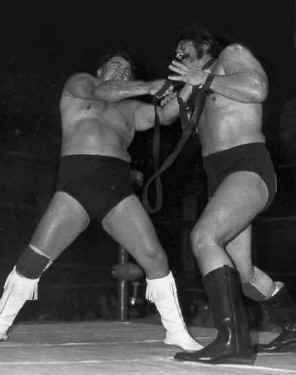
Blackjack Mulligan battles
Wahoo McDaniel in a strap match.
The modest Texan then turned his attention to his most hated rival at the time, bellowing, “Wahoo McDaniel, I want to stop right here for a second. I want to show everybody these deep cuts in my back! He put ‘em in there…he strapped me. He strapped me in front of my kin folks! He strapped me in front of my Uncle Red; he strapped me in front of my granddaddy. I took a beatin’ that day, but I got up like a man; I’m not a quitter!”

Mulligan ended the interview on Wide World Wrestling with a self-assessment, concluding, “I have maintained my national ranking…get it straight. Get it right! I am ranked number one in the nation, number one in the world. I am the greatest wrestler in the world, the greatest wrestler of all time!”

An obviously taken aback Capral quipped, “Blackjack Mulligan…if you don’t believe he’s great, just ask him!” But the announcer then added, “And obviously this man can back up what he says.” The last point was the significant one, as Mulligan would light up the reeling territory, and set it on a course of greatness for many years to come. The Mid-Atlantic area desperately needed a shot in the arm in the middle of October of 1975, and Blackjack Mulligan provided that and then some. The rocket-ship called Mid-Atlantic Championship Wrestling was now ready for lift-off!


http://midatlanticwrestling.net/yearbooks.htm

Saturday, December 03, 2016

Wide World Wrestling Theme Music 1975-1978

by Dick Bourne
Mid-Atlantic Gateway
Includes rare, exclusive audio tracks embedded below.
 

When I first got "hooked" on Mid-Atlantic Wrestling, one of the things (other than the great wrestling) that I liked most about both Crockett shows was the great theme music.

I'm not talking about wrestler's theme music. This was in 1975 and almost a decade before every wrestler had their own theme music.

I'm talking about the opening theme music that started off each show. It was a signature element of each of the two programs that Jim Crockett Promotions produced, and is today as much of the sentimental or nostalgic aspect of those shows. That's something long ago lost as it regards pro-wrestling on TV today.

Ed Capral with NWA champion Harley Race
on the set of "Wide World Wrestling" in 1977

Over the many years, I've enjoyed collecting theme music from the various wrestling shows I watched in the 1970s and 1980s. Some used edited versions of popular commercial music, some used "production" music written especially for that use.

My favorite wrestling TV-show theme of them all was the music for "Wide World Wrestling" in 1975-1978. "Wide World Wrestling" was Jim Crockett's "B" show. If a TV market only featured one of Crockett's TV shows, it would always be the "Mid-Atlantic Championship Wrestling" show, which was the "A" show. If a traditional Crockett TV market featured both Crockett shows, then "Wide World" would be added as the second show in that market, or the "B" show.

The show began in October of 1975 and was hosted by longtime Atlanta wrestling broadcaster Ed Capral. When Capral left in 1977, he was succeeded by hosts Russ Dubuc and then Tom Miller. In 1978, Crockett changed the name of the program to "World Wide Wrestling" as host Rich Landrum took over the show, and by the early 1980s, this was the show that started going into Crockett's expansion markets, as well as remaining the "B" show in Crockett's home markets.

"Truckin'" Tom Miller, host of "Wide World Wrestling"
for roughly 6 months in 1978

The opening theme music for this show was awesome! The opening video package that ran under the music was a quick montage of various wrestlers doing various wrestling maneuvers that flew by at quick pace that matched the upbeat tempo of the music. The music and video open had sort of a "Wide World of Sports" feel to it. ABC's "Wide World of Sports" was one of the most popular sports programs of the era and as much a part of Saturday afternoons as wrestling was.

Recently our friend Craig at Wrestling Media (wrestlingmedia.ws) was kind enough to send us the original recording of the music used for "Wide World Wrestling." I got his very nice email on Thanksgiving Day - - what a wonderful gift on Thanksgiving! I was thankful indeed for his generosity and for remembering at all that this was something I had been looking for for years. He was able to identify it solely by the low-resolution recording I had of it on the Mid-Atlantic Gateway Archive site.

The music, titled "Diamond Head" was written and recorded by Walter Murphy, who had a #1 pop hit back in 1976 called "A Fifth of Beethoven." Murphy has an extensive resume of production music and there are several vinyl recordings of his still floating around. The album that has "Diamond Head" was titled "Major Production Music", Vinyl 6088 on Major Records (now known as Valentino.) It is track 3 on side B of the record and was recorded and released in 1975 (the same year "Wide World Wrestling" debuted.

The "Wide World Wrestling" theme was created by taking various segments of the original 1:30 recording and piecing them together to make the final 25 sec. version you heard each week to open the show. The tempo of the wrestling version was also a little faster than the original, although at the same pitch.

I took Murphy's original recording and edited a version together that is nearly identical (in arrangement and speed) to the classic 1975 wrestling theme, and happily present it here.

There are no known video recordings of the 1975-1978 "Wide World Wrestling" show, which is a very sad thing. The theme hasn't been heard in this arrangement since 1978, so only fans who are roughly in their mid-40s or later would even remember it. But for those that watched "Wide World Wrestling" every single weekend without fail as I did each week, this will be a wonderful trip down memory lane and a nostalgic reminder of a great era in Mid-Atlantic Wrestling. And for those hearing it for the first time, this is what a real wrestling theme sounds like.


Wide World Wrestling - Opening Theme (1975-1978)


Wide World Wrestling - Closing Theme (1975-1978)


More on this album of production music on the Discogs website:
https://www.discogs.com/Walter-Murphy-Production-Music/release/3544026

Thanks to Craig at Wrestling Media (wrestlingmedia.ws) for his forwarding this information and for providing me the original track that resulted in my favorite wrestling theme music of them all.

Monday, August 22, 2016

Ric Flair's Original Challenge to the Anderson Brothers

INCLUDES VINTAGE CLASSIC AUDIO

by Dick Bourne
Mid-Atlantic Gateway

We've spent some time recently looking in-depth at the story of Mid-Atlantic Wrestling's "Dream Team" of the 1970s, Ric Flair and Greg Valentine. One of the main storylines for that team involved an almost two-year feud with the "Minnesota Wrecking Crew" Gene and Ole Anderson. The Anderson brothers were NWA world tag team champions and had held those belts for the better part of the two previous years before Ric and Greg were able to take them away in late 1976. A big part of this story was the "family feud" between Flair and his cousins.

While you might think this family feud first originated when Flair broke away from the Andersons to team with Valentine in late 1976, you would be overlooking a brief exchange that took place almost a year earlier when Ric and Blackjack Mulligan were first forming their alliance.

"You know what, Cuz? We might even remove you from those belts."   -Ric Flair

It was early December of 1975 and Ric was still recovering from the broken back that he suffered in the October 1975 airplane crash. While he was still roughly two months away from getting back in the ring, he was already back on television doing interviews and occasionally sitting in as a color commentator with Bob Caudle or Ed Capral.

The first sign that the cocky, brash, younger cousin of the Andersons might actually be thinking about challenging them for their world tag team titles took place on TV in December 1975 and early January of 1976. Flair announced in an interview with Ed Capral on "Wide World Wrestling" that he would be forming a team with Blackjack Mulligan (who had entered the area not long after Flair was injured in the plane crash) and that they would challenge anyone and everyone, including the world tag team champions.

Ole later responded to Capral:

 "Ric Flair is family. And I hate to get any kind of discussion going about family here on the television, I don't believe in airing your linen. But Ric, Ric is full of a little bit of vim and vigor, and he sometimes gets carried away, he sometimes just doesn't think. But, uh...ah, let's just leave it alone right now, I don't want to get into that family kind of discussion."


But the following week on "Mid-Atlantic Championship Wrestling", Flair made his intentions known directly to Ole during an interview that followed a particularly brutal Anderson match on TV. The interview was the closing interview of the program, and featured all four guys: Ric Flair. Blackjack Mulligan, Gene and Ole Anderson.

For full context of the following audio clip: the Andersons had just fought Tony Rocca and Roberto Soto in the final match of the program, and really put a beating on Tony Rocca's arm and injured Roberto Soto after the match. Host Bob Caudle was incredulous about the tactics of the Andersons. Notice Ric Flair early on was complimentary of his cousins, but moments later would make a quick challenge. Transcript follows, so you can read along. (And the conclusion follows the transcript.)


- - - - - - TRANSCRIPT - - - - - -

Bob Caudle: And here come the Andersons, and again...again, Ole...

Ric Flair: Have you ever seen anything like my great cousins the Andersons? In your life, ever?!

Bob Caudle: ... this was completely uncalled for!

Ole Anderson: These two guys, they shouldn't even get in the ring with us, because we're just too good for 'em. You got a couple of young guys like this that think they are pretty great. They are going to use us for a stepping stone, they think that just by getting in the ring with us that they are going to get a little bit of a reputation. Will maybe they will, but it won't be at our expense. It's going to be at theirs once you see what we've done to these guys, it's a sample of what we're going to do for the new year of '76.

Bob Caudle: Alright...

Blackjack Mulligan:  Let me tell you something, you are looking at right now two of the top rasslers in the world, the Mid-Atlantic Champion Ric Flair and none other than Blackjack Mullgian. And look at what I say: any combination with Flair and Blackjack Mulligan together, or in singles, we're gonna do it! 1976 is gonna be the big year, the big year...I'm gonna tell you right now, if we ever come to your arena, as a tag team, I don't believe there is a building big enough to handle it, Ric Flair.

Ric Flair: ... there is excitement in the air with Mulligan and Flair...everybody knows, individual or as a team, we're the greatest wrestlers in the world. We can go anywhere in the world and beat anybody, and let me tell you something: it gets down to me, I just came to the realization that the Blackjack and I are gonna be tagging up a lot in the future, and you know what, Cuz? We might even remove you from those belts, there.

Bob Caudle: Oooo! Uh oh! What about that, Ole? [Flair and Mulligan leave.] Hey, why did you walk away, Ric?

Ole Anderson: You know they've got enough to do, and uh.... he must be a little bit sick, he comes back...well that's family, and I don't want to get into that kind of stuff.

Bob Caudle: No, no...

Ole Anderson: ...I guess everybody has their days. But right now what I'm concerned about is not Flair and not Mulligan. I'm concerned about these promoters down here that keep putting these ringers against us. They bring in these young guys, they know that they are full of vim and vinegar, they know that they have a lot of endurance and everything else. And they also know, like I've said once before that we're on the road alot and they're hoping that one of these days we're gonna come in really tired and they're gonna get some team out here to beat us, to embarrass us right on television. And Gene and I are just as determined to see that that doesn't happen. And the best way...the best way that we can think of to see that something like that doesn't happen is to make sure  every time we get in the ring, we do something so damaging, so miserable to our opponents, so devastating, that the word is gonna get around, and pretty soon people are going to say "Well, now, we'll wrestle, but we don't want to wrestle the Anderson Brothers."

Bob Caudle: You can't, you can't do that every time. You can't go in and just maim somebody every time they get in the ring...

Ole Anderson: You wanna bet? You wanna watch us? Well then you and all these other people that are watcing right now, you tune in and you watch us. Becasue every time we're on television, we're going to do the same thing that we just did here to this Mr. Soto and "Mr. Wrestler" or whatever his name happens to be. And what we really want to see is guys like Wahoo McDaniel, Paul Jones, Rufus R. Jones, Ken Patera, Tim Woods...we want to see those boys...we want to see their knees start to shake. We want to see them get a little bit scared. We want to see them back out maybe of a few of the contracts that they've got set up for us. And we'll rule as kings forever. The world tag team champions.

Bob Caulde: All right, that's it from the Andersons, fans, and we'll see you next week, until then, so long for now.

- - - - - - END TRANSCRIPT - - - - - -
 
* * * * * * *

The Aftermath:

In the end, it was all much ado about nothing, at least for the time being. Flair returned to action in late January and immediately began teaming with the Andersons against various combinations involving Johnny Weaver, Paul Jones, Rufus R. Jones, and Wahoo McDaniel. Whatever friction had developed between Flair and the Andersons over the holidays had been smoothed over by the time of Flair's return. Flair maintained a tight relationship with his cousins throughout the majority of 1976 until another young and brash blonde bomber named Greg Valentine hit the Mid-Atlantic scene late in the year. And that's when Ric finally made his move to separate himself from his family and formed the team with Valentine.

To learn more about the dynamic duo of Flair and Valentine and the path of destruction they cut across the Mid-Atlantic area, check out David Chappell's mammouth 8-part series on the "Dream Team" which is currently ongoing on the Mid-Atlantic Gateway.

And for a look at the entire story of Ric Flair's tumultous relationship with the Anderson family (including the 1980s with younger cousin Arn Anderson), check out the timeline history book of the Andersons in wrestling titled "Minnesota Wrecking Crew." Click the ad below for more information!


http://midatlanticwrestling.net/andersons.htm

Sunday, May 22, 2016

The Masked Superstar vs. The Mighty Igor (Part 4)

OPPOSITES ATTRACT - Part 4
by David Chappell
Mid-Atlantic Gateway

(Catch up on what you missed in PART 1PART 2 and PART 3!)

After the Superstar reluctantly signed to face Igor on the June 8, 1977 Mid-Atlantic Championship Wrestling TV show, the tag team bouts involving Igor and Superstar morphed into mainly singles confrontations between the two. One reason for this was that Kim Duk, Superstar’s primary partner, shifted down to mid-card status. The last match involving Duk and Superstar teaming against Igor was on June 24, 1977 in Charleston, South Carolina, where Igor and Bobo Brazil defeated Duk and Superstar.


A wild singles match between Igor and Superstar in June occurred on June 18, 1977 in Hampton, Virginia, where Igor tore Superstar’s mask off! Much like the match on TV where Superstar lost his hood, Superstar was able to obscure his face before anybody could identify him. Greenville, South Carolina and Raleigh, North Carolina also saw ferocious bouts between these two during the end of the month of June. In each of these bloody encounters, Igor had his hand raised in disqualification victories.

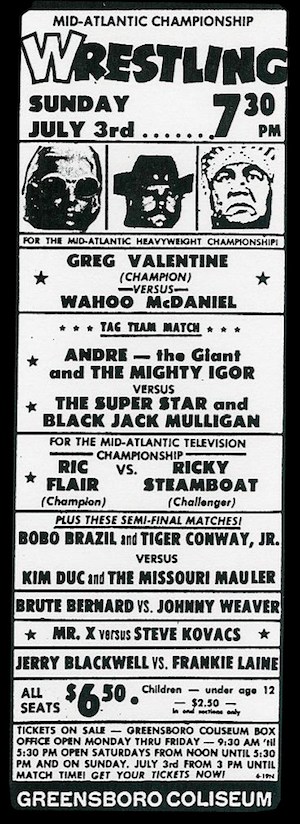
As the calendar flipped to July, noteworthy tag team matches pitting Igor and Superstar on opposing sides occurred, with none other than the “Eighth Wonder of the World” Andre the Giant teaming with Igor! On July 3, 1977 in Greensboro, North Carolina, Andre and Igor teamed up to defeat the burly duo of the Superstar and Blackjack Mulligan. On July 7th (7/7/77!), Igor and Andre again joined forces to subdue the tandem of the Superstar and the Missouri Mauler in Colonial Heights, Virginia.

After the Giant left the area, Superstar and Igor had an even-steven month of July, with the bouts between these two bitter adversaries being highly competitive. On July 5th, the Superstar gained a hard fought count out victory over Igor in Lynchburg, Virginia. However, almost immediately the Polish strongman turned the tables, defeating the Superstar by count out in Hampton, in a wild melee where Wahoo McDaniel tried to keep order as special referee.

The last noteworthy tag team bouts that featured Igor and Superstar occurred in mid July in two Texas Tornado matches, where all four men were in the ring at the same time. Somewhat predictably, these two high-energy contests saw a split decision in the results. On July 13th in Roxboro, North Carolina, Igor and Ricky Steamboat combined to vanquish Superstar and Ric Flair. But on July 16th in Spartanburg, South Carolina, the Superstar got back in the win column, teaming with the Missouri Mauler to defeat Igor and Dino Bravo.

By the end of July with the result of their feud hanging in the balance, Igor and Superstar entered a new and dangerous phase of their bitter rivalry - - Professor Malenko was pushing for a chain match!

Will the Professor have his demands met for a chain match? How will this brutal match affect the heated rivalry between Superstar and Igor?

The final chapter, PART 5!


http://www.midatlanticgateway.com/p/us-title-book.html

Friday, November 13, 2015

Jones & Mulligan Tournament Fallout

by Dick Bourne
Mid-Atlantic Gateway


PART FIVE: THE FALLOUT
Archived audio from the original television broadcast.
TOURNAMENT ANNIVERSARY GUIDE ]


Another indication of what a huge event the 1975 U.S. title tournament was for Jim Crockett Promotions was the manner in which the event was recorded for television.

The use of 16mm film footage of big matches later shown on TV was quite common during those years. This involved a single camera and no commentary. That wasn't good enough for this tournament.

Featured below are rare audio recordings of two television interviews following the tournament. The first with Paul Jones comes right after he has reviewed film of the U.S. tournament final match with Terry Funk. Ed Capral talks with Jones and notes that NWA President clearly took note of the fact that Jones had Funk pinned at one point when the referee was knocked down and didn't see it. Jones tells fans he feels like he let them down by letting the U.S. title get out of the Mid-Atlantic area. But he soon will have his rematch.

The second interview is with Blackjack Mulligan as he and Bob Caudle review film of his match with Dusty Rhodes where Mulligan was eliminated from the tournament. Tim Woods interfered and delivered a little payback to Mulligan by knocking him out with the cast on his arm.

This rare, historic audio was recorded by the late Leslie Smith Johnson using a handheld portable cassette recorder, long before the advent of video cassette recorders. The recordings were donated to the Mid-Atlantic Gateway in 2005 by Leslie's brother Kent Smith. They were included in the 30th anniversary feature we did on the tournament that same year. We are forever indebted to Kent for this gift. We treasure these recordings and are proud to present them here.


INTERVIEWS

PAUL JONES INTERVIEW

Interview conducted by Ed Capral on 11/12/75 on "Wide World Wrestling."

EXCERPT:
"I feel like I let the people down in this area. I'll tell you why. I wanted that belt to stay right here, right here where the people have supported me for the last year and a half, and stood behind me a hundred percent and called me "No. 1", made me feel good. I got our there and I fought. I felt when I had his shoulders down in that backslide, he could have counted up to six! And the referee wasn't there. That is why, that is why Jack Adkisson, the president of the NWA, he rewarded me a rematch. And I guarantee you, I never let anybody down twice, and I promise you people, I'll never let you down the next time, when I get that rematch, I guarantee you. That belt will be right back here in this area."


BLACKJACK MULLIGAN INTERVIEW

Blackjack reviews tape of his tournament match against Dusty Rhodes with Bob Caudle and Ric Flair on "Mid-Atlantic Championship Wrestling."

Here is what Blackjack and Bob are talking about  - From the results in Part One:
Rhodes had Mulligan in a headlock when Mulligan shot him into the ropes. The two collided and Dusty fell to the ringside floor, landing on top of one of the official judges Augie Wilde. Blackjack fell to his back in the ring. The referee was distracted by Rhodes and Wilde, and began issuing the ten-count on Rhodes to return to the ring. While this was going on, Tim Woods, who had his hand broken by Mulligan some weeks earlier, entered the ring. Woods hit Mulligan with his cast, knocking Mulligan unconscious. Rhodes beat the ten count and returned to the ring, and then covered the unconscious Mulligan for the three count.


A 16-page section of the massive 8x10" 250-page "Mid-Atlantic Wrestling 1975 Yearbook" is devoted to the historic U.S. title tournament in Greensboro.

Click here to order your copy: 1975 Yearbook


Wednesday, November 11, 2015

Vintage Audio Recordings from "The Tournament"

by Dick Bourne
Mid-Atlantic Gateway

One Night Tournament for the Vacant United States Championship
Sunday, November 9, 1975
Greensboro Coliseum, Greensboro NC


PART THREE: THE BROADCAST
Archived audio from the original television broadcast.
[ TOURNAMENT ANNIVERSARY GUIDE ]


Another indication of what a huge event the 1975 U.S. title tournament was for Jim Crockett Promotions was the manner in which the event was recorded for airing later on television.

The use of 16mm film footage of big matches later shown on TV was quite common during those years. These typically involved a single film camera and no commentary. That wasn't good enough for this tournament.

Jim Crockett had the whole thing video taped with "Wide World Wrestling" announcer (and former long time Atlanta TV host) Ed Capral calling the matches, with various color commentators including David Crockett and Danny Miller. Capral had only joined the promotion one month earlier on the debut of the new program. Portions of three matches were shown on "Wide World Wrestling" episodes on 11/12/75 and 11/19/75.

Featured below are rare audio recordings of those three tournament matches. Two special interviews following the tournament will be presented here on Friday's update.

This rare, historic audio was recorded by the late Leslie Smith Johnson using a handheld portable audio cassette recorder, long before the advent of video cassette recorders. The recordings were donated to the Mid-Atlantic Gateway in 2005 by Leslie's brother Kent Smith. They were included in the 30th anniversary feature we did on the tournament that same year. We are forever indebted to Kent for this gift. We treasure these recordings and are proud to present them again here.

Please note: The embedded audio player may not display properly and may not play at all or may not play completely on some versions of mobile operating systems. For optimum use, these should be played on desktop systems. 


TOURNAMENT MATCHES

BLACKJACK MULLIGAN vs. DUSTY RHODES

A Quarter-Final Match
Commentary by Ed Capral and Danny Miller
Rhodes had Mulligan in a headlock when Mulligan shot him into the ropes. The two collided and Dusty fell to the ringside floor, landing on top of one of the official judges Augie Wilde. Blackjack fell to his back in the ring. The referee was distracted by Rhodes and Wilde, and began issuing the ten-count on Rhodes to return to the ring. While this was going on, Tim Woods, who had his hand broken by Mulligan some weeks earlier, entered the ring. Woods hit Mulligan with his cast, knocking Mulligan unconscious. Rhodes beat the ten count and returned to the ring, and then covered the unconscious Mulligan for the three count.


PAUL JONES vs. HARLEY RACE

A Semi-Final Match
Commentary by Ed Capral and David Crockett
Race held the advantage most of the match, using his trademark flying head butts and knee-drops. Jones caught him by surprise with the same maneuver he used earlier to defeat Ole Anderson, coming out of the ropes with a body press for the pinfall. A major advance for Jones as he defeats former United States champ and former NWA world champ Race to advance to the finals.


PAUL JONES vs. TERRY FUNK

Tournament Final
Commentary by Ed Capral and David Crockett
Both wrestlers, exhausted from their earlier encounters, wrestled a methodical, scientific match early on. At the end, there were several back-and-forth near falls. Referee Greg Peterson was inadvertently knocked down, and while he was down, Jones was able to pin Funk for what seemed like a five or six count. Peterson, who was also physically involved earlier during the Wahoo/Race brawl, was unable to get into position to count the pin. Eventually, an exhausted Jones lifted Funk for a vertical suplex, but could not get Funk over. Funk quickly cradled Jones for a three count to win the match and the United States Heavyweight Championship.


A 16-page section of the massive 8x10" 250-page "Mid-Atlantic Wrestling 1975 Yearbook" is devoted to the historic U.S. title tournament in Greensboro.

Click here to order your copy: 1975 Yearbook