Showing posts with label Rich Landrum. Show all posts

Thursday, March 23, 2023

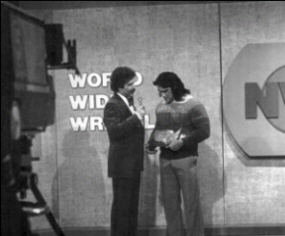
Weaver and Landrum on World Wide Wrestling

By Dick Bourne
Mid-Atlantic Gateway

Many of today's fans associate Johnny Weaver's broadcasting career with the Mid-Atlantic Championship Wrestling and NWA Pro Wrestling shows that aired in the 1980s, primarily as a result of Johnny's national exposure on NWA Pro when it was syndicated to markets all around the United States as Jim Crockett Promotions began to expand nationwide. 

But long time fans in the territory might best remember him with his first broadcast partner, the host of World Wide Wrestling from 1978-1982, Rich Landrum. 

Landrum worked in Richmond VA as the ring announcer for Jim Crockett Promotions/Murnick Promotions shows in Richmond and the surrounding area going back to the late 1960s. He took over television host duties for the re-vamped World Wide Wrestling in 1978. Landrum made the weekly trek each Wednesday from Richmond to WRAL TV studios in Raleigh NC. He originally hosted the show solo with occasional guest co-hosts, and then took on Weaver as a regular partner in late 1979, even though Weaver continued wrestling a near full time schedule through 1981. 

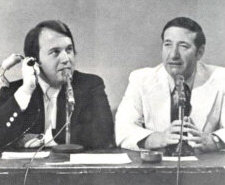
They became a very popular broadcasting duo over the next four years, and are still remembered today, especially for one of their signature spots where Johnny would offer his rendition of "Turn Out The Lights, The Party's Over" at the end of a match each week, as Landrum then reviewed the match's finish on instant replay. 

 In 2007, Landrum appeared on a Burlington, NC, wrestling event and briefly reunited with Weaver to introduce the finals of the Johnny Weaver Cup Tag Team Tournament. (Landrum wrote about that reunion here.) Johnny passed away just six months later, and in November of 2008, Landrum made a second appearance at a tribute show for Johnny Weaver in Rocky Mount, VA, along with Johnny's daughter Wendi. The show also featured wrestling legend Jim Nelson/Boris Zhukov in action, who was one of Johnny's last tag partners during the last years of his career in the ring in 1983.

Special thanks to Wendi Weaver for providing the photograph above from her father's personal collection.

Related feature: WRAL Studio Wrestling
Mid-Atlantic Gateway Interviews with Rich Landrum | Johnny Weaver


This post was edited from an original post on the Johnny Weaver Blog in January 2009.

Saturday, December 03, 2022

Harley Race vs. Paul Jones: Reflections on the Norfolk Scope

by David Chappell
Mid-Atlantic Gateway

The Scope arena in Norfolk, Virginia got its distinctive moniker shortened from the word “kaleidoscope,” because the builders saw so many varied usages for the edifice that was constructed from 1968 to its opening in 1971. And to be sure, I have seen quite a number of different events at the Scope over the years. But none held a candle to the Mid-Atlantic Championship Wrestling events that graced its presence.


Attending a recent WWE Monday Night RAW show at the fabled Norfolk Scope, as usual, brought back to me floods of memories of Mid-Atlantic Championship Wrestling. Getting a souvenir cup at that RAW show that commemorated the 50th anniversary of the Scope, replete with 70’s looking photos on it, just intensified those fond recollections.

Thursday night events at the Norfolk Scope housed a multitude of noteworthy battles in the grand history of Mid-Atlantic Championship Wrestling. When I am at current shows at the now 51-year-old Scope, I often find myself looking up at the rafters and the uniquely designed roof of that historic arena, and then with a rich imagination try to beam two Mid-Atlantic legends down to the Scope’s squared circle for them to repeat their magic of yesteryear one more time.

During the most recent RAW show I attended in Norfolk, I had a flashback to a Norfolk Scope card on November 2, 1978, featuring an NWA World Title bout between Champion Harley Race and top challenger Paul Jones. 

Mid-Atlantic Championship Wrestling announcer Rich Landrum did a special interview with Race that aired on WAVY TV Channel 10 in Norfolk to promote the bout. Landrum led off, “Norfolk Scope Coliseum, a World’s Heavyweight Championship match with the challenger Paul Jones [going] up against this man, the World’s Heavyweight Champion Harley Race.”

Race began, “Let me say this Jones, you’ve done a lot of campaigning; you must have done it quite well to come up with a Title shot at the Scope. Well let me tell you something Jones, when you come for this [belt], you come for all the marbles, you come for everything in wrestling.”

Harley continued, “You got [Ric] Flair out here bragging and going on about what he owns and controls, but this is the honcho in wrestling. And you are coming for the absolute honcho in wrestling, Harley Race. I am the cock of the walk; I am the man of the hour. I’m the man that’s got a quarter of a million-dollar bounty on him. You come for me Jones, and you come to take one awful beating and a beating is exactly what I’m going to give you son.”

The World Title match between Race and Jones was a classic one hour draw in one of Paul’s last splendid babyface efforts before he would turn into a “bad guy” in about a month when he attacked Ricky Steamboat as part of a two-ring battle royal in Charlotte, North Carolina. 

The bout at the Scope on November 2, 1978, saw Paul Jones at the zenith of his prowess as a “battle to the end babyface,” much like he was two years earlier in his classic program with the ruthless Blackjack Mulligan. The Scope saw many of those titanic struggles as well. In fact, it saw titanic struggles every Thursday night during the Mid-Atlantic years. 

The Scope. What a building. When I peer into that kaleidoscope, to this day, no matter what event I may go there to see, I still see Mid-Atlantic Championship Wrestling memories burning brighter than ever.

Tuesday, February 22, 2022

Johnny Weaver debuts as co-host of World Wide Wrestling (1979)

by Dick Bourne
Mid-Atlantic Gateway

One of Mid-Atlantic Wrestling's most beloved color commentators in the 1980s was the "Dean of Professional Wrestling" Johnny Weaver.

Johnny Weaver and Rich Landrum
World Wide Wreslting at WRAL
(Photo courtesy of Wendi Weaver)

Weaver first became the co-host of World Wide Wrestling in late 1979 alongside show host Rich Landrum. The two formed a very popular duo for the next few years. Landrum left the show in 1982 and Weaver continued co-hosting World Wide with new host David Crockett until 1984 when Tony Schiavone stepped in as co-host with Crockett. Weaver then moved over to Mid-Atlantic Championship Wrestling with longtime host Bob Caudle, and the two continued as a team on into the late 1980s, as the show transitioned to the new name of NWA Pro Wrestling

Weaver's first show as Landrum's sidekick was on the November 25, 1979 episode of World Wide Wrestling, the first weekend after Thanksgiving. The audio of his introduction can be heard below. Weaver was still active as a wrestler at that point, and would tell Landrum on air that he might not be there every week, but would try to be there most weeks. As it worked out, he was indeed there most weeks and gelled right away with Landrum. 

Weaver even developed his own shtick, paying homage to "Dandy" Don Meridith's bit of singing "Turn Out the Lights, the Party's Over"on Monday Night Football during that era. Usually once a week, Weaver would sing the opening lines of the song just as a popular babyface wrestler was getting the pinfall on World Wide.

"Turn out the lights, the party's over. They say that all good things must end."

Indeed all good things did come to an end, and when the Crockett family sold the company to Ted Turner in late 1988, Weaver was not retained, and one of wrestling's most popular color commentators was heard no more. Wrestling was never as much fun after that.

* * * * *

Listen to this vintage audio recording of Rich Landrum introducing Johnny Weaver as his co-host on Wide World Wrestling, airing first on November 25, 1979. (Audio from the collection of Gary Wray.)


Thursday, February 10, 2022

Tim Woods takes credit for costing Buddy Rogers the WWWF Championship

by Dick Bourne
Mid-Atlantic Gateway

"I'm proud to say that I was the man who caused you to get beat
in less than a minute."  - Tim Woods

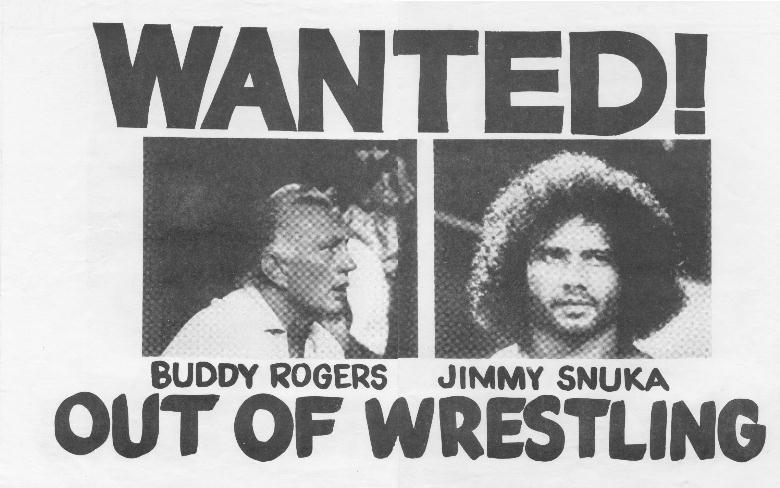
In the fall of 1979, Tim Woods and Buddy Rogers were involved in a torrid feud. Rogers and his number one charge, U.S. Champion Jimmy Snuka, had badly injured Woods (in storyline) in one of the most dramatic and violent angles ever seen on Mid-Atlantic TV, and throughout the fall, Woods was intent on revenge. He even printed up his own wanted posters to hand out to fans at arenas to generate support in his quest to get even with Snuka and Rogers.


Rogers was now a manager, and occasionally still wrestled, but was most famous for his legacy in wrestling. His world title wins aside, it was his iconic nickname "Nature Boy" from the 1950s that had been bequeathed to Ric Flair back in 1975 by JCP booker George Scott that modern fans may have been more familiar with. Scott was a longtime friend and admirer of Rogers, and the rookie Flair reminded him of the original Nature Boy. It wound up being a wonderful gift that helped shape Flair's career for decades. 

But more significantly, Rogers was at that time the only man to have ever held both the National Wrestling Alliance (NWA) and World Wide Wrestling Federation (WWWF) world championships. He was also famous for the way he lost that WWWF title to Bruno Sammartino in 1963, submitting to Bruno's over-the-shoulder bearhug in just 43 seconds in Madison Square Garden. As it happens, a young Tim Woods was working the under-card of that very same show.

Behind the scenes, Woods and Rogers developed a lasting friendship during Woods' nine-month stint in the WWF in 1963. During their feud in the Mid-Atlantic area sixteen years later in 1979, the two men occasionally played off the fact that Woods was there when Rogers lost the title to Sammartino.

In an interview with Bob Caudle on Mid-Atlantic Championship Wrestling in late October 1979, Rogers would accuse Woods of betraying a secret that would dearly cost him. Rogers called Woods a "rat" for "squealing" his secret. The result, he claimed, cost him over two million dollars in purses that he would have won otherwise.

 
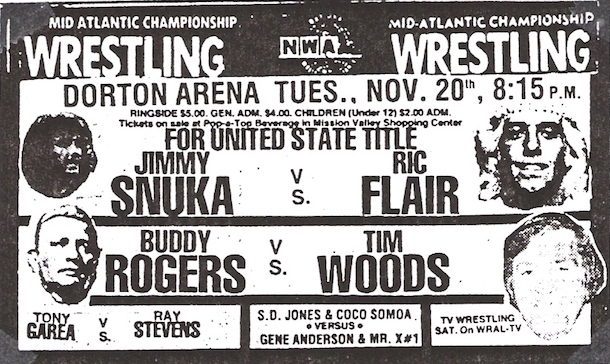
Rogers didn't go into more specifics at that time, but the details could be pieced together in various local promos that Rogers and Woods made in advance of their matches against each other in local areans throughout the territory. The best example might be in promos for their battle in Raleigh's Dorton Arena on November 20, 1979. Woods actually told Rogers how proud he was that he was the reason Rogers lost the WWWF title. "I'm proud to say that I was the man who caused you to get beat in less than a minute," Woods declared. While Bruno Sammartino's name was not specifically mentioned, the implication was clear. And by the sound of it, one could surmise that Woods must have told Sammartino that Rogers was coming into the Madison Square Garden match with a badly injured back, something Bruno would quickly exploit only seconds into their famous bout.


Buddy Rogers and Tim Woods Promos - 11/20/79 Raleigh NC

There of course was no such storyline in 1963, at least not involving Woods, who was working low on the WWWF cards at that time very early in his career. But how cool is it that Woods and Rogers would play off that historic match 16 years later, in a totally different territory, knowing they were both in the same building the night it took place? I'm guessing all of that was lost on most of the people who heard these promos in 1979, but it's a small little detail - - a sub-plot if you will - - that makes the memory of the famous Woods/Rogers feud something a little more special to reflect on now more than 40 years later.

* * * * * 

Special thanks to David Chappell and his 12-part Gateway series on the Woods-Rogers feud, to Mark Eastridge for the newspaper clipping, and to Gary Wray for the audio recording of the Woods-Rogers promos for Raleigh.

Tuesday, November 02, 2021

Greg Valentine Comes to Atlanta for the Georgia Heavyweight Title Tournament (1981)

by Dick Bourne 
Mid-Atlantic Gateway

On May 17, 1981 at the Omni in Atlanta, there was a one-night tournament for the vacated Georgia Heavyweight Championship. Ten men were entered in the tournament, including a couple of guys advertised as coming in from outside the territory to compete including Bruiser Brody and Greg Valentine.

Brody no-showed (or perhaps was never really going to appear to begin with, who knows) but Valentine came in from the Mid-Atlantic area and went all the way to the finals, defeating Mr. Wrestling II in the quarter finals and Iron Mike Sharpe in the semi-finals before losing to "Wildfire" Tommy Rich in the finals.

Prior to the tournament, Greg Valentine sent in a taped interview from Raleigh to promote his appearance in the tournament. The interview was conducted by Rich Landrum (host of "World Wide Wrestling") in the studios of WRAL TV.

The video below, which is the final seven minutes of the Georgia TV show leading up to that big Omni card, contains the Greg Valentine promo plus another tape from the Mid-Atlantic area featuring the reigning NWA World Tag Team champions Gene and Ole Anderson.

(No idea why the person who posted this clip labeled it from "WGHP-TV High Point Fox 8..." because the clip has nothing to do with any of that.)


GENERAL NOTES
  • The match with the Anderson Brothers from WRAL is from the summer of 1981 and is from "Mid-Atlantic Championship Wrestling" with Bob Caudle and Lord Alfred Hayes calling the action.  
  • Tommy Rich was wrestling in that tournament with a $10,000 bounty on his head, allegedly placed there by NWA World Champion Harley Race, who was trying to avoid having to face Rich for the NWA title. Greg Valentine mentions being interested in collecting the bounty in his promo, but was apparently unable to do so as Rich defeated him in the tournament finals to win the Georgia title and then went on to challenge Race for the NWA title at the next show at the Omni on 5/31/81. Race would successfully defend against Rich on 5/31, but then lost the NWA world title to Dusty Rhodes on the following Omni show on 6/21/81. 
  • If you look closely, you will see part of the Georgia championship belt extending off the front of Gordon Solie's podium. 
  • In a Studio Wrestling note, the backdrop you see in the Valentine interview (as seen in the image at top) was the Mid-Atlantic set used from 1975-1977 and is my favorite of all the old sets, mainly because it was first one I really remember and was used during the years I first really loved wrestling. 
  • This Georgia Championship Wrestling show featured two other Mid-Atlantic clips not seen in the video above. The first featured a match between Greg Valentine and Steve Muslin from 1980 on "Mid-Atlantic Championship Wrestling." The second was a promotional interview similar to Greg Valentine's with Rich Landrum interviewing "The Dream." (I hope to present those in a future post.)

GEORGIA TOURNAMENT NOTES
  • Gordon Solie promoted the tournament as a round-robin tournament, although it was not competed in such a fashion. There were 10 men announced as appearing in the tournament: Dusty Rhodes, Iron Mike Sharpe, Mr. Wrestling II, Tommy Rich, Ray Candy, Bruiser Brody, Greg Valentine, Ken Patera, Mike Boyer, and Bill Irwin. Brody and Boyer diod not appear, but Nickolia Volkoff and Jim Duggan replaced them.
  • From the tournament results posted on The History of the WWE website, it appears that 2 of the 10 (Rhodes and Volkoff) received byes, but I've been unable to figure out the elimination brackets from these results. But they are listed as:
Quarter Finals: Tommy Rich defeated Bill Irwin
Quarter Finals: Ken Patera defeated Ray Candy
Quarter Finals: Greg Valentine defeated Mr. Wrestling #2
Quarter Finals: Iron Mike Sharpe defeated Jim Duggan
Semi Finals: Ken Patera fought Dusty Rhodes to a no contest
Semi Finals: Tommy Rich defeated Nikolai Volkoff
Semi Finals: Greg Valentine defeated Iron Mike Sharpe
Finals: Tommy Rich defeated Greg Valentine to win the title


Originally posted November 2016 on the Mid-Atlantic Gateway.

http://www.midatlanticgateway.com/p/us-title-book.html

Wednesday, March 24, 2021

A Brief History of Wrestling in the Mid-Atlantic Area

A Look Back at the Promoters and Television History of Jim Crockett Promotions
by Dick Bourne

Mid-Atlantic Gateway

Professional wrestling has been one of the most popular live events in the Carolinas and Virginia since the early/mid-1900s. Several key players were responsible for making pro wrestling an institution here, some familiar to fans, others perhaps not so familiar.

The company known for promoting wrestling across Virginia and the Carolinas for decades was Jim Crockett Promotions. Jim Crockett, Sr. started promoting wrestling in our area when he bought an old warehouse in Greensboro, NC, in December of 1933, named it the “Sportrena”, and held his first matches there. With that first card, the company that later grew to be known as Jim Crockett Promotions was born.

Crockett established his base of operations in Charlotte a year later in 1934, moving in on a chaotic promotional scene at that time. In 1939 he and successful Richmond promoter Bill Lewis bought out the interests of promoter Pete Moore who had been in partnership with Crockett for nearly 10 years going back to their days headquartered out of Bristol, VA. Moore’s promotional interests spanned the width and breadth of the area that we think of now as the Mid-Atlantic territory.  After buying Moore out, Lewis based his operations out of Richmond, and Crockett based his out of Charlotte. Together they brought top pro-wrestlers from around the country to the halls, armories, and small arenas throughout the Carolinas and Virginia.

As the companies evolved, Crockett had become the main promoter, with Lerwis booking all of his talent through the Crockett's Charlotte office. Lewis died in 1961, and Crockett sent Joe Murnick, his top lieutenant in Charlotte, to replace him. Murnick would headquarter out of Raleigh, but assumed all of Lewis's territoy to the east, including Fayetteville, Richmond, Hampton, and Norfolk and all points in between.

Over the years, Crockett had many local promoters like Murnick working for him within the various regions of the main territory including such men as Henry Marcus (central and lower South Carolina), Paul Winkhaus (Western North Carolina and Upstate South Carolina) and Pete Apostolou (Central and Southwest Virginia.). These promoters coordinated the local promotion of Crockett’s wrestling events. However, it was Murnick who became Crockett’s largest and most trusted partner.

In April of 1973, Jim Crockett, Sr. passed away and his son in law, John Ringley, took over the operations of the company. He was soon followed by Crockett's oldest son, Jim Crockett, Jr., who during his tenure expanded the reach of the company outside of the traditional territorial boundaries that had existed for years within the pro wrestling industry, and wound up being one of the two top players nationally. 

Crockett Jr.'s lieutenants included Joe Murnick and his sons Elliot and Carl, along with longtime wrestlers Sandy Scott, Johnny Weaver, and Gene Anderson, who transitioned to regional promoters at the ground level, working with and later slowly replacing those listed earlier.

The territory was always known within the business as the “Charlotte territory” because that is where the Crocketts were based. Until the mid-1970s, fans simply knew it as “All-Star Wrestling” or “Championship Wrestling.” Around the time of Jim Sr.’s passing, the promotion began to brand its wrestling business as “Mid-Atlantic Championship Wrestling”, which also became the name of their television program. Prior to this time, television wrestling had been taped out of multiple locations each week including Charlotte, High Point, Roanoke, and Raleigh. In 1974, the company consolidated its weekly television production to one location - - the studios of WRAL in Raleigh, NC. There had been many hosts of the local programs over the years including Nick Pond, Charlie Harville, Hal Grant, Bill Ward, and Bob Caudle. After the 1974 consolidation, Caudle became the main voice of the company, and would serve in that capacity until the company was sold to Ted Turner in 1988.

But it was from the WRAL studio that the magic we saw unfold each week on our TV screens originally took place. In 1975, Crockett Promotions added a second studio program eventually known as “World Wide Wrestling” which was hosted at different times by Ed Capral, Rich Landrum, David Crockett, and Tony Schiavone.

Eventually finding itself on the losing side of a wrestling war in the late-1980s, the 53-year old family business was sold to Ted Turner in late 1988. Turner had been a partner in Crockett's national expansion, enthusiastically providing four hours of weekly television on his nationally cable-cast Superstation WTBS out of Atlanta. This eventually included quarterly prime-time TV specials as well.

The syndicated "Mid-Atlantic Championship Wrestling" (later renamed "NWA Pro Wrestling") and "World Wide Wrestling", along with the national WTBS "World Championship Wrestling" battleship, drove hundreds of thousands of fans to the arenas each month. For a short time anyway, the once small Mid-Atlantic territory one of the largest and most successful wrestling promotions in the country.

This article was based on a shorter limited piece originally posted June 28, 2017 on the Mid-Atlantic Gateway.

http://www.midatlanticgateway.com/p/book-store.html

Friday, October 16, 2020

Trial Run: The Origins of Ric Flair's First Babyface Turn (1979)

by Dick Bourne
Mid-Atlantic Gateway

 
Featuring exclusive vintage audio of Ric Flair
and Rich Landrum from 1979!

This is a look at an interesting point in wrestling history, something that never would - - or never could - - happen today.

In 1979, Jim Crockett Promotions booker George Scott finally pulled the trigger on something he had known he would eventually do for the last year or so - - turn Ric Flair babyface.

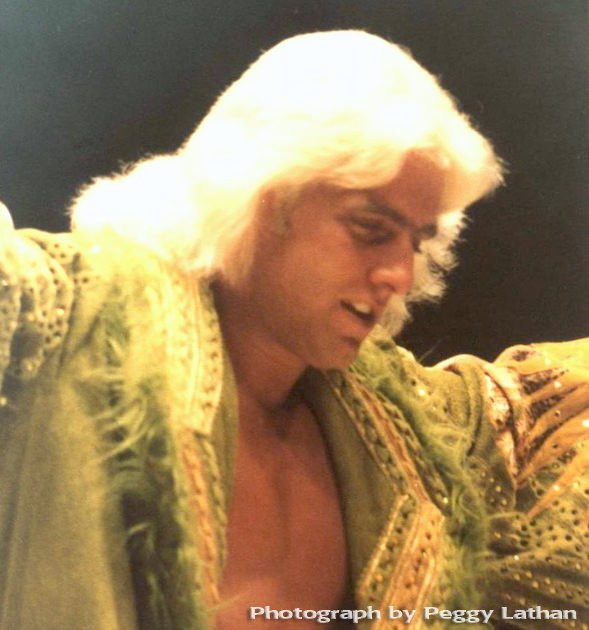
Photo by Peggy Lathan
Looking back, it's curious how Scott went about it. I'm not sure he completely trusted his decision. The most effective turns in wrestling were always when you took a babyface or heel who was hot, but close to perhaps running out of steam in that role, and making the turn before the heat started to cool. You could argue there was no cooling down Ric Flair even if you wanted to, but in reality, had been the top heel for three years and had long protracted feuds with Wahoo McDaniel, Ricky Steamboat, and Blackjack Mulligan, and there wasn't another top level babyface to marry Flair to that would have the impact those programs had. And a lot of fans loved him regardless.

But Flair had been so generally hated as a heel, that Scott seemed unsure if the fans would readily accept or trust Flair as a "good guy." Plus, he would be losing his number one heel if it flopped.

So George Scott made the decision to drag it out over a couple of months in a single market, out of sight from the rest of the territory, beginning with what in hindsight looks like almost a trial run in Greensboro to see what the reaction would be. 

Indeed the fans in person at the Greensboro Coliseum and those watching on Greensboro television were the only fans who saw the initial phase of Flair's historic first turn take place.
 

THE CARD IN GREENSBORO
The April 22, 1979 card at the Greensboro Coliseum was the place it first started with no early indication going into it that something like this was getting ready to happen.  

The Greensboro cards were usually pretty loaded, and this was no different with four big main events featuring two Mid-Atlantic-territory title matches and two world title matches featuring both the NWA  and AWA World Heavyweight champions. 

  • AWA champ Nick Bockwinkel was in the middle of a tour of the Mid-Atlantic area defending his AWA title during an odd period where he was making more title defenses here than Race, although none of them had an angle or story with them. But it was a treat to get to see a technician like Bockwinkel on our cards. He defended the title that night against Paul Orndorf, one half of the current NWA World Tag Team Champions.
  • Paul Jones and Ricky Steamboat were continuing their 5-month feud over the NWA TV title that had begun when Jones turned on Steamboat (although that's not the way Jones remembered it) the previous December in a memorable angle that took place during a huge two-ring battle royal.  Jones had held the TV during all of that time, Steamboat trying again and again to take it from him, being frustrated at every turn. This match was to be the culmination of the feud for awhile, the two settling things in a Texas Death Match!
  • Ric Flair was defending the U.S. title that night against the popular "Superfly" Jimmy Snuka, the other half of the current NWA World Tag Team champions with Orndorf. This was of course before roles were reversed five months later and Snuka would win the U.S. title in a tournament as a new heel managed by Buddy Rogers, and Flair would be the challenger.
  • In the main event, Harley Race defended the NWA title against Dino Bravo, who had just recently lost his Canadian Heavyweight Championship, but remained a top contender both in Canada and the U.S. for Race's title. He had recently been the top contender for Ric Flair's U.S. title as well.
  • Wrestlers on the undercard included former WWWF champion Pedro Morales, Big John Studd, Don Kernodle, Abe Jacobs, Leo Burke, and others.


THE ANGLE: PART ONE
Flair later claimed that Paul Jones had approached him about "holding his hand" in his title defense against Steamboat, Flair saying Jones was paranoid that Steamboat was getting close to beating him. None of this happened on the main TV programs, and if it happened at all, it perhaps was mentioned in the local Greensboro promos leading up to the April 22 card. 

The match was a Texas Death match, but as was the case in those days, Jones' NWA TV championship was only up for grabs in the first fifteen minutes of the match.

Flair did indeed show up during the match, sitting in a steel folding-chair at ringside. When the wild action spilled out of the ring onto the floor and Steamboat was getting the better of Jones, Ric went to Jones’ aid and attempted to hit Steamboat with the chair. But Ricky ducked, and Flair instead nailed Jones with the chair, knocking him out cold. Steamboat won the match because Jones was unable to answer the 10-count after the Flair chair-shot. While Steamboat won the Texas Death match, he didn't win the TV title, which was only on the line for the first 15 minutes of the match (TV title rules at the time) and the Texas Death match had gone 35 minutes and six falls!

Needless to say, even though Flair claimed it was all an accident (and it certainly appeared it was), Jones was plenty angry with the Nature Boy for costing him the match.

THE ANGLE: PART TWO
Later that evening, Flair was defending the U.S. title against Jimmy Snuka, and just as in the earlier match, action spilled out of the ring and onto the floor. As Snuka and Flair brawled outside, Paul Jones suddenly appeared with his own steel folding-chair and whacked Flair with it from behind. Except in this case, it was clearly no accident. Jones was aiming for Flair and it was payback for what happened in his match with Steamboat. Flair was also knocked out, and Snuka won the match (but not the title) by count-out.  

Moments later, a revived but visibly angry Flair grabbed the house mic and screamed for Jones to return to the ring. Jones didn't return but the ring announcer announced that Flair and Jones would face each other one-on-one at the next Coliseum show on May 5.   


THE PRESENTATION

A specially-taped two-minute segment aired on the TV shows that aired in the Greensboro market the afternoon of May 5 card at the Coliseum. The segment aired in place of the normal mid-show interview in the Greensboro TV market. So only fans in that market saw it.  It featured World Wide Wrestling host Rich Landrum with Flair in the empty WRAL studio reviewing film from both of the matches outlined above, with Flair giving his perspective on both.

Flair pleaded his case to Landrum that it was an accident that he hit Jones with the chair and was furious that Jones had intentionally hit him with a chair in retaliation, which cost Flair his match with Jimmy Snuka. 


Listen to Ric Flair and Rich Landrum:

The local promos for the Flair/Jones battle featured Jones with the other heels as normal, which signaled to fans that Jones wasn't turning back babyface, in case some fans might have thought that. Flair did not appear on the babyface side (having had his earlier segment with Landrum) but Ricky Steamboat spoke in Flair's spot, mentioning that he didn't have love for either guy and hoped this match might eliminate both of them. 

The rest of the Mid-Atlantic territory knew nothing of this happening, and Flair continued as a heel for the next month or so with most people unaware of his sudden feud with fellow-heel Paul Jones. 

Flair won the match with Jones on 5/5 when Jones was disqualified for the interference of Baron Von Raschke. They gave Flair a vicious beating which started building sympathy for Flair. On the very next show in Greensboro 5/20/79, Flair solicited the aid of his old tag team partner Big John Studd to challenge Jones and Von Raschke for their NWA World tag team titles. Notice Flair was not asking for help from the babyface side of the roster.....yet. His teaming with Studd signaled he wasn't becoming an official fan-favorite anytime soon. It was a heel-vs.-heel tag team battle.


THE AFTERMATH

The two Jones/Flair steel chair films from Greensboro 4/22/79 that were shown to Greensboro fans on 5/5/79 were not shown to the rest of the territory until later in May, and Flair faced Jones again for the first time since their 5/5 Greensboro match in Charlotte on 5/26. 

Throughout the month of May and into early June, Flair continued to team with the various heels including former tag partner Big John Studd and Ernie "The Big Cat" Ladd. He defended his U.S. title against most of the popular wrestlers in the territory during that time, including Dino Bravo, Ricky Steamboat, Tony Atlas,  Rufus R. Jones, and a visiting Dusty Rhodes. 

Things finally started to shift in June, as Flair began to solicit the "good guys" to be his partner, beginning with Dusty Rhodes in Greensboro on 6/3 and Jim Brunzell in Asheville and Raleigh. He eventually persuaded a reluctant Ricky Steamboat into being his partner on 6/23 in Charlotte, and the turn was complete. From that point forward, Flair was a card-carrying member of the "good guy" brigade, and quickly became one of the fan's favorites. 

Flair would continue to battle Jones in singles matches throughout the summer, and take Steamboat as a partner in failed attempts to take the NWA World tag titles from Jones and Raschke. It wasn't until August that Flair finally succeeded when he reunited with former friend and foe Blackjack Mulligan and the pair won the the titles from Jones and Raschke in dramatic fashion in Greensboro. 


THE BUDDY ROGERS EFFECT

Not only did the long war with Paul Jones set up Flair's eventual babyface turn, but happening a short time after in June was "Nature Boy" Buddy Rogers' entry into the area as a special referee for a match between Flair and Dusty Rhodes for Flair's U.S. title. Rogers was involved in the finish which made it briefly appear that Rhodes had defeated Flair for the title. This created animosity between Flair and Rogers and fans sided with Flair in that conflict, too. The Rogers affair was all part of the larger story to turn Flair babyface.

Flair's slow-burn babyface turn would hardly be possible today. No one would have the patience to do it that way for any number of reasons we are all familiar with. The unique aspect to this, though, was the "trial run" George Scott booked in Greensboro. It was part of what made the year 1979 a special one in Mid-Atlantic Championship Wrestling.  

Special thanks to Mark Eastridge.

Friday, August 28, 2020

Masked Superstar: The First Twist of the Turn

by David Chappell
Mid-Atlantic Gateway
 

August of 1980 would see a gradual change developing in one of the Mid-Atlantic area’s most feared “bad guys,” the Masked Superstar. From the Superstar’s first stint in Jim Crockett Promotions that began in September of 1976 through about six months of his second stint in the territory that began in the winter months of 1980, there was no hint that the masked marvel would be gravitating towards becoming a “fan favorite.” 

The Mid-Atlantic wrestling television tapings that took place at the WRAL TV studios in Raleigh, North Carolina on August 13, 1980 would in hindsight, provide the first clues that the Superstar would be turning into a “good guy.” The first TV show taped that evening, the Mid-Atlantic Championship Wrestling television program, didn’t seem to offer much out of the ordinary. On that show, Superstar teamed with fellow rulebreakers Greg Valentine and the Iron Sheik for an easy win. But it would be the second show taped later that night, World Wide Wrestling, that would provide the first twist in the turn to come.

The Superstar had a match earlier in the World Wide Wrestling show against young Brett Wayne, and came out in the show’s final segment for an interview with announcer Rich Landrum. Joining the masked man on the set were the NWA World Tag Team Champions Ray Stevens and Jimmy Snuka, along with their manager Gene Anderson. From the get-go, something seemed amiss during this interview segment.

Anderson immediately took control of the interview, extolling the virtues of his team, then claiming, “The Superfly and the Crippler, the greatest and the best World’s Champions that have ever held the belts!” At that time, Landrum turned toward the Superstar, but Stevens immediately cut in and asked Landum why his announcing partner, Johnny Weaver, wasn’t asking him questions. Stevens bellowed, “You know, I’d like to ask you a question. How come you come out here and interview us? Why doesn’t Johnny Weaver come out here and interview us sometime? I’d like to slap him right across the mouth! What’s the matter with him, doesn’t he have any guts?”

Rich responded, “I don’t think that plays a part in it in an interview…you want to come out and tell us how great you are.” Stevens then proceeded to tell the viewing audience that he and Snuka along with manager Gene Anderson were an unbeatable combination. Landrum answered, “It’s difficult to compete with a three-man team like that.” 

At that juncture Landrum attempted to bring the Superstar into the interview saying, “Superstar…” But Gene Anderson cut in immediately saying, “Hold it, hold it…” before Superstar could even get in a word. Anderson continued, “Jimmy, show ‘em that body! Flex that body, show ‘em that belt!” Gene continued extolling the virtues of Snuka’s physique and Stevens’ knowledge and experience, which Ray readily agreed with. 

Stevens then asked, “What do you think Superstar?” The masked man only got out, “I was just going to say…” before Stevens interrupted him and explained, “Well, I’ll tell you what, they [Ricky Steamboat and Jay Youngblood] don’t have a chance! There’s nobody that can compare to us, the athlete that Jimmy Snuka is, the wrestling that I know, and like I said with our main man [Gene Anderson] behind us right here, nobody’s gonna come close to beatin’ us.” 

A clearly frustrated Landrum then stated, “You know ya’ll are fine champions [but] I’d like to talk to the TV champion the Superstar about…” Surprisingly Landrum was then cut off by Snuka, who rarely spoke but on this occasion blurted out, “We wanna talk about these belts!” Anderson immediately picked up where Jimmy had left off reeling off the names of the area’s good guys and shouted, “You don’t have a chance, you get that through your head, you don’t have a chance and if any of you people want to sign a contract with the World’s champions, you just put your names on the dotted line and I’ll sign ‘em and I’ll have ‘em in the ring.”

Landrum again engaged the Superstar saying, “Superstar, you…” before Stevens butted in and bellowed, “If they wanna pay the price to try and win this [belt], they have to pay dearly with PAIN, and I mean a lotta pain because my partner and I enjoy hurting people and that’s exactly what we do.” Ray continued on about that subject and when he finished, Rich took a final stab at bringing the Superstar into the segment saying, “Super, I’d like to hear from you.” The Masked man replied, “It’s about time, I’d like to…”

At that instant there was a commotion on the set with the floor manager coming over to Landrum, whispered something in his ear which Landrum followed up on by explaining, “I’m sorry, they took all the time. Well fans, as always, too short on time [so] that’s it for this week, look forward to seeing you next week right here on World Wide Wrestling.”

Over the next couple of weeks, several more circumstances continued to push the Superstar towards a “good guy” turn, including showing compassion for Brett Wayne during another television match with him after a clothesline maneuver clearly hurt the youngster, and holding back Greg Valentine to keep the sides even when Blackjack Mulligan and Valentine’s friend Bobby Duncum had a dust-up on TV.

Superstar’s good guy turn was completed at the beginning of September 1980 when Anderson came out to the TV interview area and again interrupted the Superstar’s interview, leading to Anderson hitting the Superstar with his cane and soon thereafter the Superstar turning the tables and breaking the cane on Anderson and throwing Stevens through the air onto Snuka. In his interview after that incident, Superstar pointed to the interview interruption on August 13th as a big component of his turn to the good side.

The Masked Superstar had a solid run as a good guy, winning the NWA World Tag Team Titles with Paul Jones on Thanksgiving night of 1980 and then again in early 1981 before leaving the Mid-Atlantic area for good in the late spring of 1981. And looking back on it, the good guy persona of the Masked Superstar was born because of the disrespect shown to him during an otherwise normal interview segment at the end of the August 13th World Wide Wrestling taping…the first twist of the turn.

Tuesday, January 28, 2020

Rich Landrum Remembers Rocky Johnson

Rocky Johnson as Sweet Ebony Diamond
(Photo from Maple Leaf Wrestling)
Rich Landrum shared a nice memory with us about working with Rocky Johnson in the Mid-Atlantic area, back when Rich hosted "World Wide Wrestling" and Rocky was working under a mask here as Sweet Ebony Diamond.

I thought I would share Rich's tribute.
 
I was really saddened by the death of Rocky Johnson. He was a terrific wrestler in the Mid-Atlantic Wrestling area and a good friend.

He was truly one of the "nice guys". He had some great matches. One in particular, with the Masked Superstar, Bill Eadie. Two masked men going after each other was a sight to behold. Especially with those two. I believe that was the first time that had ever happened. Especially on TV.

After the TV taping moved from Raleigh to Charlotte, I would fly in and out to Charlotte every Wednesday. Rocky would pick me up at the airport early Wednesday mornings and take me the studio's of WPCQ. He continued to do this right up until the time he moved from Charlotte.

It was during this time that I had the opportunity to meet his young son Dwayne. He was a cute kid.

Rocky was fun to be around and always seemed to have a kind word for the fans. He will be missed by many.

RIP Rocky!
- Rich Landrum                

Sunday, April 28, 2019

Cool Photo: Rich Landrum and Gene Anderson arrive at WRAL

Photo by Steve Davies

While it appears Rich Landrum didn't offer to carry Gene Anderson's bags on this night, he was happy to carry his belt!

Landrum, the host of "World Wide Wrestling" from 1978-1982, arrives at the studios of WRAL TV in Raleigh, NC, with his trademark tuxedo in a travel bag in his hand and one of the NWA World Tag Team title belts over his shoulder.

To Landrum's right is Gene Anderson, one half of the Minnesota Wrecking Crew and also one half of the then-reigning NWA World Tag Team Champions with his brother Ole Anderson.

A great behind-the-scenes photograph taken by Steve Davies in the summer of 1981.

Saturday, March 23, 2019

Pvt. Jim Nelson


Pvt. Jim Nelson is under orders to hold and protect Sgt. Slaughter's United States Championship belt.

Many fans may know him better as Boris Zhukov, who challenged Sgt. Slaughter in the AWA for his Americas title, or teamed with Nikolai Volkoff at WrestleMania III in the WWF.

But to us he will always be Sgt. Slaughter's young recruit Pvt. Nelson.

Nelson was one half of the Mid-Atlantic Tag Team champions with Pvt. Don Kernodle. He was also later a behind-the-scenes spy for Ricky Steamboat and Jay Youngblood in their quest to regain the NWA World Tag Team titles from Sgt. Slaughter and Don Kernodle, which they finally did at the famous cage match in Greensboro in March of 1983.

Don't drop that belt, maggot! Now drop and give me 20!


http://bookstore.midatlanticgateway.com

Wednesday, March 13, 2019

Ric Flair vs. Gene Anderson: The Figure Four/Hair Challenge (1980)


AUDIO RECORDING BELOW
by Dick Bourne
Mid-Atlantic Gateway
(Includes Rare Vintage Audio Recording)


"You might have pushed me around when I was five years old. You were a lot bigger then, brother. But times have changed. You wanna push me around now? Get a contract, and just like Buddy Rogers learned, brother, I'll go through you to get to Snuka."    -Ric Flair, World Wide Wrestling, January 12, 1980 

In late 1979, Gene Anderson retired from full-time competition to begin his managerial career, taking over the contracts previously held by Buddy Rogers. One of those wrestlers was "Superfly" Jimmy Snuka, the reigning United States Heavyweight champion.

Ric Flair, at this point a beloved fan-favorite in the Mid-Atlantic area, was chasing the U.S. title once again, a title he never lost in the ring to begin with. He had given up the championship in August of that year when he and Blackjack Mulligan won the NWA World Tag Team titles. Snuka subsequently won the vacant U.S. championship in a tournament. Now Flair wanted the U.S. title back.

But in January of 1980, Gene Anderson suggested on television to "World Wide Wrestling" host Rich Landrum that he didn't think Flair deserved a shot at Snuka when he couldn't even beat him (Gene), calling himself "the teacher." In wrestling lore, it was Flair's cousins Gene and Ole Anderson that broke him into the business and taught him the ropes.

Flair obviously took issue with that and challenged Anderson to a match and told his cousin to name the town and that if he couldn't beat him in under 30 minutes with the figure four leglock he would never wrestle in that town again. And if he won, he would get the U.S. title shot at Snuka.

Anderson agreed, but said there would be something else Flair would have to put up. The following week, Anderson announced the stipulation and presented Flair with a contract: if Flair didn't beat him in under 30 minutes with the figure-four, he would have to shave his head!

We are happy to present here a vintage audio recording of the confrontation described here between Ric Flair and Gene Anderson, on World Wide Wrestling hosted by Rich Landrum and Johnny Weaver:


RIC FLAIR / GENE ANDERSON CONFRONTATION (2:34)


In a recent story here on the Gateway, I outlined a series of title matches over the years where Flair was chasing a championship with his "golden mane" on the line and how that stipulation proved enough motivation to Flair to never lose one of those matches. That same motivation served him well in the matches with Anderson that took place at the end of January and first of February as Flair defeated Anderson in each one.

There were at least four of those matches, taking place in Columbia and Charleston, SC, Greensboro, NC, and Hampton, VA (newspaper ad seen above.)

As a result of these matches, Gene Anderson had to begin using a cane because Flair had injured his knee with the figure-four. The cane became a source of great controversy after that as Gene often used it to interfere in matches where he managed Snuka, the Sheik, Stevens and others. It was also the cane that legitimately broke Ric Flair's nose in an angle gone haywire when Valentine tuned on Flair in the summer of 1980 setting up Valentine's eventual first U.S. title run. 

After the Figure Four/Hair match challenges between Flair and Gene Anderson, Flair would eventually take the U.S. title from from Snuka in April of 1980, but not before enduring one of the most brutal feuds in Flair's long career. He and Snuka, with manager Gene Anderson always causing trouble at ringside, had one of the most bloody feuds in Mid-Atlantic  Wrestling history.

* * * * * *

Thanks to Mark Eastridge for the newspaper clipping,
Gary Wray for the audio recording, 
and Carl Richardson for additional research. 

http://www.midatlanticgateway.com/p/us-title-book.html

Monday, January 07, 2019

Bruce Mitchell: One Night at the WRAL Wrestling Tapings

by Bruce Mitchell, Senior Columnist for PWTorch.com
Special for the Mid-Atlantic Gateway


The line stretched all the way down the sidewalk.

We were in front of the WRAL TV studios in Raleigh, North Carolina early one Wednesday evening in 1980, waiting to get into a Mid Atlantic Championship Wrestling show taping. I was the devout fan who would leave the UNC-Greensboro Strong dorm keg parties at 11:30 sharp every Saturday night, bend the rabbit ears around, and settle in to watch a slightly snowy MACW show out of Raleigh on my portable black and white TV. The rest of the group was pretty eclectic – Johnny, one of my old high school friends, his brother Henry, a student at Duke Divinity School, their mother Rose (I still don't know how that happened) and some of the brother's buddies. This group was there for the spectacle, (Henry had worked part-time at Dorton Arena and seen some shows from the back) and included some skeptics. I was the only one who knew who all the wrestlers were and who was feuding with whom.

Henry, the Duke Divinity School student, came in handy, at least his sense of ethics did, because he created a phony church name for us to use when requesting free tickets from WRAL. They gave us more tickets that way.

Not surprisingly, Henry subsequently left the ministry to become a successful lawyer.

As we waited in line it was pretty clear some of the folks waiting with us were regulars who came to the tapings every week. I was a closet wrestling fan at this point who didn't know many other fans, so it was pretty cool to be able to eavesdrop on people in line as they speculated on what was coming next in the promotion. It would take me some years before I would become a member of a community of fans like that.

The wait was broken up a little when Rich Brenner, then the sports anchor at WRAL, came out and greeted some fans on the way to his car. Brenner was drawing huge ratings in the area at the time, and was soon lured to a big market job in Chicago. I mention this because the weekend anchor, Tom Suiter, took his place and remains at WRAL to this day. Suiter is the best local sports anchor I've ever seen, and Brenner isn't far behind. Brenner soon returned to North Carolina and recently retired from WGHP in Greensboro, another station where Mid Atlantic Championship Wrestling was taped for years, so I've been watching both guys off and on for three decades. In those days of three television station choices, local news was more intertwined in the lives of the community, so you can see how these two sports guys, their station, and Mid Atlantic Championship Wrestling are, to me, all part of the same tapestry.


WRAL today. (Photos by Dick Bourne at the Mid-Atlantic Gateway)

After a wait almost as long as it took me to connect Tom Suiter to pro wrestling, we were let into the TV studio where the wrestling action was filmed. The first thing that stood out, obviously, was the wrestling ring. Since we were all sitting on one set of bleachers every seat in the house was close. I figured it was about as close to the front row at one of these shows as I was ever going to get.

Not only were the fans close to the ring, we were close to each other. The real job of security that night was to encourage us, as we settled into the bleachers, to "move over", "scootch down", "scrunch up", and "C'mon, let's get one more, folks," as they tried to fit everyone in before the taping started.
I, for one, was prepared for my big chance to be on TV. I worked part-time at the late, lamented South Square Mall Belk's Department Store in the Men's Budget department, so I was sporting a green three-piece polyester suit that was sure to stand out even on a black and white TV screen. The poor lady crammed up against me on that bleacher for two plus hours probably didn't notice how much I sweated that night.

It wouldn't be the first time I had been on a TV show that had been taped at that studio, either. When I was a kid my parents brought me to a taping there of The Uncle Paul Show ("And now it's time for Uncle Paul and all his friends…"). Many major TV stations had their own local kiddie show host, and Uncle Paul was WRAL's version. I dutifully marched in the Happy Birthday March that day, but my favorite part of the show was when the fleas in Uncle Paul's hat would sing their little high-pitched songs.

Interestingly enough, Uncle Paul (Paul Montgomery) was legally blind, and if you looked closely you could see him at the podium reading his Braille show notes with his fingers.

One of the coolest things about this night came before the taping. Wrestling news could be hard to come by in those days, so David Crockett, the MACW color man, walked over to casually chat with fans in the bleachers. He let us know that the Iron Sheik had recently beaten the fresh-faced favorite Jumpin' Jim Brunzell for the Mid Atlantic title, the second biggest title in the territory. Most fans were distressed at the news.

Not me. I got a huge kick out of the Iron Sheik, his unique interview style, his Iranian Club Challenge and his  pointy toed boots, so I was glad he beat that goody-two shoes Brunzell. (I also noticed how the Iranian Sheik or anyone else in the promotion never mentioned the American hostages the Iranian government held at the time. I'm pretty sure the fans got the point anyway.)

Crockett let us know that Brunzell would get his re-match tonight for the title, so we had picked a good night to be there. (Many, if not most, MACW television shows of the time didn't feature main event matches, preferring to whet the appetite of fans for those matches, not quench it.)

As the show started, I looked for another high school friend, Aaron Thompson, who worked as a cameraman at the station. I wanted to see the look on his face when he saw us there, and sure enough, he recognized me and mouthed, "What the hell are you doing here?"

I just laughed.

They were taping two shows (as they usually did) that night – the syndicated hours of Worldwide Wrestling and Mid Atlantic Wrestling. Worldwide Wrestling was taped to begin the night, so that meant host Rich Landrum and the Dean of Wrestling Johnny Weaver were out first.

Rich Landrum had a real sense of style. Some of the leisure suits he wore on the show could hold their own even against David Crockett's assortment of multi-colored sport coats, and he had one of the great perms of the era.

Landrum was also a smooth, enjoyable play-by-play man who had a real respect for the wrestlers and what they did. He had a pleasant chemistry with Johnny Weaver, and it wasn't surprising to hear that they resumed their friendship in recent years. Weaver used to tell Landrum whenever some wrestler was trapped in, the corner of, say, The Masked Superstars I & II, with no hope of making a tag, that the poor guy was caught in "Rich Landrum's No Man's Land."

What, you thought "Stone Cold! Stone Cold! Stone Cold!" was the first announcer catch phrase?

Weaver's trademark on Worldwide Wrestling, of course, was singing Willie Nelson's "Turn Out The Lights, The Party's Over" as some hapless wrestler was clearly beaten once a show, just like Don Meredith did back then on Monday Night Football when the game was clearly over. I say, of course, but former WCW announcer Chris Cruise didn't believe me when I insisted he include that in his introduction of Johnny Weaver for his induction into the NWA Legends Hall of Heroes.

Cruise, who grew up in Maine watching Chief Jay Strongbow, thought I was ribbing him (even after a lot of yelling), so he asked the audience at the Hall of Heroes ceremony, "What was it that Johnny sang?" and was surprised when the fans sang one last time for the Dean.

Mid Atlantic Championship Wrestling had a great talent roster back then. Ric Flair was the top star, the heroic U.S. champion and number one contender to Harley Race's NWA Heavyweight championship (at least in the Mid Atlantic and sometimes St. Louis territories), and watching him up close laser-in on the camera with that supreme confidence was something to see. I was disappointed that Blackjack Mulligan wasn't there that night, as I would have loved to hear him go on about Reba Joe and just how they settled things out back at two in the morning. Greg Valentine was strong and mean, and even then I knew he was an exceptional wrestler. I was also a big fan of Ray "The Crippler" Stevens talking out of the side of his mouth. You knew he could whip any and everybody's asses in the bar, no problem.

Jimmy Snuka was, to that point in my life, the single biggest and scariest bastard I'd ever seen. I had just watched Flair beat him for the U.S. title in the Greensboro Coliseum. Five years later, though, that same size would put Snuka in the middle of the pack for pro wrestlers.

Number 1 Paul Jones had just turned back good after an entertaining NWA World Tag Team Championship run with Baron von Raschke and a brief stint in Florida Championship Wrestling as Mr. Florida. I enjoyed the stories in the wrestling magazines about the mystery behind Mr. Florida's identity, when one look at Mr. Florida's picture solved the riddle for me. (I didn't enjoy the looks on the convenience store clerk's faces when I bought the magazines, with their blood-soaked cover shots, to the counter.)

Ricky Steamboat & Jay Youngblood were there, and they are still the single best, most effective tag team I've ever seen. Their synchronized style paved the way for all the great tag teams that followed that decade, and man, did their devoted fans love them. They would erupt in ecstasy and relief when, say, Youngblood finally, finally, escaped the double-teaming of Jones & Von Raschke and tagged in Steamboat for some much deserved retribution.

It was cool to see the guys cut their promos for the syndicated shows, how they calmly waited for the cue and then either revved themselves up for revenge, or matter of factly explained why it only looked they were cheating.

I was disappointed I didn't get to see the wrestlers do my favorite part of the show – the localized promos that came at the second and last breaks on the hour. (I didn't know that taping those promos took hours every week, what with all the markets the company had to cover.) First the bad guys would hype the matches and explain the stipulations for the next local show, then the good guys would get the last word, since (hopefully) they spoke for the fans.

The fun part was how the wrestlers would drop in local color, including the clubs they might party in after the matches, and try to out-do and entertain the other wrestlers who were waiting their turn to talk. Like any sport, pro wrestling had its own code. For example, if, on a local promo, Ric Flair said the magic words, "bleed, sweat, and pay the price of a wrestling lifetime," someone was going to catch a beating at the local arena.

On the other hand, if Paul Jones said, "Let me tell you something right now", that meant Paul Jones was going to tell you something right then.

Even the localized promos had a WRAL flavor, wherever you were watching them, because the man who intoned the deathless words "Let's take time for this commercial message about the Mid Atlantic wrestling events coming up in your area" (code for "Head's up – here comes the good stuff") was the station's then Biggest Name in Weather, Bob Debardelaben.

The matches on Worldwide Wrestling were pretty straightforward that night. The main event wrestlers took on the likes of Nick DeCarlo, Young Lion Vinny Valentino, Don Kernodle (who would main event his hometown of Burlington, North Carolina years before he main evented the entire territory) and veterans like Abe "Kiwi Roll" Jacobs and Swede Hanson, who at that point may have sported the greatest perm in the sport's history, better than Landrum's or Canadian Champion Dewey Robertson's.

My favorites on this side of the roster were Tony Russo and Ric Ferrara, who looked like beer kegs with short, stumpy legs. They teamed together this night, I couldn't tell you against who, and the crowd enjoyed their work, well, actually they enjoyed the slightly risqué sight of their boxer shorts peeking over the tops of the trunks, the first hint of what Russo and Ferrera would bring to the business in the years to come.

One of the coolest moments of the night for me came just after the Worldwide Wrestling taping ended. Rich Landrum caught the attention of referee Sonny "Roughhouse" Fargo, who was still in the ring, and pantomimed with a nod and a wrist twist asking Fargo whether he wanted to have some refreshment later. Why they didn't invite me to go with them I'll never understand. Maybe it was the green polyester suit.

The Mid Atlantic Championship Wrestling show was taped next, and the long-time voice of MACW, Bob Caudle, came out. Caudle was a former weatherman at WRAL. He worked during the day for the Constituent Services department of North Carolina Senator Jesse Helms, the former news director and editorialist at WRAL.

(No wrestler or politician ever cut more effective promos than the ones Helms delivered during his famous "Viewpoint" editorials on the station – " I don't know why taxpayers would be asked to build a zoo in Asheboro when you could just put a fence around Chapel Hill.")

David Crockett joined Caudle. Crockett told wrestling fans directly who to root for and why, so enthusiastically that many fans secretly enjoyed it when bully Greg Valentine knocked him on his butt for sticking his nose in his and Ray Steven's business one too many times.

It was time for the promised main event – Jim Brunzell's chance to regain the coveted Mid Atlantic title from the Iron Sheik. Up to then, the fans in the studio had enjoyed the matches, but they had a strong idea who was going to win each match, and the skeptics, at least in my little group, remained unconvinced.

Jim Brunzell was the well-mannered All American boy who any dad would be proud to have take his daughter to the church social, and stood in stark contrast to the foreign born Iron Sheik. He may have had the biggest teeth in wrestling.

Now, though, it was time for Jumping Jim to get his chance for revenge. You see, Brunzell had had the Iron Sheik all but beaten in their last championship match, when the referee unfortunately went down, young idealistic Brunzell went to help him up, and The Sheik took his opportunity to tap his right boot toe-first three times on the mat.

Why did The Iron Sheik do such a strange thing at such a critical time in this championship match? His manager, Gene Anderson of the famed "A table with three legs cannot stand" Anderson Brothers championship tag team, explained that the Sheik had problems with circulation in his legs, and was just banging on the mat to get the feeling back in his foot.

Brunzell claimed that The Iron Sheik did that to load the curved end of his boot with lead.

Whatever the reason, The Iron Sheik did what he did, then kicked Brunzell in the ribs, Brunzell went down like a shot, the revived referee counted three, and the entire Mid-Atlantic area was ruled by a champion from Iran, the country that refused to return our American hostages.

So, as you can see, there was a lot at stake in this re-match. What made it even better was that both Jim Brunzell and The Iron Sheik were, at the time, damn good wrestlers and a top level performance in a match like this across the MACW syndicated TV network might lead to big money main events for both.

Brunzell had a tremendous standing dropkick and The Iron Sheik at that point in his career had an array of suplexes second to no one in the sport. (Sadly, a few years later, during his famous WWF run, he had lost much of both his in-ring energy and suplex array.) The two tore the studio down (if only symbolically, since the action stayed in the ring) from the very beginning of the match.

That action picked up even further, though, when it became clear Brunzell had lost his manners and was up to something more than just beating The Iron Sheik for the title - something that the Sheik and his manager Anderson were desperate to stop.

Pandemonium.

Brunzell was trying to rip the Iron Sheik's allegedly loaded boot right off his leg, and the fans in the studio, who clearly thought he was justified in this action, were going crazy.

Brunzell got the boot, too, but, alas, he was disqualified and lost this chance to regain the Mid Atlantic title for the people of the area. What Brunzell did get, thanks to a ruling from the athletic commission, the National Wrestling Alliance, the promotion, somebody important, that fair was fair, and he deserved the right to wear that boot, the same boot The Iron Sheik kicked him with to win the Mid Atlantic title, in any subsequent rematches for the belt.

Anderson and the Sheik protested, but to get what was now Brunzell's boot banned they had to admit the boot was loaded in the first place, and risk both having the title win rescinded and getting suspended from the territory. This was the best wrestling territory in the country, so they couldn't have that.

So, you see, Brunzell was a shoo-in to get his revenge and regain the Mid Atlantic championship from the hated Iranian. After all, he had the Sheik's loaded boot, and the right to use it.

I mean, you had to buy a ticket for that match when it came to your local area, right? A Brunzell title win was virtually guaranteed!

I knew I was in the hands of master craftsmen when, after that match, one of the skeptics turned to another and said, "I don't know about the rest, but that last match was real!"


Bruce Mitchell is Senior Columnist  for the Pro-Wrestling Torch at PWTorch.com.

More from Bruce Mitchell on the Mid-Atlantic Gateway:
A Thanksgiving Surprise: Starrcade Magic Returns to Greensboro
The Lightning and Thunder of the Nature Boys

 
For more information on the history of wrestling at WRAL television studios from the 1950s to the 1980s, visit the WRAL page at the Studio Wrestling website (part of the Mid-Atlantic Gateway family of websites.) 

This article was first published on the Mid-Atlantic Gateway in support of the Studio Wrestling history section of the Gateway in 2008, and again in 2011 for the Studio Wrestling website. It was published again when we relaunched the Mid-Atlantic Gateway in 2015, and is republished now as part of the "Best of the Mid-Atlantic Gateway" series.


http://bookstore.midatlanticgateway.com

Sunday, December 09, 2018

Mr. Wrestling Tim Woods' Last Stand (Part 8)

by David Chappell
Mid-Atlantic Gateway

Catch up on this entire story in:
PART ONE  |  PART TWO  |  PART THREE  |  PART FOUR
PART FIVE  |  PART SIX  |  PART SEVEN

* * *

PART EIGHT

At the World Wide Wrestling television taping on October 24, 1979 Tim Woods and Buddy Rogers had their final dueling TV interviews before the bombastic in-ring action between Woods and Jimmy Snuka finally occurred. Announcer Rich Landrum opened the program with Tim Woods standing beside him holding one of his "Wanted" posters. Landrum told the fans, "Tim Woods, Mr. Wrestling,  joining us... what have you got there?"
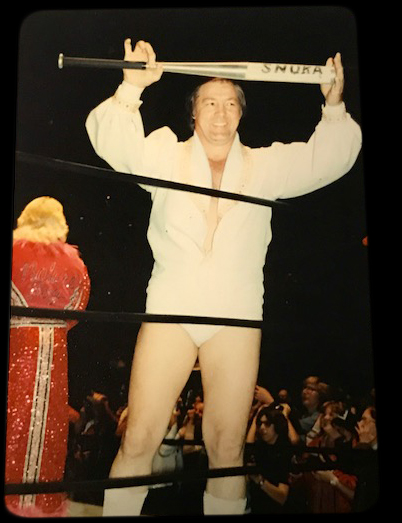
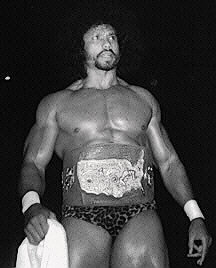


Woods answered, "Well, all it is, is just a 'Wanted' poster...I've been distributing these to all the arenas and to anybody that will take one from me. This is at my expense, they are free of charge to the people. I just want 'em to know, and I want especially Rogers and Snuka to know that I want 'em out of wrestling, and I'm gonna put 'em out of wrestling."

Tim then pulled out his baseball bat with Snuka's name on it, that he now referred to as his "ding-bat," and continued, "All I want is my hands on either one of 'em anytime I can get, and I will be carrying an equalizer here. It's not baseball season anymore as far as I'm concerned..." Landrum then interrupted, "It's a Louisville Slugger though!" Woods agreed, "It's a Louisville Slugger and I assure you they hurt me once, they hurt me twice, but they're not gonna do it again!

Tim Woods and his "Ding Bat"
Landrum then commented on Woods' recovery, "Well, I see you don't have the collar on and I'm glad of that; you must be progressing fairly well." Tim responded, "I'm comin' along real fine, I've taken the mask off and I said I'd leave it off until I settled the score. And if nothing else maybe that should make you believe that I mean what I say. I WILL settle the score. I'm a firm believer in doing unto others as they have done unto you. And Rogers and Snuka, you've got something coming and I'm gonna give it to you...that's all I've got to say." Rich then concluded the segment, "Thank you Tim Woods, Mr. Wrestling, glad to see him recovering too, and I know he means what he says."

Later during the same World Wide Wrestling television taping, Snuka and Rogers got equal time. Landrum addressed the fans as Rogers stood next to him holding one of the posters Woods had left behind."Jimmy Snuka, U. S. Heavyweight Champion, is here and his manager Buddy Rogers, and Tim Woods, Mr. Wrestling, was out here on the opening of the program...yeah, he had one of those 'Wanted' posters," Landrum stated.

Rogers countered about the 'Wanted' poster, "Well, I don't know if you people seen this thing but just imagine, this would be about the lowest thing you could do to a man in his livelihood. We've put a whole lifetime in wrestling, Snuka and I, and by golly we come in this business to be square shooters, straight guys, all the way. Well let me tell you, when a man can do what this man did, this is trying to deprive him of a livelihood, and trying to hurt him..."

That prompted a quick rebuke from Landrum, "Well that's exactly what you tried the do!" Rogers fired back, "Wait a minute! We hurt the man because he came out here and challenged us. Well, we got news for him, he'll wait a long time before he ever gets a shot at this man's title, because as long as I'm this man's manager I will guarantee you that he will never get that shot at the title...this man will have to be next to dead before he gives him that title shot."

Rich replied, "Well, I tell you Tim Woods has assured me that he's on his way back and he's gonna get some kind of revenge." Rogers scoffed at that idea laughing, "Like I said, I don't care where he's at...we don't fear him, we're ready for him anytime at all but before he gets a title shot, which I know he wants, he'll wait a long, long time. As far as Snuka and I are concerned, he'll never do nothin' to us...we're just too much for him to handle!"

The October war of words in this feud were boiling red hot, but they had finally reached their zenith. Tim Woods would return to the ring in a week's time, and the time for talking would be done. In November it would be action time!

Tim Woods returns to in-ring action...to be continued in Part 9!

(Special thanks to Brack Beasley for the photos!)

Saturday, September 08, 2018

"Mr. Wrestling" Tim Woods' Last Stand (Part Two)

by David Chappell
Mid-Atlantic Gateway

Catch up with everything you missed in PART ONE.
U.S Champion Jimmy Snuka


PART TWO

When Mr. Wrestling battled "Superfly" Jimmy Snuka on the World Wide Wrestling television show on September 5, 1979 it was the classic case of two against one. With Snuka's manager Buddy Rogers interjecting himself in the proceedings early and often, the masked man succumbed to Snuka, but unfortunately Mr. Wrestling lost more than a match...he lost his health in a scary series of events both during and after the bout.

Announcer Rich Landrum immediately after the match following a commercial break exclaimed, "Mr. Wrestling for all intents and purposes is not moving too well. Jimmy Snuka and Buddy Rogers while we were away for the commercial message really, literally attacked Mr. Wrestling again. So far as I have been able to determine he has not moved too well in the brief time that we were away."

At this juncture a number of other wrestlers came to the ring to check on the fallen masked man. Landrum observed, "Now perhaps some help is coming in to get Mr. Wrestling out. Ricky Steamboat, Ric Flair, Jim Brunzell, Blackjack Mulligan...and as you can see Snuka and Rogers didn't want to get down off the ring too much, not with these guys around. It looks like Mr. Wrestling's neck may be injured."

Things then began to break down between Rogers and Snuka and Mr. Wrestling's friends. Landrum blurted out, "Snuka's back in again and takes a stomp! Now it's Flair who's got Snuka, rams him into the turnbuckle." Rich continued, "Steamboat has Rogers backed into the corner...and it's a real donnybrook in the middle of the ring! We've got about six or seven wrestlers here; Rogers manages to get out and now Flair throws Snuka out of the ring!" The mayhem continued as Snuka then fell into the set knocking it partially over before grabbing his U.S. Championship belt and running backstage.

Mr. Wrestling
The focus then shifted to the injured Mr. Wrestling and the attempts to remove the masked man from the ring. Landrum noted, "Of course the important thing now if he does have a neck injury is not to move him around too much and let's keep him on an even plane...not move his neck and trunk around too much here." As the camera angle moved Rich observed, "There's Abe Jacobs, who is already in the ring, he's supposed to go up against the AWA champion Nick Bockwinkel and we have a delay in that match because obviously we don't want to have any further injury to Mr. Wrestling."

Landrum then opined on the recent episode, "Mr. Wrestling's a fine competitor; he was frankly taken advantage of. I don't like to say that but that is the case. He was out long before Snuka went after him with that guillotine hold that Rogers has taught him to use, and really he could have been pinned much sooner. This is really quite a serious thing to happen in professional wrestling, not just because of Mr. Wrestling because he is a fine competitor but I don't like to see any professional athlete injured. Whether you like them or not, it's still the way they participate and the way they make their living."

The concern over the condition of the fallen masked man was palpable in the ring, except from one quarter. Landrum explained, "Now they're still trying to move Mr. Wrestling out, very gently, very carefully...trying to get him over toward the ropes. Got to be very careful now men, don't want to create any more injury than what may have already been sustained. There's Nick Bockwinkel the AWA Champion looking on; I don't know if he's concerned or if that's just some type of look. No, apparently he's not too concerned about it. I think he just wants them to hurry up and get out of the ring so he can get his match started."

"World Wide Wrestling" announcer Rich Landrum


You could hear a pin drop as the hushed studio crowd saw a stretcher brought toward the ring. "They're still now attending to Mr. Wrestling; there you see Jim Brunzell, Ric Flair, Ricky Steamboat, Blackjack Mulligan," the announcer stated. "They have called for a stretcher to carry Mr. Wrestling from the ring and that's a very wise move. They do have him now on the flat surface of the ring. He's outside of the ropes so no further injury could hopefully be incurred in moving him. And they're doing it very quickly, trying to move him out of the ring," Landrum added.

An exceedingly rare on-camera appearance by the President of Mid-Atlantic Championship Wrestling Jim Crockett put in context how serious this injury situation was. Landrum noticed, "Coming now to ringside is NWA representative Jim Crockett, and they're trying to get the stretcher out now, get everything locked in place, got to open it up and get it locked in which is what they're doing." Rich continued his observations, "They will now then try to gently slide Mr. Wrestling over onto that stretcher and move him out. And of course as I say, the important thing is now not to move his neck or his back too much to keep him on an even plane so that he will not incur any more injury and this is what they're doing."

Landrum concluded this chilling segment by saying, "Now they have him on the stretcher and they are removing him from the ring and from the studio. And it does look like he has incurred some type of neck or back injury. I'm sure he'll be taken now to the hospital to be checked and if we do have any information on him from the hospital before the program's over we will pass it along."

Later, as the TV show neared its conclusion, Landrum confronted Rogers and Snuka about their dastardly acts. Rich told the fans, "Now joining me are Buddy Rogers, the U.S. Heavyweight Champion and his man Jimmy Snuka and Buddy I must say, that wasn't too respectable what you did to Mr. Wrestling." Rogers pointed at the Superfly and joked, "What I did to him? Here's the man that did it to him!" Landrum countered, "You say he only does what you say."

Buddy gleefully answered, "That's right, I told him what to do and he went out and did it...he did a better job than I thought he could do! When this man does a job, he does it to perfection. I told you that this man would be a champion; here he is, he has the title, he has everything I told him he would get. He listens to me; anybody that listens to me gets great results! You know, the proof is in the pudding. When you're around someone's that got ability, naturally it rubs off and this man's gonna be the next...not only is he the champion but a champion a long, long time!"

So when the September 5, 1979 edition of World Wide Wrestling went off the air it seemed the new U.S. Champion Jimmy Snuka and his manager Buddy Rogers had dispatched the challenge of Mr. Wrestling with ease, putting the masked man out of wrestling indefinitely, if not forever, in the process. But as the late summer of 1979 turned into fall, if Rogers and Snuka truly believed they had sent Mr. Wrestling to the dust-bin of Mid-Atlantic Championship Wrestling history, they were in for a rude awakening in short order!

Mr. Wrestling returns without his mask and vows revenge on Buddy Rogers and Jimmy Snuka...to be continued in Part 3!


http://bookstore.midatlanticgateway.com