Showing posts with label NWA World Championship. Show all posts

Friday, May 03, 2024

Walking With Ghosts

Origins of the National Wrestling Alliance
The building, the match, the belt.


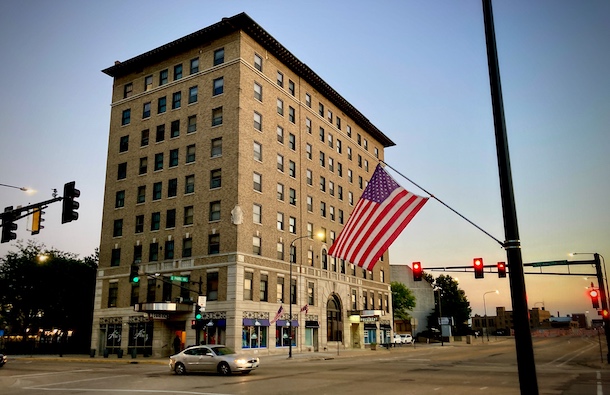
 The Hotel President, Waterloo, IA (2022)


PART ONE: Walking with Ghosts: A Visit to the Birthplace of the NWA
The Hotel President in Waterloo, Iowa, hosted a group of regional wrestling promoters as they got together to form the National Wrestling Alliance in 1948. That building still stands and bears that name. Take a look inside and see where this famous meeting took place and who was there.


PART TWO: Waterloo: The First Ever NWA World Heavyweight Title Defense
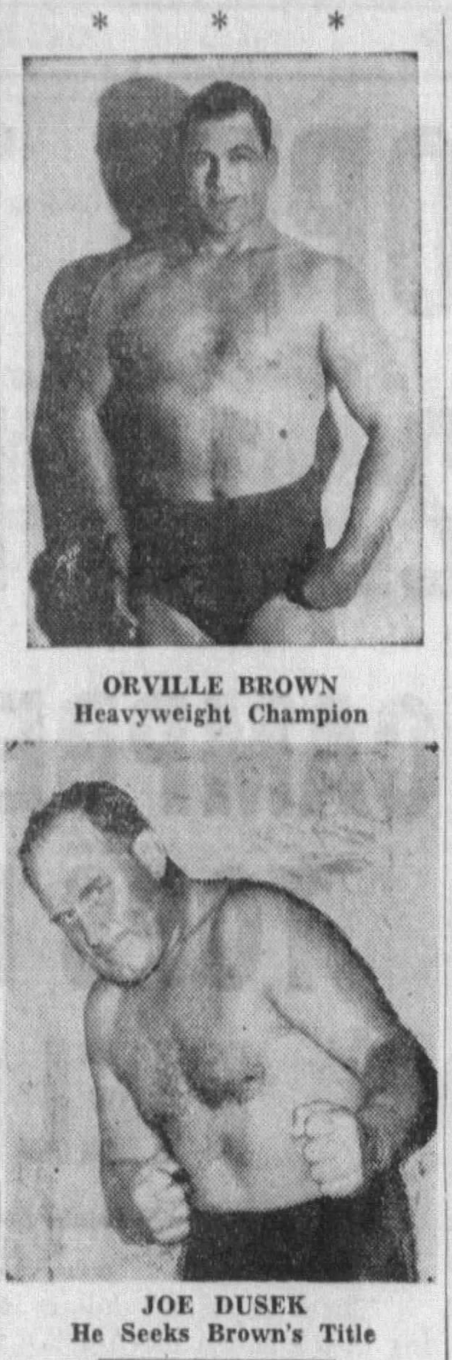
Orville Brown defeats Joe Dusek in a match held hours after the National Wrestling Alliance is chartered in Waterloo, IA. Brown had been selected by the NWA's founding fathers in 1948 as the the organization's first champion, making the match the unofficial first defense of the NWA Championship. The NWA dignitaries were in attendance. See all the details.


PART THREE: Orville Brown and the First NWA Title Belt (1948)
On the night of the first unofficial NWA title defense, Midwest Wrestling Association champion Orville Brown successfully defended the title wearing the MWA belt to the ring. That very belt would later be modified to represent the new NWA organization's championship. See photos of the belt before and after, plus the rest of the story.


Saturday, March 04, 2023

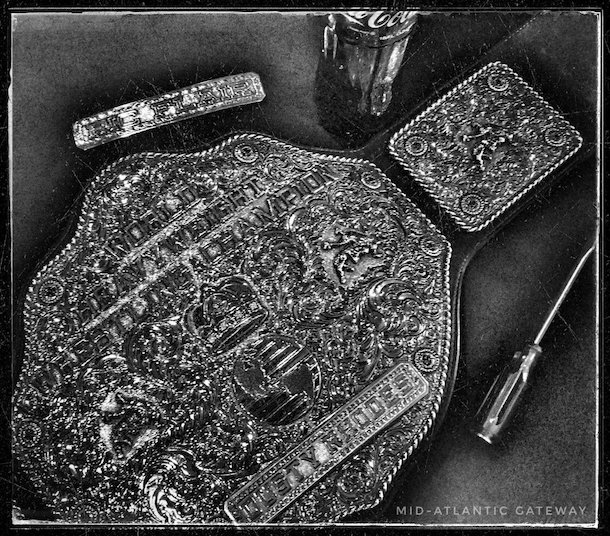
The Big Gold Nameplate Exchange


By Dick Bourne
Mid-Atlantic Gateway

Take a look at the image above and just imagine Klondike Bill’s workbench in his shop behind the office on Briarbend Drive a few days after the Great American Bash in Greensboro, July 26, 1986.

Yes, that's the Dusty Rhodes nameplate on the original 1986 Big Gold belt. It was rumored to not have existed. Jim Crockett told us on television that next Saturday afternoon that a nameplate for Dusty had been ordered and would be on the belt soon. But we never saw it, and most of us never believed it. As fans, we all were pretty confidant Ric Flair would get the Big Gold belt back soon and his iconic nameplate would go back on the belt. So we figured, why would they go to the trouble and expense behind the scenes of ordering a new nameplate?

But the Dusty nameplate was indeed ordered. And it was delivered. It just didn't make it in time for Dusty to have it on the belt when he was NWA champion for the third and final time. 

We verified the order later with the actual Crumrine order form and art work (it's all in the Big Gold book by the way - - thank you Teddy Srour.) But what we didn't know when the book was published was that the Dusty nameplate had actually been made until Cody Rhodes posted about it on Twitter several years ago. (See that story: American Dreams Come True.) Cody found it in a cigar box when going through his dad's belongings after Dusty had passed.

The original photo above was taken by Clint Beckley, and we created the special fantasy image above.   

See also: Big Dust, Big Gold

Edited and expanded from an original Twitter and Gateway post in September 2022.

Tuesday, February 07, 2023

NWA Belt Art Revisited (David Williams)

The fourth and final version of the original 1973-1986 NWA World Championship belt, the "Ten Pounds of Gold."
The final version featured new leather with a slightly different cut around the center plate
and a fourth and final different flag configuration.


PART 5
by Dick Bourne, Mid-Atlantic Gateway
Art by David Williams

ORIGINAL ARTICLES FROM 2019
PART ONE : Introduction & History of the Project
PART TWO: The Red Velvet
PART THREE: Black Leather and Dented Globe
PART FOUR: New Globe, Refurbished Plates
PART FIVE
: The Final Version of a Classic

We pick up where we left off in Part 4:

Not long after Harley Race defeated Terry Funk for the title in Toronto in February of 1977, the refurbished and repainted plates were attached to a brand new cut of leather. This new leather strap had a different style of lacing and was cut slightly different, the main change being that the cut of the leather did not follow the shape of the main plate as closely as the old leather did, which tightly hugged the upper edge of the main plate (as seen in the image at the top of Part 3.)

Pretty soon, however, the plates began to show the same wear and tear as the earlier version of the belt did. The globe was badly dented again, and paint began flaking off the plates in different areas. Most noticeably, some of the segments of ornamental "beads" around the edge of the main plate began to break off as well.

The look of the belt in its last years: dented globe (again), missing beads, missing paint, missing eyelets.

Let's face it, after several years of observation, it was clear that this type of construction for a ring used title belt just didn't make much sense. Those bead-sections were each attached individually with 4-6 beads to a section. And many of them were getting broken off the belt.

In addition, some of the faux eyelets and snaps broke away from the belt, too. By the time Jim Crockett had the new "Big Gold" belt made in 1986, the old Ten Pounds of Gold was in pretty rough shape.

An illustration of the shape the belt was in at the end, with the busted lacing and missing paint.

Artist David Williams has done an incredible job of recreating every version of the belt, with sub-versions illustrating the damage to the belt in later years.

The following chart shows the progression of the belt from its original configuration in 1973 to it's final look in 1986.

The final progression chart.


The book "Ten Pounds of Gold" that I authored with Dave Millican lays out in great detail all four versions of the NWA "domed-globe" belt. (There is a detailed flow chart summarizing those versions in pp. 70-71 of the book.)

My thanks to computer artist extraordinaire David Williams for the amazing work he did on all the different versions of the famous domed-globe belt.

PART ONE : Introduction & History of the Project
PART TWO: The Red Velvet
PART THREE: Black Leather and Dented Globe
PART FOUR: New Globe, Refurbished Plates
PART FIVE
: The Final Version of a Classic
Final Progression Chart

 Originally series published on the Mid-Atlantic Gateway in July of 2019


Friday, February 03, 2023

U.S. Champion Terry Funk

Edited from Original NWA Promotional Photograph
 

If you are looking at this photograph and thinking to yourself, "Wow, I've never seen a photo of Funk with the old Crockett U.S. title belt," well - - you still haven't.

You see, even to this day as of this writing, there has never been a legitimate photo to surface of Terry Funk wearing the Crockett/Mid-Atlantic Wrestling version of the U.S. title belt. The night he won the championship in a tournament in Greensboro in 1975, the actual belt wasn't present and they used a stand-in (a WWWF tag belt of all things.) Funk then only wore the original belt to the ring one time, in his first defense on Thanksgiving night against Paul Jones, the man he beat in the finals of the aforementioned tournament. While there certainly had to have been a photo taken by the wrestling media that night, one has never surfaced, and believe me  - - we have searched long and hard. One may show up one day.

The above photo is a well done photoshopped image originally from a mid-1970s promotional photograph when Terry Funk was NWA World Heavyweight Champion. In the original, Terry is wearing the "domed-globe" NWA title belt. Longtime Mid-Atlantic Wrestling fan Steven Chandler (aka Jesse Santana in his wrestling persona) did a great job in modifying the photo to have Terry wearing the Crockett version of the U.S. title belt from that same era. It gives us all a great idea of what Terry would have looked like wearing that classic cast U.S. title belt.

Funk briefly held that U.S. title in November 1975, in the weeks leading up to his historic win over Jack Brisco for the NWA World title in Miami Beach, FL in December 1975. It was all part of classic booking from that era to simultaneously build Funk up as top world title contender as well as establish Paul Jones as U.S. champion and the #1 contender for Funk's world title when he would later win it. 

You can read more about the famous tournament Funk won in Greensboro to win the U.S. title, as well as the aftermath that Thanksgiving, in our feature on its 40th Anniversary published back in 2015. You can also read about my brief interaction with Funk at the NWA Wrestling Legends Fanfest in Charlotte in 2010 where he posed for a photo with a cast replica of the U.S. belt. 

Tuesday, October 04, 2022

NWA Champion Jack Brisco / Japan Coverage 1973


Tiger Conway, Sr. straps the brand new NWA world championship belt around the waist of Jack Brisco moments after he defeated Harley Race in Houston, July 20, 1973.
 
Originally published on the Domed Globe website in February 2015. 

Thursday, September 29, 2022

NWA champion Giant Baba (1979)


Giant Baba in the locker room after his victory over Harley Race for the NWA World Championship in Nagoya, Japan, 1979. 
 
Originally posted on the Domed Globe website.

Saturday, August 20, 2022

Orville Brown and the First NWA Title Belt (1948)

PART THREE IN THE 1948 NWA WATERLOO HISTORY SERIES
by Dick Bourne
Mid-Atlantic Gateway

The NWA's early history with the various belts that represented their world heavyweight title is a bit odd, because even though the organization was formed in 1948, they didn't actually own their own title belt until 1959, as outlined in the book Crown Jewel (available on Amazon and from the Mid-Atlantic Gateway Book Store.) Before that, they used various belts that belonged to others.

In an earlier article, I wrote about my pilgrimage to the Hotel President in Waterloo, Iowa, and the historic events of July 18, 1948 at a wrestling card in that same city.  July 18, 1948, is a day that holds a special place in pro wrestling history, as a group of five Midwest wrestling promoters led by Iowa promoter Paul "Pinkie" George met at the Hotel President to forge the documents that chartered the National Wrestling Alliance. Later that night, they all attended a card at Waterloo's Electric Park that featured a heavyweight title defense by Orville Brown against Joe Dusek, a match which I argue was the first de facto defense of the NWA World Heavyweight Championship.

THE BELT
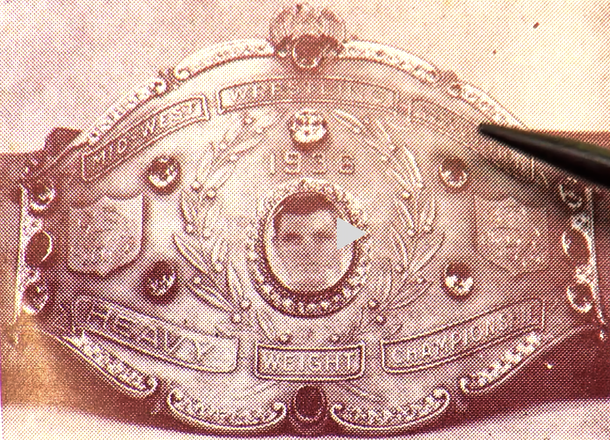
The first belt used as the NWA Heavyweight title belt was actually a modified belt created in 1936 that had been used to recognize an earlier claim to the world championship. It was the Midwest Wrestling Association (MWA) belt, and it was the belt worn into the ring in Waterloo on July 18, 1948 when champion Orville Brown defended against Joe Dusek. Brown was the MWA Heavyweight Champion at that time as recognized by the MWA based in Kansas City. But because of the events at the Hotel President earlier in that day, it was in a practical sense the first defense of the new National Wrestling Alliance title.


Screen capture / pbs.org
 

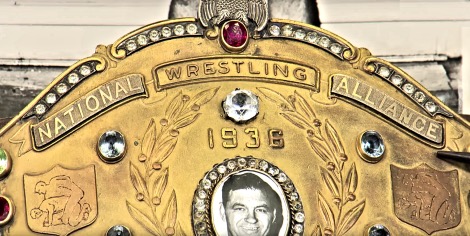
The MWA championship belt (seen in this late 1930s photo above with champion John Pesek's photo) was modified to represent the name of the new NWA organization by placing new plates that said "National" and "Alliance" over "Midwest" and "Association," the the original words cast on the belt.

Screen capture / pbs.org


If you look closely at the image above, you can see the two new National Alliance script plates attached where Midwest and Association were. That's champion Orville Brown's photo in the center oval.

ORVILLE BROWN AND LOU THESZ
Brown wore this modified belt as NWA World Champion until his career was tragically cut short by an automobile accident in late 1949, just weeks before a scheduled title unification match with Lou Thesz, who was also a claimant to the world title out of St. Louis. At that point Thesz was recognized as NWA champion. He began using his own world title belt that he had been presented by St. Louis promoter Tom Packs in 1937 (known commonly now as the "Thesz belt") to represent the NWA world title belt from that point forward. 

The "Thesz belt" was recognized as the NWA title belt until 1957 when Thesz stepped down as NWA kingpin, losing the title to his handpicked successor Dick Hutton. Thesz owned his belt and did not allow the NWA to keep using it as their title belt, taking it with him on tour of the far east. Hutton, known as the champion without a belt, briefly used promoter Al Haft's WLW-TV title belt as his championship belt during his reign. The NWA finally had their own belt made in 1959 (the belt covered in my book Crown Jewel), the first belt the NWA actually owned, presented to then champion Pat O'Connor.


For more on the Midwest Wrestling Association / National Wrestling Alliance belt, see this feature from the Antiques Roadshow on PBS.
  Thanks to William Murdock for his assistance with this article. And thanks as always to Tim Hirnbaker and his book "National Wrestling Alliance."

Sunday, August 14, 2022

Waterloo: The First Ever NWA World Heavyweight Title Defense

PROMOTERS ATTEND CARD OF "NATIONAL IMPORTANCE"
PART TWO IN THE 1948 NWA WATERLOO HISTORY SERIES
by Dick Bourne
Mid-Atlantic Gateway

It certainly wasn't official, but I enthusiastically put forth the argument that the first ever defense of the National Wrestling Alliance World Heavyweight championship was on the very evening following the formation of that alliance.

In an earlier article, I wrote about my pilgrimage to the Hotel President in Waterloo, Iowa, while attending the 2022 Induction Weekend of the Tragos/Thesz Professional Wrestling Hall of Fame. The Hotel President holds a significant place in pro wrestling history.  On July 18, 1948, a group of five Midwest wrestling promoters, led by Iowa promoter Paul "Pinkie" George, met there where they forged the documents that chartered the National Wrestling Alliance. But that wasn't all the group did on that historic day.  

That very Sunday evening, this group attended a wrestling card in Waterloo promoted by Pinkie's brother, Andy George. That card featured a world heavyweight title defense (Midwest Wrestling Association version) by Kansas City's Orville Brown against the top contender, Nebraska's Joe Dusek.  

The Waterloo Courier newspaper had several mentions in the week leading up to July 18 of the gathering to attend the matches at Warerloo's Electric Park, but no mention was made of the real reason they gathered along the shores of the great Cedar River, which was the meeting to discuss forming an official alliance.

SPECIAL GUESTS RINGSIDE
On the Friday before the Sunday wrestling card, the Courier reported that attending the matches would be a group of distinguished promoters including Fred Kohler of Chicago, Pinkie George of Des Moines, Max Clayton of Omaha, Sam Muchnick of St. Louis, George Simpson of Kansas City, and Wally Karbo representing Tony Stecher of Minneapolis. Karbo got a booking out of the trip, too, as the referee for the world title tilt between Orville Brown and Joe Dusek.

As it turned out, Simpson was not at the Waterloo combine, but Orville Brown was. Brown, while as champion, was also a partner in Simpson's Kansas City office. It isn't clear why Simpson wasn't there, but he would later be a signatory at the second meeting of these same promoters in Minneapolis in September.  

Fred Kohler also did not attend due to a prior commitment, but consented to the agreements made that day by telegram.

FIRST NWA TITLE DEFENSE
One of the covenants agreed to at the Waterloo meeting was that the allied promoters would recognize one single world heavyweight champion, Orville Brown. It is fair then to say that Brown's heavyweight title defense that night can be considered the first ever title defense of the National Wrestling Alliance World Heavyweight Championship. It surely was not declared officially as such, but it was - - in essence - - exactly that. The Alliance had been formally founded and Brown had been named its champion only hours earlier. Brown walked into the ring against Dusek that night at Electric Park with the official recognition of the allied promoters as NWA world champion, even if the five people that met earlier in that Waterloo hotel conference room were the only ones who knew it at that point. 

Brown successfully retained his title that night. The undercard included Jr. Heavyweight champion Billy Goelz of Chicago topping Mashall Estep out of Missouri. Otto Kuss of Minneapolis took the opener from Nebraska's Danny Plechas. 

Promoter Andy George had called this event "a card of national importance" in the hype leading up to the July 18 program at Electric Park. Most of that hyperbole regarded the dignitaries attending the world title event. But even Andy was likely unaware of the significance of the main event that night in Waterloo. 


COMING UP NEXT
In PART THREE, the final post in this series, I'll take a look at the belt that likely was used as the first NWA title belt, modified from the Midwest Wrestling Association belt Orville Brown wore at the time of the chartering of the NWA.

See also: Part One - Walking with Ghosts: A Visit to the Birthplace of the NWA
 

* * * * *

BULLDOG PLECHAS
In an unrelated side note, I was delighted to see the name of "Bulldog" Danny Plechas on this card. Pleachas must have been somewhat of a memorable character throughout the years as Blackjack Mulligan would occasionally mention him in his local promos in the Mid-Atlantic area in the 1970s. Occasionally Plechas would sarcastically be included on a list of challengers Blackjack claimed he was willing to face for his U.S. title. Other times he would mention him as someone he'd had a fight with out behind the Mesquite Club at 1:00 AM on a Saturday night. For some reason, I remembered Bulldog Plechas and was happy to come across his name on such a historically significant card, even if the true historical significance really wasn't known at the time.   

*****

Special thanks to Tim Hornbaker and his book "National Wrestling Alliance."

Wednesday, June 22, 2022

The Brisco Reign Begins: Hand Raised in Houston (1973)


Ring announcer Boyd Pierce raises the hand of a triumphant Jack Brisco moments after Brisco defeated Harley Race for the NWA World Heavyweight championship on July 20, 1973 in Houston, Texas. A dejected Race is seen in the corner behind them.

NWA President Sam Muchnick is at left. He had attended the card that night in Houston and brought the new NWA World title belt with him. It was presented to Race before the match, but he didn't have a chance to enjoy the new belt, as Brisco took the 2-out-of-3 fall match and the championship laurels that night.

Although hidden behind Brisco in this photograph so you can't see him here, it is Tiger Conway, Jr. who is strapping the belt around the new champion's waist.

A wonderful photograph, perhaps taken by promoter Paul Boesch who took many photos that night, featured in an issue of Gong Magazine in Japan.


Originally published in January 2019 on the Mid-Atlantic Gateway's Domed-Globe website. 
 

Tuesday, June 21, 2022

NWA World Champ Kerry Von Erich Tours Florida (1984)


When Kerry Von Erich won the NWA world title in 1984, he fulfilled the appearance contracts of the previous champion Ric Flair, which included dates in the state of Florida for Championship Wrestling from Florida. 


NWA Champ Kerry with Coach John Heath on the set
of Championship Wrestling from Florida

The magazine from Japan seen below features a photo on the cover taken during that Florida tour of Kerry sporting the Ten Pounds of Gold with Florida heavyweight champion Billy Jack Haynes.  


Thanks to Brian Rogers for providing the cover image.

Thursday, June 09, 2022

Poster: Flair vs. Anderson at Cincinnati Gardens


by Brack Beasley
Mid-Atlantic Gateway Contributor

This poster promotes a card held at the Cincinnati Gardens, a venue rich in professional wrestling history. Held on Friday, October 16th, 1981, both the NWA World Heavyweight Championship and the United States title were on the line. 

Ric Flair, still riding high only one month into his first reign with the Ten Pounds of Gold, took the challenge of cousin Ole Anderson, while Sgt. Slaughter would defend his belt against Johnny Weaver. 

The big names didn't stop at the main events as the rest of the lineup included Wahoo McDaniel, Roddy Piper, Greg Valentine, Ivan Koloff, Jay Youngblood, and Bad Leroy Brown. No doubt an exciting night of wrestling for the fans in Cincinnati.

With a horizontal layout, the poster has red and black print over an ultra bright yellow background and great images of Flair, Wahoo, Koloff, and the Andersons. It's especially nice to see the full body image of Flair in my personal favorite Olivia Walker robe.

 NO. 35 IN THE BEASLEY POSTER SERIES

* * * * * * * * * * * *

Mid-Atlantic Gateway Notes
by Dick Bourne

Cincinnati was an interesting town for JCP, as it fell outside their usual territorial footprint at the time. It was really more a Georgia Championship Wrestling town when Georgia had started running Ohio, Michigan, and West Virginia after it had been basically abandoned by the Sheik's Detroit promotion. Their cards were promoted off of Superstation WTBS. But Crockett had a TV outlet there that did pretty well, and booker Ole Anderson, who was booking both Mid-Atlantic and Georgia territories at the time, stacked the Cincinnati cards with more Mid-Atlantic talent than he did Georgia talent for awhile. 

Anderson booked himself as Ric Flair's first regular title challenger in the Mid-Atlantic territory. The Andersons had been in a bitter feud with Flair the entire summer of 1981 before Ric won the NWA title in September, and so Ole made a natural choice as Flair's challenger plus it was a continuation of the on-again / off-again family feud between Flair and his cousins that had been going on since 1976. Flair and Ole headlined cards all over the reach of JCP including Cincinnati, Buffalo, NY, Savannah, GA, and all across the traditional Mid-Atlantic territory.

Wahoo McDaniel and Roddy Piper was the most heated feud in the territory at that point, coming off Piper's hiring of Abdullah the Butcher a month and a half earlier to attack Wahoo on TV which resulted in Wahoo being injured and being stripped of the U.S. title for failing to defend against Piper, even though it was Piper who had hired the Butcher. The U.S. title had been placed in a tournament.

And speaking of that U.S. title tournament, Sgt. Slaughter, a newcomer to Jim Crockett Promotions, was just coming off his big surprise tournament win of the United States Championship less than two weeks earlier. Johnny Weaver was his early opponent in lots of towns across the Mid-Atlantic territory helping to establish Slaughter as a top heel, including this card in Cincinnati.

A great card in the Queen City!

Wednesday, May 11, 2022

Texas Sized Memories of the NWA Tilte

Memories of Texas Stadium 1984:
Ring jacket, replica belt, Texas flag, and yellow roses.


by Dick Bourne
Mid-Atlantic Gateway

The month of May in 2022 marks the 38th anniversary of the brief NWA World title exchange between Kerry Von Erich and Ric Flair. Kerry won the title on May 6, 1984 at Texas Stadium in Irving, Texas. He dropped the title back to Flair in Yokosuka, Japan on May 24, 1984.

Kerry's victory was at the "Parade of Champions" show that honored Kerry's brother David, who had passed away earlier that same year.

The photograph above contains several iconic elements, not the least of which is the original ring jacket Kerry wore in the ring the day he won the title. The belt is a Dave Millican replica of the National Wrestling Alliance world championship belt, affectionately known as the "domed globe" or "the ten pounds of gold." The belt and jacket are adorned with the Texas flag and yellow roses, all of which call back to that memorable and emotional day in Texas Stadium.

The book "Ten Pounds of Gold" features dozens of photos of the original NWA belt shot especially for the book, one with the original Kerry Von Erich ring jacket paying tribute to his late brother David, the belt and the jacket reunited at the time of the photo in 2008 for the first time in 24 years. I've always loved this photo above, though, taken the following year that featured the flag and the yellow roses with Dave's replica. I've always regretted not thinking to do that when I shot the original belt and robe together for the book.

Republished in edited form in May 2022 on the Mid-Atlantic Gateway.

http://midatlanticwrestling.net/nwabelt.htm

Friday, May 06, 2022

New NWA Champion Dusty Rhodes Wrestles on Wide World Wrestling


In July of 1981, the new NWA World Heavyweight Champion Dusty Rhodes made his first appearance with the ten pounds of gold on World Wide Wrestling. Rhodes had defeated Harley Race for the honors weeks earlier in the Omni in Atlanta, GA. Commentators Rich Landrum and Johnny Weaver called the action as Rhodes battled Jim Nelson in the cozy confines of WRAL TV studios in Raleigh. 

Video from that era is very rare, but through the magic of a vintage audio recording, we present Dusty's first appearance on Mid-Atlantic area television as NWA World Champion.


NWA World Champion Dusty Rhodes on World Wide Wrestling

Audio from the collection of David Chappell.

Friday, April 22, 2022

The NWA Champions Remembered in Japan

http://midatlanticwrestling.net/nwabelt.htm


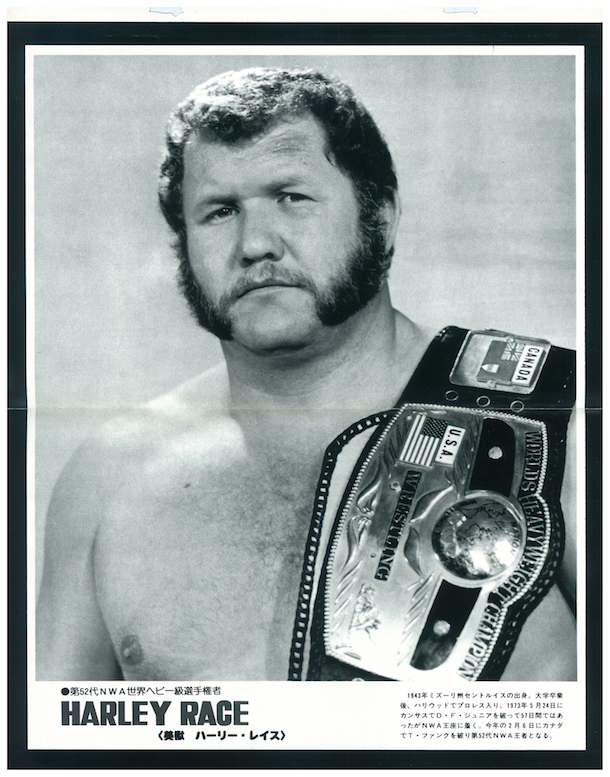
The Japanese magazines still do an excellent job of remembering the old NWA champs. These are images from a special section of a magazine in Japan that looked back at the history of the NWA World title and presented a special interview with Harley Race.


Originally published April 2016 on the Mid-Atlantic Gateway.

Monday, March 21, 2022

Gene Anderson gets One Last Shot at the NWA World Champioinship

by Dick Bourne
Mid-Atlantic Gateway 

The great Gene Anderson, original founding member of the famous Anderson family in wrestling, was never known for his singles competition. He was primarily known for being part of a famous tag team known as the Minnesota Wrecking Crew with two different worked-brothers: Lars Anderson in the 1960s and Ole Anderson in the late 1960s through the early 1980s.

Photo courtesy of WrestlerWeekly.com
@wrestlerweekly on Twitter
Gene was the silent killer of the team, letting his braggadocious, loudmouth, younger brothers do all the talking. Les Thatcher once noted while calling an Anderson Brothers match on Mid-Atlantic Championship Wrestling in 1975:

"As Teddy Roosevelt said, 'Talk softly and carry a big stick.' You'll hear very little out of Gene Anderson," Thatcher quipped. Gene Anderson carried a very big stick in the Minnesota Wrecking Crew.

The Andersons were no strangers to tag team championships. They held multiple regional and world championships over several decades. But it was somewhat of a rare occurrence when Gene Anderson received a shot at the NWA World heavyweight singles title.

He received a few in the early 1970s against champion Dory Funk, Jr., in towns like Norfolk, Richmond, and Raleigh for promoter Joe Murnick, who more than others apparently saw value in putting Gene in the ring on top with Funk.

But after those shots in 1970 and 1971, Gene Anderson's days as a contender for the World heavyweight singles title ended. To my knowledge, he never got a shot at Harley Race, Jack Brisco, or Terry Funk throughout the remainder of the 1970s. (Please correct me if I am wrong about that.)

And then suddenly, almost exactly 10 years after his last NWA title shot on July 7, 1971, Gene gets one last shot at the title again, this time against new champion (and long time rival in the tag team wars) Dusty Rhodes on July 11, 1981 in Spartanburg, SC.


http://midatlanticwrestling.net/andersons.htm

Admittedly, on the surface the booking of this match doesn't make a whole lot of sense. Throughout his career, Gene was predominantly a tag team wrestler and never was in the mix for singles titles. Ole as an opponent made more sense, and indeed Ole was getting several shots at Rhodes during this time. Ole had the long running singles feud with Dusty, particularly in the Georgia Championship Wrestling area. He could also deliver a better promo to promote the match.

Gene Anderson, Bob Caudle, and Ole Anderson
This Spartanburg card was a matinee show at 3:00 PM. Ole is not listed on it, so it's likely he was booked on another spot show town on a matinee card. I've not been able to find a record of any such show at this point. Both Ole and Gene reunited later that same evening in Charlotte for a defense of their NWA World tag team championship against Ricky Steamboat and Bad Bad Leroy Brown. Rhodes and the NWA title weren't on that Charlotte show, so it's safe to assume Rhodes defended the title in some other Crockett town that Saturday night,  but I've not come across any record of a title defense for Rhodes that night.

The Spartanburg newspaper reported the following day that Rhodes had defeated Anderson in the main event. In other action on that 7/11 Spartanburg card, Bad Bad Leroy Brown defeated the Iron Sheik. No other results were listed.


This would be Gene's last shot at the NWA championship. He never got another shot after that, at least none that we have ever come across. (As always, we welcome additional information.) He and Ole were also in their final run as NWA World tag team champions. I kind of like knowing this one last, odd singles title shot was against Dusty Rhodes, who had a long and storied rivalry and feud with the Andersons.

If you've hung around the Mid-Atlantic Gateway for very long, you know we are big fans of the Anderson Brothers. This is a nice little rare piece of Anderson lore to hang on to.


* * * * * *
Thanks as always to Mark Eastridge for the newspaper clippings. Thanks to Scottie Richardson at WrestlerWeekly.com for the poster image. Thanks also to Brack Beasley.

Originally published on the Mid-Atlantic Gateway in July of 2017, and republished in 2018 and 2020 as part of our Classic Poster Series. 

http://horsemen.midatlanticgateway.com

Tuesday, February 15, 2022

Dr. Tom Prichard: The Night Brisco Became NWA Champion

by Dick Bourne
Mid-Atlantic Gateway

Back in 2012, while surfing the internet, I came across a great article by pro-wrestling superstar Tom Prichard on his "Doctor's Note" blog. I originally wrote about it on the Domed Globe website, and I am now posting it on the Gateway as well.

Tom Prichard's ticket stub for wrestling at the
Sam Houston Coliseum, July 20, 1973


In his article "Harley Race vs. Jack Brisco: The Night Brisco Became NWA World Champion", Prichard looks back at the significance the date July 20, 1973 had for him in several ways, not the least of which was the historic title change between Race and Brisco, but also the night the belt known as "the ten pounds of gold" was first presented to the champion.

Prichard, who grew up in El Passo, TX, watching wrestling out of the Amarillo territory, was there in Houston that night and the pomp and circumstance surrounding the big night left a lasting impression on him. I greatly enjoyed his first hand account.

Included in the article are images of the actual newspaper reports that week (not reproductions) as well as programs, magazines, and his row 12, seat 8 ticket stub. This stuff is very cool to me.

Many of the clippings seen in Prichard's post are also featured in the "Ten Pounds of Gold" book, copies of which were provided by Harley Race.

Click the link the below to go to Tom Prichard's blog and relive the night history was made in Houston.


Dr. Tom's blog is "The Doctor's Note" and is located here:
 
 Originally published on the Domed Globe website in October of 2012
 

Sunday, February 06, 2022

Florida's Role in the Race/Funk NWA Title Change in Toronto

Today (February 6) marks the anniversary of Harley Race's historic NWA title win over Terry Funk in Toronto, Canada, that took place on February 6, 1977. It was Race's second NWA title win, with six more to come over the next seven years.

Forgotten by many is the key role Championship Wrestling from Florida played in the key events that led up to title change in Toronto.

The following is an article about all of that magic originally published on The Domed Globe website and republished on the Mid-Atlantic Gateway in May of 2021.


by Dick Bourne
Mid-Atlantic Gateway

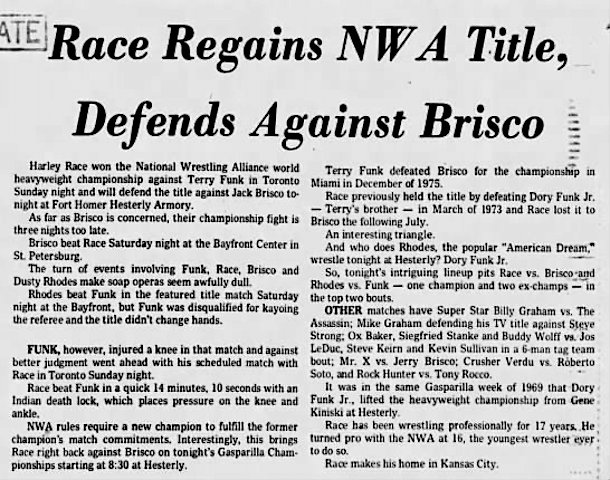
We're always appreciative of newspapers that do a good job of presenting wrestling in a journalistic fashion. This is a particularly good article in the Tampa Tribune promoting an upcoming card for Championship Wrestling from Florida on February 8, 1977, just two nights after Harley Race defeated Terry Funk with an Indian deathlock to win the NWA World Heavyweight Championship. 

Who knows who wrote the piece. It doesn't really sound like it came from the office, but it sounds way too informed to be written by the a staff sports writer either.

The article captures all the complete twists and turns in the wonderful story leading up to this night at the fabled Fort Homer Hesterly Armory. There were actually two separate stories being told.

The first story cemented former champion Jack Brisco as Florida's top contender for the NWA title. Many of the fans coming to the Hesterly Armory that Tuesday night had witnessed Brisco cleanly beat Harley Race, also a former champion, that past Saturday in St. Petersburg. Surely Brisco could beat Race again, this time with his newly won NWA World championship at stake in Tampa.

The second story told answered a question many might have had following the finish to the title change match in Toronto. As a teenage fan watching wrestling in 1977, when the film of the match from Toronto was shown on Mid-Atlantic television, it seemed strange to me that Race had won by submission with an Indian deathlock. I had only ever seen our local hero Paul Jones win with that hold. In the wrestling magazines, it seemed the reports usually suggested Race typically won with various suplexes or his infamous flying headbutt from the top turnbuckle, resulting in wins by three-count pinfall. Why had Race instead gone for the submission for the win against Funk in Toronto? 

The answer, it turned out, played out the night before in Florida.

The main event of the card in St. Petersburg on Saturday night was Terry Funk defending the NWA title against Dusty Rhodes. As the article above reports, Funk injured his knee in the match against Rhodes, and "against his better judgement" went ahead with the scheduled title defense against Race the next night in Toronto.

The rest, as they say, is history. Race knew what most fans didn't about the night before in the St, Petertsburg Bayfront Arena. Funk was hurt, and Race took advantage. He defeated Funk in 14:10 with an Indian death-lock to capture the gold belt. (I can still hear ring announcer Norm Kimber make the famous call.) It was a hold Race used infrequently (if ever?) and seemed almost out of place as it happened that night in Maple Leaf Gardens.

As the author of the article pointed out. Brisco's victory over Race in St. Petersburg came three days too early. Race got the better of him in Tampa this night to retain.  

  • SAT FEB 5, 1977 - St. Petersburg, FL - NWA Champ Terry Funk injures his knee in a successful world title defense against Dusty Rhodes. On the same card, Jack Brisco defeats Harley Race.
  • SUN FEB 6, 1977 - Toronto, ON - Harley Race defeats Terry Funk to win the NWA World Title. Race deploys a rarely-used Indian deathlock to win the match, exploiting Funk's hurt knee from the night before in St. Petersburg.
  • TUE FEB 8, 1977 - Tampa, FL - New NWA Champion Harley Race defeats Jack Brisco to defend title, the result of the match written about in the article seen above.

The injury to Funk's knee in St. Petersburg gave Funk an excuse he could bandy about after his loss to Race in Toronto the next night.

The article also colors between the lines nicely, accurately reporting key dates in the NWA title history of Brisco and the Funk Brothers, and even including a reference to an NWA title change in the same building eight years earlier to the week.

It's just an all around amazing piece to be found in a newspaper, and one of my favorite clippings from the history of the NWA title changes during the domed-globe era. And for those curious, it explains one of the mysteries about the historic Toronto finish some fans may have had at the time. 

* * * * * 

Video of Harley Race's win over Funk in Toronto can be found on the Domed-Globe website here.

See three pages from the Florida program "The Grapevine" for the Feb. 5 show in St. Petersburg that set the stage for Toronto. (Thanks@bobbynorton9115 on Twitter.)  

This article was originally posted on The Domed Globe in May 2021 and the Mid-Atlantic Gateway that same month.

Thursday, May 20, 2021

A Story Well Told: Florida's Role in the Race/Funk NWA Title Change in Toronto (1977)


by Dick Bourne
Mid-Atlantic Gateway

We're always appreciative of newspapers that do a good job of presenting wrestling in a journalistic fashion. This is a particularly good article in the Tampa Tribune promoting an upcoming card for Championship Wrestling from Florida on February 8, 1977, just two nights after Harley Race defeated Terry Funk with an Indian deathlock to win the NWA World Heavyweight Championship. 

Who knows who wrote the piece. It doesn't really sound like it came from the office, but it sounds way too informed to be written by the a staff sports writer either.

The article captures all the complete twists and turns in the wonderful story leading up to this night at the fabled Fort Homer Hesterly Armory. There were actually two separate stories being told.

The first story cemented former champion Jack Brisco as Florida's top contender for the NWA title. Many of the fans coming to the Hesterly Armory that Tuesday night had witnessed Brisco cleanly beat Harley Race, also a former champion, that past Saturday in St. Petersburg. Surely Brisco could beat Race again, this time with his newly won NWA World championship at stake in Tampa.

The second story told answered a question many might have had following the finish to the title change match in Toronto. As a teenage fan watching wrestling in 1977, when the film of the match from Toronto was shown on Mid-Atlantic television, it seemed strange to me that Race had won by submission with an Indian deathlock. I had only ever seen our local hero Paul Jones win with that hold. In the wrestling magazines, it seemed the reports usually suggested Race typically won with various suplexes or his infamous flying headbutt from the top turnbuckle, resulting in wins by three-count pinfall. Why had Race instead gone for the submission for the win against Funk in Toronto? 

The answer, it turned out, played out the night before in Florida.

The main event of the card in St. Petersburg on Saturday night was Terry Funk defending the NWA title against Dusty Rhodes. As the article above reports, Funk injured his knee in the match against Rhodes, and "against his better judgement" went ahead with the scheduled title defense against Race the next night in Toronto.

The rest, as they say, is history. Race knew what most fans didn't about the night before in the St, Petertsburg Bayfront Arena. Funk was hurt, and Race took advantage. He defeated Funk in 14:10 with an Indian death-lock to capture the gold belt. (I can still hear ring announcer Norm Kimber make the famous call.) It was a hold Race used infrequently (if ever?) and seemed almost out of place as it happened that night in Maple Leaf Gardens.

As the author of the article pointed out. Brisco's victory over Race in St. Petersburg came three days too early. Race got the better of him in Tampa this night to retain.  

  • SAT FEB 5, 1977 - St. Petersburg, FL - NWA Champ Terry Funk injures his knee in a successful world title defense against Dusty Rhodes. On the same card, Jack Brisco defeats Harley Race.
  • SUN FEB 6, 1977 - Toronto, ON - Harley Race defeats Terry Funk to win the NWA World Title. Race deploys a rarely-used Indian deathlock to win the match, exploiting Funk's hurt knee from the night before in St. Petersburg.
  • TUE FEB 8, 1977 - Tampa, FL - New NWA Champion Harley Race defeats Jack Brisco to defend title, the result of the match written about in the article seen above.

The injury to Funk's knee in St. Petersburg gave Funk an excuse he could bandy about after his loss to Race in Toronto the next night.

The article also colors between the lines nicely, accurately reporting key dates in the NWA title history of Brisco and the Funk Brothers, and even including a reference to an NWA title change in the same building eight years earlier to the week.

It's just an all around amazing piece to be found in a newspaper, and one of my favorite clippings from the history of the NWA title changes during the domed-globe era. And for those curious, it explains one of the mysteries about the historic Toronto finish some fans may have had at the time. 

* * * * * 

Video of Harley Race's win over Funk in Toronto can be found on the Domed-Globe website here.

Late update: See three pages from the Florida program "The Grapevine" for the Feb. 5 show in St. Petersburg that set the stage for Toronto. (Thanks@bobbynorton9115 on Twitter.)  

This article was originally posted on our sister website, The Domed-Globe.

Wednesday, May 19, 2021

In the Tiger's Den: Paul Jones confronts NWA Champion Terry Funk


"In the Tiger's Den"

On the February 14, 1976 episode of Jim Crockett Promotions' "Wide World Wrestling" television show, host Ed Capral interviews NWA world champion Terry Funk. Funk was frustrated with the fact that Paul Jones held a victory over him which took place only a few weeks before Funk won the NWA title from Jack Brisco.

That victory was on the annual Thanksgiving night show at the Greensboro Coliseum when Jones pinned Funk to win the United States Heavyweight Championship. Jones' win paired with the title made him the undisputed number one contender for Terry Funk's NWA World Championship.

In this vintage audio recording, Funk calls out Paul Jones and a brief confrontation occurs. It takes place during the 2-minute "halftime" interview segment of the program. This is a classic Terry Funk promo during his reign as champion.

Originally published October 2012 on our sister website The Domed Globe.

Monday, May 10, 2021

NWA Champion Harley Race and Sylvester Stallone (1978)


This is one of or favorite images from the late 1970s in the Stanley Weston ("Apter") magazines. NWA World Heavyweight champion Harley Race stands with "Rocky" franchise star Sylvester Stallone. Sly looks like he's ready to take on the champ right then. He knows a good lookin' championship trophy when he sees one.

There are certain photos from the old wrestling magazines that have always stuck out in my mind. This is one of them.

The photo is thought to have been taken in Houston, TX in 1978.


(Originally posted in Feb. 2018 on our sister-website The Domed Globe.)

http://www.tenpoundsofgold.com