When it comes to old Mid-Atlantic Championship Wrestling posters, this one could be considered somewhat of an oddity as it promotes a spot show in -- of all places -- "The Big Apple".
It took place on Wednesday September 25th, 1985 at the Holy Cross Catholic high school gym in Queens, NY and featured quite a lineup of wrestling stars. Jimmy Valiant challenged Abdullah The Butcher (managed by Paul Jones at the time) in the main event while Terry Taylor and Black Bart fought for the NWA National Heavyweight belt in the semi.
The remainder of the card included Superstar Billy Graham, Pez Whatley, Baron Von Raschke, Curt Hennig, and Larry Zbyszko.
With a vertical layout, the poster has all black print over an attractive tri-color background and 4 wrestler images.
* * * * * * * * * * *
MID-ATLANTIC GATEWAY NOTES by Dick Bourne
Man, I'd love to know the story behind this very rare and very unusual poster. First of all, for the poster to promote "Mid-Atlantic Championship Wrestling" and to be taking place in the borough of Queens, NY is a pretty big disjuncture in an off itself.
Secondly, this line-up, which featured a card almost entirely made up of semi-main event and mid-card talent for that time in Jim Crockett Promotions (except for the AWA talent I'll mention in a moment), indicates it was a sold spot-show and certainly not part of a JCP plan to expand northward into the heart of WWF territory. Otherwise, it would have featured the likes of Flair, Rhodes, Magnum, Blanchard on top.
In fact, this card features much of the roster (other than Dick Slater, Buzz Sawyer, Jim Cornette, and the Midnight Express) that was largely relegated to the old Georgia Championship Wrestling territory at this time after JCP had purchased it earlier in 1985 and tried to continue to run it as its own touring territory. (The exception to that, of course, was Atlanta and the Omni, which always received a loaded card full of all the top JCP talent.)
Lastly, making this card even further a bit of an oddity are the unusual billed appearances of AWA talent who were not appearing for JCP at the time, including Baron Von Raschke, Curt Hennig, Larry Zbyszko, and Tom Zenk, an indication that the nearly defunct "Pro Wrestling USA" alliance of late 1984 was still a thing, if only held together by a thread.
Most of this same crew worked a show the next night in Staten Island, NY.
What an unusual card and fascinating poster. Thanks to Brack for sharing this one.
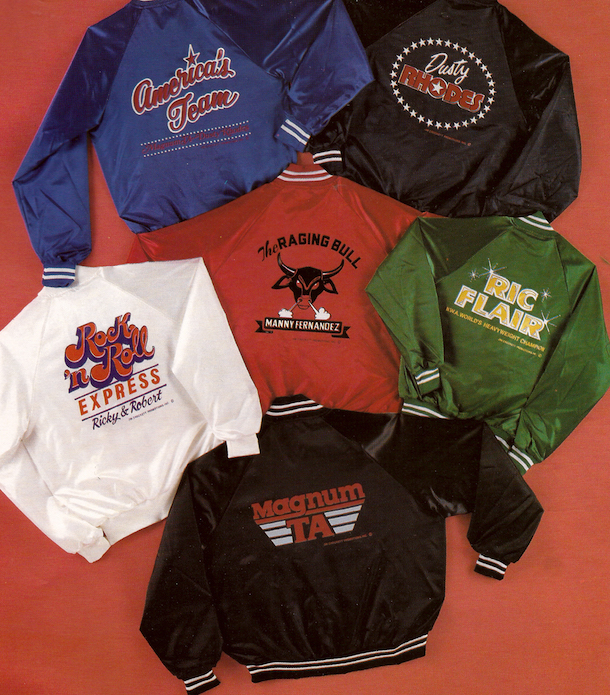
It would be pretty cool to have a complete collection of these satin jackets today. They were sold by Jim Crockett Promotions in 1985 and 1986, primarily through mail order out of their in-house magazine.
The jackets feature some of the earliest designs for JCP as they worked to get merchandising off the ground in those years.
The wrestlers featured included a team jacket for "America's Team" Dusty Rhodes and Magnum T.A., as well as individual logos for each of them. Also featured were Ric Flair, Manny Fernandez, and the Rock and Roll Express.
The jackets sold for a whopping $50, which was a lot of money back in the mid-1980s. I'm guessing not a whole lot of them were sold. However, those same logos appeared on caps and t-shirts as well, which likely sold better, especially at the arenas.
My personal favorite, strictly from a design standpoint, was the logo for Dusty Rhodes, which had a great western look and evoked an image that just said "TEXAS" with the star in the center of the letter "O" in Rhodes. The Ric Flair design is great looking, too, and a variation was used in the famous "I Do It With Flair" t-shirt of the same era.
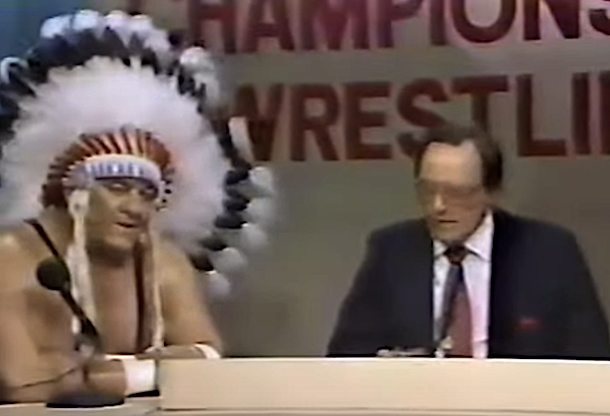
I just came across an interesting interview with Chief Wahoo McDaniel on an episode of "Championship Wrestling '85", formerly known as Championship Wrestling from Florida. The episode has two interesting connections to Jim Crockett Promotions and Mid-Atlantic Wrestling as it relates to Wahoo McDaniel.
The episode originally aired Saturday, 3/16/85 in Florida. It was taped the prior Wednesday morning 3/13/85 at the famous Sportatorium in located at 106 North Albany Avenue in Tampa.
THE UNITED STATES TITLE The first Mid-Atlantic connection was that Wahoo McDaniel was the reigning United States Heavyweight Champion for Jim Crockett Promotions at the time of this appearance in Florida. He was just over a week away from losing the title to Magnum T.A. in their famous cage match back in Charlotte on 3/23/85. So when Wahoo appeared on Florida TV, he was wearing the Crockett U.S. title. he was not acknowledged by the ring announcer or announcer Gordon Solie as champion, but was wearing the belt in the ring. Wahoo teamed with Jay and Mark Youngblood who were former Mid-Atlantic stars and the reigning United States Tag Team champions, a Florida-based title at the time. (Wahoo and Mark Youngblood had held the NWA World Tag Team titles a year earlier in the Mid-Atlantic area.)
THE APOLOGY The second Mid-Atlantic connection was the interview Wahoo did with host Gordon Solie at the desk. Wahoo had been one of the most popular wrestlers in the history of Jim Crockett Promotions throughout the mid-1970s to the mid-1980s. But in 1984 he had "turned heel" over his frustration with being stripped of the United States title after defeating Ricky Steamboat for the belt in Greensboro. Wahoo became bitter and found an unlikely ally in Tully Blanchard, the two dubbing their tag team combination as the "Awesome Twosome." Suddenly, Wahoo had become one of the most hated wrestlers in the territory.
So when he appeared in Florida, still with the U.S. title, it was perhaps surprising for him to team with the babyface tag team of the Youngblood brothers.
After the match was over, Wahoo sat down with Solie and the two discussed Wahoo's return to Florida and his ongoing chase of Ric Flair and the NWA World Heavyweight title, a chase that had been going strong back in the Mid-Atlantic area, but now would continue in Florida. It was here that Wahoo actually apologized to the fans.
"You know, I've done a lot of things in the last couple of months," Wahoo told Solie. "My style of wrestling has changed some. I'd like to apologize to a lot of people, because in some places I've done some things I wouldn't ordinarily do."
Wahoo's use of the phrase "in some places" may have been a little cryptic for most Florida fans who would have been largely unaware of Wahoo's heel run in the Mid-Atlantic unless they had read about it the wrestling magazines or perhaps seen some of his occasional appearances in Georgia on WTBS. But that was directly aimed at Mid-Atlantic fans, some of whom could see the weekly Florida TV show on their cable systems.
Wahoo would apologize a second time, this time directly to Mid-Atlantic fans a few months later in a video tape sent in from Florida. It was in advance of a special return appearance for Jim Crockett Promotions to aid Dusty Rhodes against Tully Blanchard and Abdullah the Butcher in Greensboro.
A week after this Florida episode aired, Wahoo lost the U.S. title to Magnum T.A. in Charlotte, and immediately left the territory to take the booking job in Florida.
The entire episode is embedded below, although you can go directly to Wahoo's match and interview using the links embedded in the paragraphs above.
(The complete episode is on the "106NAlbany" YouTube channel.)
Originally published in our 30th Anniversary salute to Starrcade '85 in 2015.
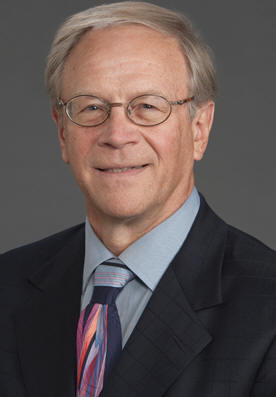
Noted Charlotte orthopedist recalls his experiences treating the wrestlers of Jim Crockett Promotions, marvels at their toughness and athleticism by Kyra Quinn Special for the Mid-Atlantic Gateway
“Let people know how great these athletes were,” said Dr. Joseph Estwanik, referring to the wrestlers of Jim Crockett Promotions in the 1980s. Dr. Estwanik said this at the close of our recent telephone interview, which he had graciously agreed to after I reached out to him with questions about his involvement with professional wrestling decades ago.
Dr. Joseph Estwanik
Not Just a Doctor on TV
After recently discovering that Dr. Estwanik was still practicing medicine in Charlotte some 30 years after his initial appearance on Crockett television, I became curious about how he had become associated with the Crocketts, and about the extent of his involvement with the wrestlers. Estwanik had appeared on television as part of two highly memorable and now-classic angles: the ankle injury to Dusty Rhodes at the hands of Ric Flair and the Andersons in the buildup to Starrcade ’85, and the neck injury suffered by Ric Flair as the result of being piledriven on a ringside table by Terry Funk in 1989. But I wondered: were those two TV appearances all there was, or was there perhaps more to his story?
As I found out, there was much more. Joe Estwanik treated many of Crockett’s wrestlers throughout the 1980s. They were his patients and his friends, and his respect for them, even after all these years, remains profound and undiminished.
The Wrestling Connection
Dr. Estwanik’s association with professional wrestling developed as a result of the geographic location of his practice as well as his own background in and involvement with athletics, including Greco-Roman wrestling. Estwanik moved to Charlotte in 1978 after graduating from medical school at Wake Forest University and completing his residency. At that time he was one of the few doctors in the Charlotte area with an interest in sports medicine, which resulted in, as Dr. Estwanik put it, “sort of a natural hook-up with the Crocketts. Plus,” he added, “I was an avid weightlifter and bodybuilder, so I actually was in the gym with many of the athletes anyway… so I think I gained the, if I can say, respect for my knowledge base of wrestling [and] of weight training.”
“Tough as Nails”
Though he treated numerous Crockett wrestlers over the years, Dr. Estwanik actually had no professional relationship with Jim Crockett Promotions. “I think I felt better that way,” he explained, “that I was able to maintain a doctor-patient relationship. But because we had so many athletes in common I couldn’t help but at times meet the Crocketts or serve a need for them if I could.
Dr. Estwanik maintains an incredibly high regard for the wrestlers he treated, telling me, with amazement in his voice, “their athletic ability was superb, and… their toughness was insanely crazy!” Few people would know more about that toughness than Joe Estwanik. As the doctor to so many of the wrestlers, Dr. Estwanik was privy to injury knowledge that remained well-hidden from fans at the time. “I had their x-rays,” he explained, “and I knew the battering that they were taking, and I had performed some of their surgeries.” Estwanik continued, “It was even amazing what they sacrificed in the normal post-operative expected recovery, to get back on the road and perform in some capacity, somewhat shielding or protecting an injury or an operated area.” Dr. Estwanik even gave an example of seeing a wrestler in the ring on television still wearing the post-operative dressing Estwanik had applied at the completion of his surgery.
During those days, as part of his research for an academic paper that he later presented, Dr. Estwanik also surveyed over 100 professional wrestlers regarding injuries they had sustained throughout their careers; that paper, he says, documented the serious reality of the injuries the wrestlers were living and competing with. His succinct summary of the results of his research and observation: “They were always, always injured. They were tough as nails. And finally, they never got a day off.”
Patients and Friends
Joe Estwanik did not require any prompting when asked if he had any specific recollections of the wrestlers he worked with during the 80s. Immediately the memories started to flow. “Chief Wahoo McDaniel,” Estwanik recalled, “what a character and an extraordinary guy. I got to know him very well and operate on him.” Estwanik marveled at Wahoo’s toughness in continuing to wrestle into his 50s even though, as Estwanik put it, “anybody who was not a physician could see the significant arthritic changes” by simply looking at Wahoo’s x-rays.
Other wrestlers who Joe Estwanik counted as both patients and friends include Magnum T.A., Jimmy Garvin, and Ivan and Nikita Koloff. “So many of [the wrestlers] were so pleasant to work with,” Estwanik shared, “and just genuine guys from the gym, compared to a persona they got paid to play.”
Estwanik also recalled being there with his friends during some difficult times; he was one of the few visitors Magnum requested to see in the hospital after his career-ending auto accident in 1986, and he was there as a friend to Nikita Koloff as Nikita’s first wife, Mandy, died of cancer in 1989.
Agony at the Omni and Dusty’s “Hard Times”
When Dr. Estwanik finally did appear on-screen for Jim Crockett Promotions, he did so in the middle of one of the hottest angles and well-crafted stories in wrestling history: the ankle injury to Dusty Rhodes which set the stage for the Flair-Rhodes main event at Starrcade ’85 – one of the key moments in the legendary feud between the “Nature Boy” and the “American Dream”. As most fans of that era will recall, the injury occurred at the Omni in Atlanta on September 29, 1985, when Ric Flair turned full heel in grand and nefarious fashion, gleefully joining the Andersons in a brutal three-on-one attack in a cage against Dusty Rhodes. It was the ultimate betrayal, with Dusty having just single-handedly rescued Flair from a beating by the Russian trio of Ivan and Nikita Koloff and Krusher Khruschev.
Dr. Estwanik talks about Dusty's injury.
The attack resulted in a serious injury to Dusty which Flair had inflicted by landing a knee drop off the top rope onto Rhodes’ ankle. In the aftermath, Rhodes lay in clear agony on the mat, tended to by the Rock and Roll Express, announcer David Crockett and several others. As the house lights were brought up, the stunned Omni crowd watched with grave concern as one side of the cage was removed, the ring ropes were loosened, and the “American Dream” was carried to the dressing room with a huge bag of ice tied around his ankle.
On the following week’s “Mid-Atlantic Championship Wrestling” the angle was recapped, with Tony Schiavone informing fans that Dusty was put on a private plane and flown to Charlotte, North Carolina, where he was examined by Dr. Joseph Estwanik. Subsequently, David Crockett conducted an interview with Estwanik in which the doctor explained the diagnosis of a third degree ankle sprain and addressed Dusty’s time frame for recovery. (Estwanik also appeared in a later interview with Dusty to discuss his rehab progress). Rhodes was put in a cast and was out of action for over a month, during which time the feud only became hotter as Dusty gave inspired interviews, including “Hard Times,” one of the most well-known and beloved promos ever. To go back and re-watch the events leading to Starrcade ‘85 is to be reminded of why people believed: incredible athletes, charismatic personalities, and storytelling that was compelling and realistic.
Revelation
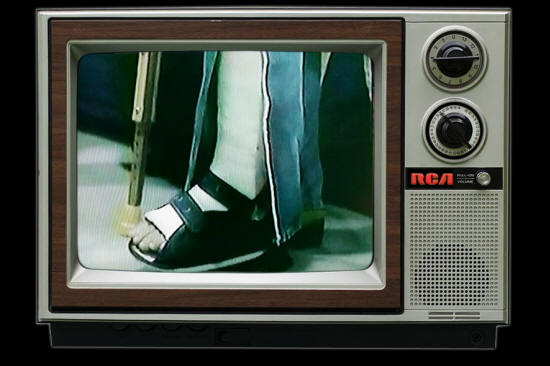
Dusty Rhodes in the cast.
When I asked Dr. Estwanik about his interview with David Crockett all those years ago, he chuckled and had to confess that he didn’t remember it among all the other interviews he has given. But he did reveal something that is likely to surprise and possibly intrigue many fans: Dusty did have an actual injury. We can’t know for certain when the injury occurred; we can speculate that it may have been something that had been bothering Dusty and was then worked into the story at the perfect time. But regardless of timing, Estwanik stated: “There was an injury. TV exaggerates everything… but it was an injury requiring some immobilization and he elected to go with a cast… it’s the same cast on him that I would put on anybody.”
Dr. Estwanik took it in stride when I suggested to him that, during that era, there may have been a number of skeptical wrestling fans who did not believe he was a real doctor. “The fact is,” he laughed, “my enduring signature is suture lines, healed scars from surgeries.” He continued, assuring us, “I was really performing ACL surgeries and all the other things.”
These Days
In addition to his very successful Charlotte orthopedic practice, Dr. Estwanik continues his three-plus decades of work as a ringside physician for the sport of boxing and has also served in that same capacity for numerous years in Mixed Martial Arts. His extensive list of professional experience includes serving as the team physician for USA Boxing at multiple international events, and having served as the President of the Association of Ringside Physicians. In addition, Dr. Estwanik, along with Ken Shamrock and others, was instrumental in developing the original Boxergenics Grappling Glove used by MMA fighters; he developed the glove in the early days of MMA when the sport was in danger of being banned. That basic glove, says Estwanik, in still in use today, and he now jokingly refers to himself as the “idiot that didn’t patent it.”
Joe Estwanik’s favorite sports are the combat arts (which include wrestling, boxing, martial arts and MMA), in which he has decades of experience as both a treating physician and a fan. But he does seem to hold a special place in his heart for the professional wrestlers he knew and treated in the 1980s. When asked if he had become a fan of wrestling during that era, Estwanik responded, “You can’t help but watch your buddies.” Estwanik missed those buddies when Jim Crockett sold the business and the wrestlers left town. He still keeps up with some of them, though, and very fondly recalls that special era, telling us: “It was a great time of my life. I loved it.”
Originally published November 2015 on the Mid-Atlantic Gateway
November 28, 2015 was the 30th Anniversary of Starrcade '85. The event took place on Thanksgiving night in the cities of Atlanta, GA and Greensboro, NC.
It would be pretty cool to have a complete collection of these satin jackets today. They were sold by Jim Crockett Promotions in 1985 and 1986, primarily through mail order out of their in-house magazine.
The jackets feature some of the earliest designs for JCP as they worked to get merchandising off the ground in those years.
The wrestlers featured included a team jacket for "America's Team" Dusty Rhodes and Magnum T.A., as well as individual logos for each of them. Also featured were Ric Flair, Manny Fernandez, and the Rock and Roll Express.
The jackets sold for a whopping $50, which was a lot of money back in the mid-1980s. I'm guessing not a whole lot of them were sold. However, those same logos appeared on caps and t-shirts as well, which likely sold better, especially at the arenas.
My personal favorite, strictly from a design standpoint, was the logo for Dusty Rhodes, which had a great western look and evoked an image that just said "TEXAS" with the star in the center of the letter "O" in Rhodes. The Ric Flair design is great looking, too, and a variation was used in the famous "I Do It With Flair" t-shirt of the same era.
Originally posted February 15, 2017 on the Mid-Atlantic Gateway.
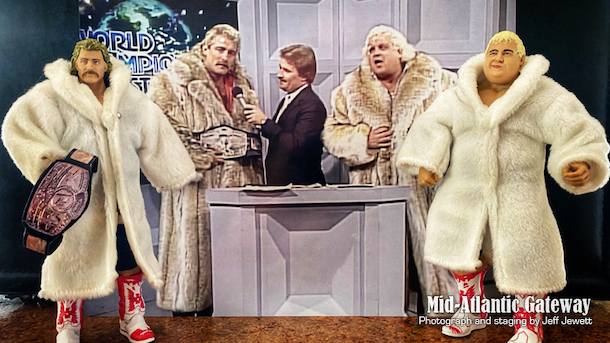
Who can forget Dusty Rhodes and Magnum T.A. walking out on Superstation WTBS to interview with Tony Schiavone wearing those big fur coats? It was on World Championship Wrestling back on December 14, 1985, and that nutty moment is still talked about today (and lives on the WWE Network.)
"I don't believe there is any explanation for this right here," Dusty said to Schiavone. "We was on the JCP private sports plane...I mean, you can go all over the world and not see nuthin' as bad as this."
From the creative mind of Jeff Jewett comes this action figures staging of America's Team with custom made min-furs. Excellent job, and great memories!
"Action Figures Friday" makes random appearances here on the Gateway. It all began with Mike Simmerman's amazing collection of custom figures staged in an even more amazing custom mini-studio based on WRAL in Raleigh in the 1970s and early 1980s. There have been other contributors including Jeff Jewett, Scottie Richardson, Matty Montcalm, Barry Hatchet, and others.
In 1985, Jim Crockett Promotions released their first line of commercial merchandise that was based on their wrestlers. They previously had released some event-related t-shirts, but none directly related to the wrestlers themselves. These were sold at the live events as well as through mail order.
Ric Flair's first shirt was a classic. The phrase "I do It With Flair" was boldly emblazoned in sparkling gold on the front of a royal blue t-shirt. This particular shirt was only available for a short period of time in late 1985 and early 1986.
Thirty years later, in 2015, Ric's daughter Ashley, working under the name Charlotte Flair in the WWE, featured a very cool shirt that was a variation on that same theme.
Charlotte's shirt had a two-sided message. On the front it said "If you're gonna do it..." and then the back says "Do it with Flair."
What an awesome tribute to her Dad and a long forgotten piece of memorabilia from the Crockett days.
We love it!
WWE/NXT Superstar Charlotte Flair in 2015
(The shirt is no longer available at WWEShop.com.)
Edited from an original article published June 16, 2015 on the Mid-Atlantic Gateway.
I always marvel looking back at some of the old mainstay venues for Mid-Atlantic Wrestling in the 1970s and 1980s and how busy those venues were at the time. It sure isn't the same today for many of those that remain, as the larger multi-use facilities have strangled many of the mid-size buildings that once thrived.
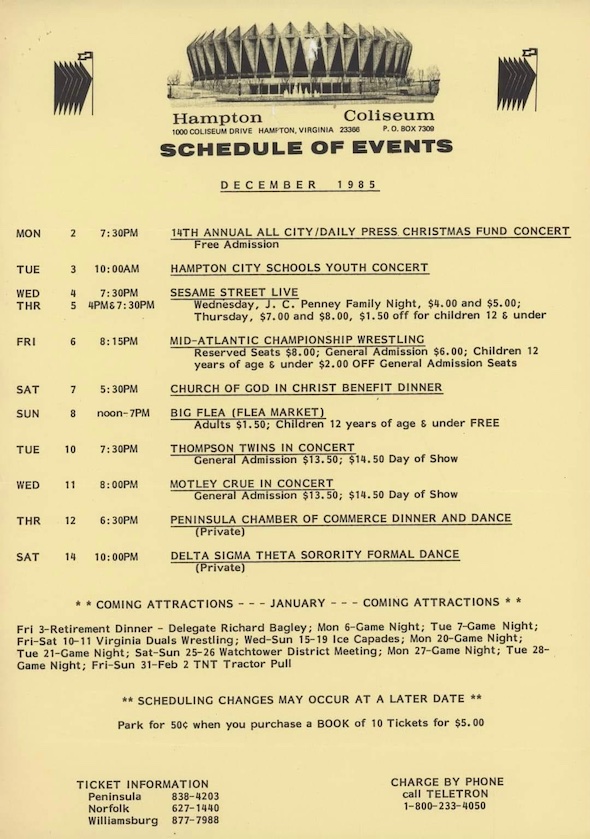
Take a look at this venue event schedule for the Hampton Coliseum in Hampton, VA for December 1985. It is loaded with a wide array of diverse programs, including of course a card of Mid-Atlantic Championship Wrestling on Friday night, December 6. Friday was usually Richmond's night if promoter Joe Murnick had his druthers, but with the Church of Christ holding a big dinner there on Saturday night (12/7) and perhaps something else booked in Richmond for 12/6, Hampton took the Friday slot.
The card that night primarily consisted of the "B" circuit at that time, which had been anchored around Jim Cronette and the Midnight Express for most of 1985. Crockett had organized a "second circuit" to run all of the old Georgia towns now that they ran the old Georgia territory. (You will remember they got the WTBS TV slots from the WWF in in April of 1985 and absorbed all of the towns that Ole Anderson and Georgia promoter Fred Ward had been running up until that point.) That second circuit also hit a lot of regular or semi-regular smaller Crockett towns in the Carolinas and Virginia, too, and such was the case this night with Hampton. The "A" team, which consisted of Rhodes, Flair, Magnum, Steamboat (still around), Road Warriros, Andersons, etc., was likely in Charleston, SC perhaps even split over two locations.
The Crockett crew would undergo some unexpected personnel changes during December involving two people who were no-shows on this particular card in Hampton. Billy Jack Haynes quit the promotion shortly after Starrcade '85, reportedly unhappy with his Starrcade pay-off and his positioning on post-Starrcade cards. More famously (or infamously perhaps) was the situation with Buddy Landel, who had just won the the National Heavyweight title from Terry Taylor at Starrcade and missed an important TV taping where he was reportedly scheduled to get a big push in a big angle, and was fired by Dusty Rhodes soon after. That hadn't happened yet by the night of this 12/6 show in Hampton, but Landel's no-show this night might have been indicative of his growing performance and reliability issues during this time.
Thanks to George Pantas for forwarding this Hampton venue schedule to us. We love seeing stuff like this!
"I was an Anderson before I was a Horseman." - Arn Anderson
Anyone who has hung around this website for any length of time knows what a fan I am of the Anderson family in wrestling. It was Gene and Ole, the Anderson Brothers, who captured my fascination as a 13-year old fan in their epic feud with Paul Jones and Wahoo McDaniel back in 1975. And it was the match where Ole sacrificed his brother Gene to win the tag titles on television that hooked me as a fan for life.
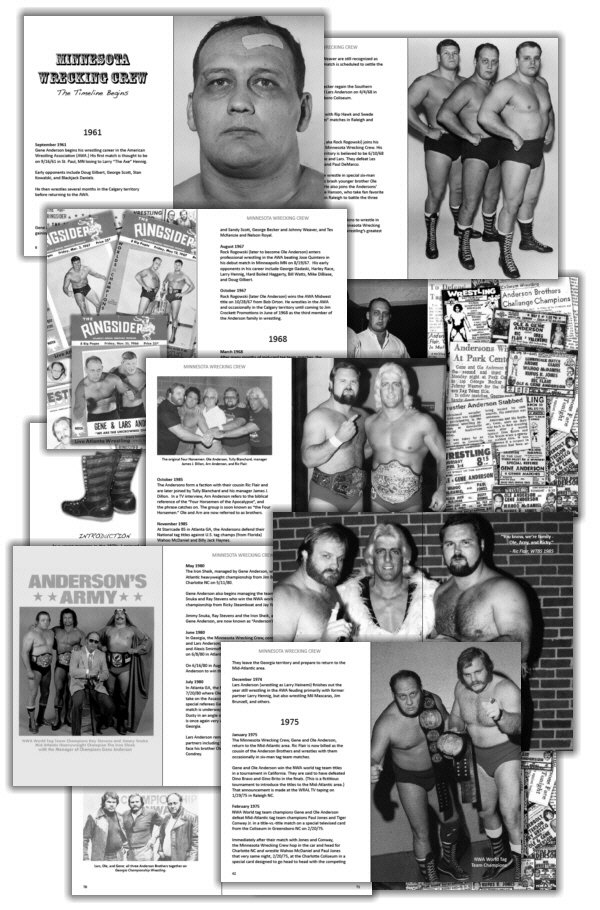
One of the trademarks of the Anderson team was their unique maroon-and-gold striped boots they always wore in the ring. Gene and Lars Anderson (the third Anderson brother, before Ole came along) wore those boots back to the mid-1960s in Georgia. Once Ole became a member of the family in 1968, I don't think he ever wore any other style of boots in his entire career, a career that stretched across four decades.
When Ole made up-and-comer Marty Lunde an official member of the Anderson family in April of 1983 and gave him the name Arn Anderson, Lunde's career was seemingly made at that point, although I'm sure he had no idea then how significantly that name would impact his entire career, a career now entering its fifth decade.
Arn Anderson understood the significance of the gift Ole had given him, having been a fan of the Anderson brothers himself as a teenager. When Ole took Arn as his partner in April of 1985, Arn ordered dered his own pair of "Anderson boots" and the transformation to a full blown member of the Minnesota Wrecking Crew was complete.
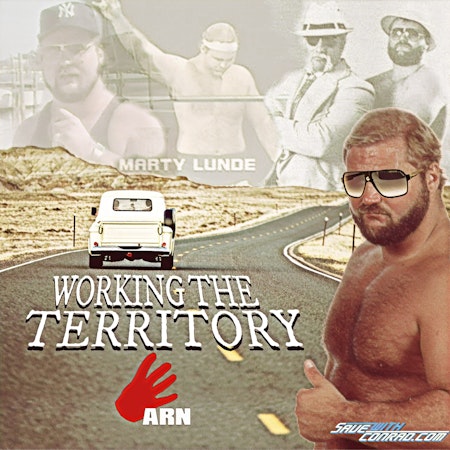
Arn has talked about the boots before and their significance to him, and recently did so again on his Westwood One podcast ARN. Executive producer and co-host Conrad Thompson asked him about boots in general, and wondered if any particular color combination was a particular favorite to him.
I love hearing Arn talk about the Anderson boots. Here is that one-minute audio clip, with a transcript below.
Transcript
CONRAD THOMPSON: Tell me about the boots. You had quite a few different color combinations - - the red and the black, black and silver, the white and the red. Is there a favorite pair or a favorite color combination, that you were really feelin' yourself, like aw sh*t, these are my best ones?
ARN ANDERSON: I felt like when the Horsemen were in their infancy . . . first of all, I have a pair of Anderson boots that will always be special, which means when Ole Anderson made me a member of his family, which made me a member of Gene's family, that's about as strong as it can get for a kid with my aspirations at that time. And the fact that I was allowed to copy his boots and for us to match was a big deal for me.
CONRAD: Yep.
ARN: And that's the boots that I hold nearest and dearest to my heart because that's when I was given my career. I was an Anderson before I was a Horseman. And for them to accept me as equals at the point of my career I was at, they'll always mean the most.
Edited from a post originally published November 23, 2015
AUDIO AND VIDEO EMBEDDED IN THIS POST
As the years pass, it's natural for the smaller details to fade from memory on any good story. When folks talk about the build-up to Starrcade '85 all these 35+ years later, the story usually begins with Ric Flair and the Andersons turning on Dusty Rhodes in the cage in the Omni on 9/29/85. That's the angle they think of when they remember all the things that led up to the big world title match at Starrcade.
This story was originally part of a big 30th Anniversary celebration of Starrcade '85 on the Mid-Atlantic Gateway.
But the story began much earlier. You see, Dusty Rhodes needed to be the number one babyface and he had to have more than just the number one heel do bad things to him to set up his biggest match of the year. He needed someone the fans were beginning to love as much or more than him to turn on him. He needed more than evil deeds; he needed a betrayal.
Ric Flair had somewhat of a dual personality in the spring and summer of 1985 on Atlanta TV. For a majority of the time that Flair had been NWA world champion since September of 1981, he remained the most popular wrestler imaginable in his home territory of the Mid-Atlantic area, while wrestling straight heel as defending NWA world champion in every other territory in the NWA. When Jim Crockett Promotions acquired the wrestling TV time on Superstation WTBS, Flair maintained his heel persona on the national broadcast, while staying the babyface in the Mid-Atlantic area (even though many Mid-Atlantic fans were seeing the Superstation cable broadcasts, too.)
In the early months of Jim Crockett Promotion on the Superstation, Flair feuded with Magnum T.A. But in the home area of Mid-Atlantic Wrestling, the company prepared for the first Great American Bash at Memorial Stadium in Charlotte with mega-babyface Flair defending the honor of America and his world title against the rising "Russian Nightmare" Nikita Koloff.
At this same time, the company was in the early stages of making plans for the biggest show of the year that was more than a half year away - - Starrcade. Booker Dusty Rhodes knew he wanted to end up challenging Flair for the world title, but he didn't want a repeat of the situation he had the previous Thanksgiving at Starrcade '84 where he and Flair met both as babyfaces in the main event of that show.
Dusty needed more than a simple angle where the heel carried out some dastardly deed to set up the match. With Flair still hugely popular in the Mid-Atlantic area, and riding the successful program there with Nikita Koloff, Dusty devised the ingenious plan to add betrayal into the mix heading towards Starrcade '85.
He allowed the Mid-Atlantic Flair/Nikita feud to also play out on Atlanta TV, and planned a series of three main events between the two in Atlanta.
On 8/11/85, Flair defended the NWA title against Nikita at the Omni, with the match ending in a double count-out. A return match was set for 9/1 with the title on the line again but this time in a lumberjack match, with wrestlers surrounding the ring to make sure the combatants stayed in the ring.
The day before that rematch, on the 8/31/85 World Championship Wrestling show, Dusty shot an angle that was every bit as important as the big turn in the cage to come later, because it laid the foundation for the turn in the cage to have maximum impact. yet sadly, that small angle is largely forgotten in this story.
On that Saturday's show, Ivan and Nikita continued to run down Flair and the U.S.A. until Flair had had enough. During Nikita's TV match, with Ivan at the podium doing commentary with Tony Schiavone, Flair interrupted and challenged Ivan Koloff. Nikita saw what was happening, left the ring and jumped Flair from behind and through him in the ring. Nikita had the upper hand until Flair ducked a clothesline and nailed Nikita with a flying forearm. As he applied the figure four, Ivan hit the ring and the two Koloffs started to do a major number on Flair as the TV studio crowd was in an uproar.
Then the nearly unthinkable happened. Dusty Rhodes hit the ring to make the save. Dusty cleared the ring and then helped Ric to his feet. If you watch the angle carefully, you will notice that Flair gently pulled way from Rhodes as he was trying to help him up, and didn't really acknowledge his assistance. As Flair lit into a crazy promo on Nikita, Rhodes left the studio unnoticed.
Dusty Rhodes takes Ric Flair's hand after Flair had been attacked by the Koloffs
On its face, the angle was to add heat for the Flair/Nikita rematch at the Omni the following night. It certainly did that, but it also served the larger purpose as a subtle beginning to what would be the Flair turn on Dusty a month later in the cage.
The following night 9/1 in the Omni, Ivan and Khrusher Khrushchev, who were part of the contingent of lumberjacks at ringside, repeatedly attacked Flair during the match. The match ended again in a no contest, resulting in a third match between the two being set for 9/29, this final confrontation to take place inside a steel cage.
The following Saturday on World Championship Wrestling, Flair warned Dusty in unmistakable terms to stay out of his business, referring to the previous week's events on TV where Rhodes had saved him from the Koloffs' attack - -
"Dusty Rhodes, don't ever make the mistake of sticking your nose in my business. If I'm down and out, I'll get up and take care of myself. ... don't think you can walk into that ring and give me a hand or try to help me out and ease the tension in our relationship."
It didn't seem odd or out of place at all. Flair and Rhodes had feuded for years, and although Flair had become increasingly popular on the Superstation as of late, he still maintained that heel edge, cutting masterful promos where he would crack on both babyfaces and heels all at the same time in the same interview. It was beautiful to behold. Dusty had been warned. It was subtle, and yet direct at the same time.
Apparently, though, not direct enough for Dusty to get the message.
Fast forward to the infamous cage match of 9/29/85. Flair, with a sold out Omni behind him, finally turned back the challenge of the "Russian Nightmare" Nikita Koloff. But when the cage door was unlocked, Ivan Koloff and Khrusher Khrushchev hit the ring and three began to pummel Flair. The crowd didn't like it, but suddenly their boos turned into a loud roar as the "American Dream" hit the ring, throwing those famous elbows and sending the Russians running. The Omni came unglued.
With the Russians dispatched, Dusty turned to help Ric to his feet just as he did four weeks earlier on the Superstation. Except this time Ric pointed at Rhodes from the mat and shouted angrily, "I told you not to interfere in my business!" As Dusty stood confused at Ric's reaction, he failed to notice Ole and Arn Anderson entering the cage door behind him. The Andersons attacked Rhodes. Ric got to his feet, paused for a moment, and then went over to the cage door, pulled the chain back through, and padlocked it shut.
If you watch this carefully, you will notice fans at ringside within the camera shot screaming at Flair and pointing to the Andersons pounding Rhodes as if to implore the champ to return the favor and help Rhodes out. But instead, Ric went and joined his cousins and the three put an epic beatdown on the Dream.
You know the rest. As the Andersons held Rhodes, Flair leapt from the top turnbuckle onto Dusty's leg, badly injuring the ankle.
Booker Rhodes used the betrayal to turn Flair heel in the Mid-Altlantic area as well, as the Crockett syndicated shows the entire Omni cage angle. Ric was now a full fledged heel everywhere. Dusty was out of action for a little over a month. TV followed his rehab along with his doctor Joseph Estwanik. When he made his return on 11/3 in the Omni in an undercard match against Mike Davis, he proved the ankle was well, and Jim Crockett signed the NWA world title match between Rhodes and Flair for Starrcade '85.
The angle in the cage in Atlanta was hot and resulted in a near riot at the Omni, as fans at one point rushed ringside and braced the cage door to prevent the Andersons and Flair from being able to exit the ring.
But what made that angle work so well and what made that crowd riot was the betrayal - - not the attack. The weeks leading up to that betrayal are what are often overlooked today as we look back on that famous build to Starrcade '85.
Whatever you think of Dusty Rhodes as a storyteller and how this particular story played out in the end, you have to admit he hit this part of the story out of the ballpark.
YouTube video - - WTBS 8/31/85
Thanks to Scott Anderson for sending us the link.
Originally published November 23, 2015, and republished November 23, 2016.
On the debut episode of the Arn Anderson podcast (arnshow.com), Arn and host Conrad Thompson discuss Arn's early career touring some of the southeast territories in the NWA including Mid-South, Southeastern (Pensacola/South Alabama), and Georgia. The topic inevitably turned to Arn becoming an Anderson and wearing the infamous fedora.
We thought we'd reprise an earlier article her on the Gateway talking about that very thing.
ANDERSONS DON'T WEAR FEDORAS
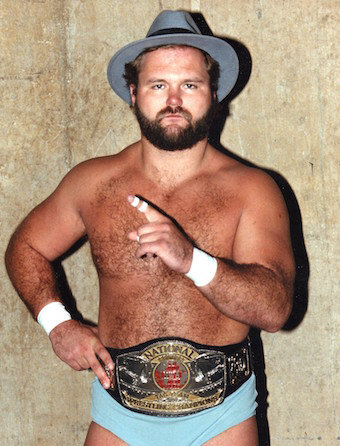
When Arn Anderson arrived in Georgia Championship Wrestling in 1983 and began teaming with Matt Borne, the two began wearing fedoras to the ring. It was a trademark Arn kept through his time in Georgia and Southeastern Wrestling in Alabama, and on through his early days for Jim Crockett Promotions in the Carolinas.
Arn Anderson (1985)
(Photo by Eddie Cheslock)
During a visit to the Conradisson in August of 2015, I asked Arn about the origin of the fedora.
"That was all Matt Borne," he said. "He wore it when he was part of the "Rat Pack" in Mid-South Wrestling teaming with Ted DiBiase. I liked it and so we started wearing them as a team [in Georgia]."
Their manager, Paul Ellering, would occasionally wear one, too.
Right away, Georgia booker Ole Anderson didn't like it.
Ole: "What the hell are you wearing?"
Arn: "It's a fedora,"
Ole: "Well I hate it."
"Ole just shook his head and walked away," Arn told me. "I'm not sure I completely fit the Anderson mold yet."
When Matt Borne was fired from the Georgia promotion a few months later, Arn lost his spot with the company. Bob Armstrong was leaving Georgia, headed to work for the Pensacola, FL booking office known as Southeastern Championship Wrestling. Bob got Arn booked there and the fedora went with him.
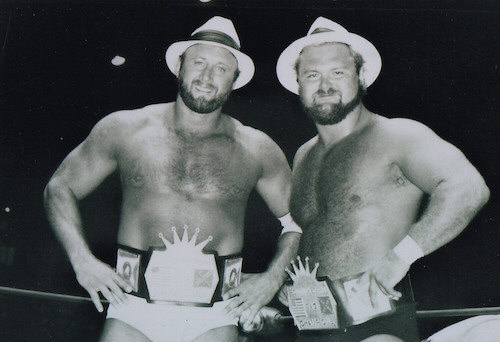
Arn soon formed a very successful tag team with Jerry Stubbs in Southeastern Championship Wrestling. Stubbs wore a mask working as "Mr. Olympia" and Arn came in also under a mask as "Super Olympia." Eventually they both worked without their masks and held the Southeastern Tag Team championships many times. Just as Matt Borne had passed on the fedora tradition to Arn, Arn now passed it on to Stubbs, and the two wore the trademark hats during their championship run there.
Southeastern Tag Team Champions Jerry Stubbs and Arn Anderson in 1984
When Arn went to work for Jim Crockett Promotions in the spring of 1985, he occasionally wore the fedora there, too. This time, when paired with Ole Anderson as the new Minnesota Wrecking Crew, Ole put his foot down.
"Ole told me, Andersons don't wear fedoras. And that was that."
Ole made Arn ditch the fedora (although it popped up a time or two after that) and order the trademark maroon and gold striped boots that had been worn by Andersons going back to 1966 when Gene and Lars first wore them in Georgia. Those boots became the Anderson trademark, and had been worn by Gene and Ole ever since. While Arn didn't wear them all the time, he did often wear them teaming with Ole in 1985 and 1986.
Personally, I always loved Arn in the fedora. It just suited him well and was a common thread through his early career in his first three territories.
So at least one Anderson did wear a fedora. And in the great tradition of the Anderson family, that Anderson had one of the great tag-team careers in the history of pro wrestling.
This story was edited from a larger post about Arn Anderson originally published on the Mid-Atlantic Gateway in August 2015.
Back in the early 2000s, the Mid-Atlantic Gateway briefly hosted a second website (now defunct) called "The Glory Days." It focused primarily on NWA wrestling on Superstation WTBS in 1985-1986. There were show summaries and lots of video clips that we embedded from our linked YouTube site called GloryDays TV. (Most, although not all, of those videos are still up and can be found here.)
Without commentary here one way or the other, it's interesting to note the letter I received from YouTube regarding one of these video clips from a 1985 episode of "World Wide Wrestling" featuring David Crockett, Magnum T.A., Baby Doll, and Tully Blanchard.
Nicknamed "She likes it!!", here is the infamous clip:
Here is an excerpt from the YouTube letter I received:
As you may know, our Community Guidelines describe which content we allow – and don’t allow – on YouTube. Your video GloryDaysTV - Magnum & Babydoll Kiss was flagged to us for review. Upon review, we’ve determined that it may not be suitable for all viewers and it has been placed behind an age restriction.
This clip is indeed one of the more controversial clips from those old wrestling shows. Even in 1985 it was controversial for David Crockett's reaction (not to mention the reaction of the crowd.) So in 2019, I'm surprised YouTube hasn't pulled it down completely. They've left it up, just with the new age restriction.
One wrestling note: I've always thought Tully Blanchard came across as the real babyface in this angle, vociferously coming to the defense of his "Perfect 10."
For what it's worth, our old website address for The Glory Days website was theglorydays.net which now apparently forwards to a Japanese gambling website. Go figure. (And no connection to us whatsoever!)
"...if you're big star bound, let me warn you, it's a long hard ride." -David Allan Coe
As the fall of 1985 began, I was convinced of one thing: Sam Houston was going to be a huge break-out star for Dusty Rhodes and Jim Crockett Promotions. It was probably a year or two away before he would be on top, but it was going to happen. He had that "it" factor.
But he never made it.
It's too bad because he was still so young and hadn't even filled out physically yet and already had so much potential and was so smooth in the ring. And he had that great Texas gimmick that Dusty would have pushed to the moon.
His personal demons took over, and it didn't help that Dusty put him in a position he just wasn't yet ready for as the top babyface in the Kansas City territory that Jim Crockett Promotions had recently taken over. That move helped finish off that territory and derailed Sam's career.
This match in the video embedded above was one of Sam's biggest moments as a "young lion" for the company. He upset Arn Anderson on "World Wide Wrestling" from September 7, 1985, at a time where Arn had only recently stepped onto the main event stage himself as one half of the modern day Minnesota Wrecking Crew. This was just as the Four Horsemen were starting to take form, even if we didn't know that at the time. You'll notice Sam with a cast on his arm; the Andersons and Tully Blanchard had jumped him weeks earlier and broken his arm as a warning to Dusty Rhodes and Magnum T.A. of what could happen to them.
Sam went on later to win the Mid-Atlantic Heavyweight Championship and the Central States Championship for JCP before leaving for the WWF for a short stint.
On a side note, David Crockett calls the match (along with Ole Anderson and Tony Schiavone.) It always amused me how David mispronounced Arn's name as 'Iron' Anderson. He could say the word 'arm', as in "Sam Houston's broken arm", but he could never quite seem to say 'Arn' Anderson.
Also, as an avowed mark for the Andersons, I loved seeing Arn wearing the famous "Anderson boots" and executing two perfect "Anderson slams" (a modified hammerlock slam) on Houston's broken arm. Those slams even got Ole excited a little bit, as he was doing color commentary with David Crockett.
The match also features appearances by Dusty Rhodes and Magnum T.A.
1985 was a great year. Sam Houston was a part of what made that fall of 1985 special, even if part of a smaller background story. As Dusty liked to say, quoting David Allan Coe, he certainly was "big star bound."
What a great photo taken in Atlanta's Omni at Starrcade '85. It features the Atlanta crowd watching Greensboro's closed circuit broadcast featuring the legendary Johnny Weaver with the old Greensboro Coliseum logo behind him. Great memories. 32 years ago. (More on STARRCADE '85)
We also should point out one of the photographers listed for the photos that would follow in the article from Greensboro was Mid-Atlantic Gateway contributor Eddie Cheslock.
As the years pass, it's natural for the smaller details to fade from memory on any good story. When folks talk about the build-up to Starrcade '85 all these 30+ years later, the story usually begins with Ric Flair and the Andersons turning on Dusty Rhodes in the cage in the Omni on 9/29. That's the angle they think of when they remember all the things that led up to the big world title match at Starrcade.
But the story began much earlier. You see, Dusty Rhodes needed to be the number one babyface and he had to have more than just the number one heel do bad things to him to set up his biggest match of the year. He needed someone the fans were beginning to love as much or more than him to turn on him. He needed more than evil deeds; he needed selfish betrayal.
Ric Flair had somewhat of a dual personality in the spring and summer of 1985 on Atlanta TV. For a majority of the time that Flair had been NWA world champion since September of 1981, he remained the most popular wrestler imaginable in his home territory of the Mid-Atlantic area, while wrestling straight heel as defending NWA world champion in every other territory in the NWA. When Jim Crockett Promotions acquired the wrestling TV time on Superstation WTBS, Flair maintained his heel persona on the national broadcast, while staying the babyface in the Mid-Atlantic area (even though many Mid-Atlantic fans were seeing the Superstation cable broadcasts, too.)
In the early months of Jim Crockett Promotion on the Superstation, Flair feuded with Magnum T.A. But in the home area of Mid-Atlantic Wrestling, the company prepared for the first Great American Bash at Memorial Stadium in Charlotte with mega-babyface Flair defending the honor of America and his world title against the rising "Russian Nightmare" Nikita Koloff.
At this same time, the company was in the early stages of making plans for the biggest show of the year that was more than a half year away - - Starrcade. Booker Dusty Rhodes knew he wanted to end up challenging Flair for the world title, but he didn't want a repeat of the situation he had the previous Thanksgiving at Starrcade '84 where he and Flair met both as babyfaces in the main event of that show.
Dusty needed more than a simple angle where the heel carried out some dastardly deed to set up the match. With Flair still hugely popular in the Mid-Atlantic area, and riding the successful program there with Nikita Koloff, Dusty devised the ingenious plan to add betrayal into the mix heading towards Starrcade '85.
He allowed the Mid-Atlantic Flair/Nikita feud to also play out on Atlanta TV, and planned a series of three main events between the two in Atlanta.
On 8/11/85, Flair defended the NWA title against Nikita at the Omni, with the match ending in a double count-out. A return match was set for 9/1 with the title on the line again but this time in a lumberjack match, with wrestlers surrounding the ring to make sure the combatants stayed in the ring.
The day before that rematch, on the 8/31/85 World Championship Wrestling show, Dusty shot an angle that was every bit as important as the big turn in the cage to come later, because it laid the foundation for the turn in the cage to have maximum impact. yet sadly, that small angle is largely forgotten in this story.
On that Saturday's show, Ivan and Nikita continued to run down Flair and the U.S.A. until Flair had had enough. During Nikita's TV match, with Ivan at the podium doing commentary with Tony Schiavone, Flair interrupted and challenged Ivan Koloff. Nikita saw what was happening, left the ring and jumped Flair from behind and through him in the ring. Nikita had the upper hand until Flair ducked a clothesline and nailed Nikita with a flying forearm. As he applied the figure four, Ivan hit the ring and the two Koloffs started to do a major number on Flair as the TV studio crowd was in an uproar.
Then the nearly unthinkable happened. Dusty Rhodes hit the ring to make the save. Dusty cleared the ring and then helped Ric to his feet. If you watch the angle carefully, you will notice that Flair gently pulled way from Rhodes as he was trying to help him up, and didn't really acknowledge his assistance. As Flair lit into a crazy promo on Nikita, Rhodes left the studio unnoticed.
Dusty Rhodes takes Ric Flair's hand after Flair had been attacked by the Koloffs
On its face, the angle was to add heat for the Flair/Nikita rematch at the Omni the following night. It certainly did that, but it also served the larger purpose as a subtle beginning to what would be the Flair turn on Dusty a month later in the cage.
The following night 9/1 in the Omni, Ivan and Khrusher Khrushchev, who were part of the contingent of lumberjacks at ringside, repeatedly attacked Flair during the match. The match ended again in a no contest, resulting in a third match between the two being set for 9/29, this final confrontation to take place inside a steel cage.
The following Saturday on World Championship Wrestling, Flair warned Dusty in unmistakable terms to stay out of his business, referring to the previous week's events on TV where Rhodes had saved him from the Koloffs' attack - -
"Dusty Rhodes, don't ever make the mistake of sticking your nose in my business. If I'm down and out, I'll get up and take care of myself. ... don't think you can walk into that ring and give me a hand or try to help me out and ease the tension in our relationship."
It didn't seem odd or out of place at all. Flair and Rhodes had feuded for years, and although Flair had become increasingly popular on the Superstation as of late, he still maintained that heel edge, cutting masterful promos where he would crack on both babyfaces and heels all at the same time in the same interview. It was beautiful to behold. Dusty had been warned. It was subtle, and yet direct at the same time.
Apparently, though, not direct enough for Dusty to get the message.
Fast forward to the infamous cage match of 9/29/85. Flair, with a sold out Omni behind him, finally turned back the challenge of the "Russian Nightmare" Nikita Koloff. But when the cage door was unlocked, Ivan Koloff and Khrusher Khrushchev hit the ring and three began to pummel Flair. The crowd didn't like it, but suddenly their boos turned into a loud roar as the "American Dream" hit the ring, throwing those famous elbows and sending the Russians running. The Omni came unglued.
With the Russians dispatched, Dusty turned to help Ric to his feet just as he did four weeks earlier on the Superstation. Except this time Ric pointed at Rhodes from the mat and shouted angrily, "I told you not to interfere in my business!" As Dusty stood confused at Ric's reaction, he failed to notice Ole and Arn Anderson entering the cage door behind him. The Andersons attacked Rhodes. Ric got to his feet, paused for a moment, and then went over to the cage door, pulled the chain back through, and padlocked it shut.
If you watch this carefully, you will notice fans at ringside within the camera shot screaming at Flair and pointing to the Andersons pounding Rhodes as if to implore the champ to return the favor and help Rhodes out. But instead, Ric went and joined his cousins and the three put an epic beatdown on the Dream.
You know the rest. As the Andersons held Rhodes, Flair leapt from the top turnbuckle onto Dusty's leg, badly injuring the ankle.
Booker Rhodes used the betrayal to turn Flair heel in the Mid-Altlantic area as well, as the Crockett syndicated shows the entire Omni cage angle. Ric was now a full fledged heel everywhere. Dusty was out of action for a little over a month. TV followed his rehab along with his doctor Joseph Estwanik. When he made his return on 11/3 in the Omni in an undercard match against Mike Davis, he proved the ankle was well, and Jim Crockett signed the NWA world title match between Rhodes and Flair for Starrcade '85.
The angle in the cage in Atlanta was hot and resulted in a near riot at the Omni, as fans at one point rushed ringside and braced the cage door to prevent the Andersons and Flair from being able to exit the ring.
But what made that angle work so well and what made that crowd riot was the betrayal - - not the attack. The weeks leading up to that betrayal are what are often overlooked today as we look back on that famous build to Starrcade '85.
Whatever you think of Dusty Rhodes as a storyteller and how this particular story played out in the end, you have to admit he hit this part of the story out of the ballpark.
Added: YouTube video - - WTBS 8/31/85
Thanks to Scott Anderson for sending us the link.