

Showing posts with label Four Horsemen. Show all posts
Showing posts with label Four Horsemen. Show all posts
Wednesday, May 18, 2022
Sunday, May 16, 2021
How Firm a Foundation: What Ole Anderson left to Arn Anderson and the Four Horsemen
by Dick Bourne
Mid-Atlantic Gateway
On a recent episode of ARN, the terrific podcast with Conrad Thompson on Cumulus/Westwood One and Ad Free Shows, Arn Anderson spoke about the early days of the Four Horsemen. The context was his early association with Ole Anderson and how that association legitimized Arn early in his career.
During a recent "Ask Arn Anything" episode, a question about Arn's early family relationship with Ole Anderson and Ric Flair (a storyline that dated back to 1974 with Flair and the Anderson family), led Arn down the path of talking about what that "cousin" association with, not only Ric Flair, but with Ole Anderson in particular, meant to his career at that point, but also to the early formation of the Horsemen. "Ole was a huge part as far as giving us credibility off the get-go. He gave me credibility off the get-go," Arn told Conrad. "He helped give us a launching pad," Arn said, for what became the legendary force that was the Four Horsemen.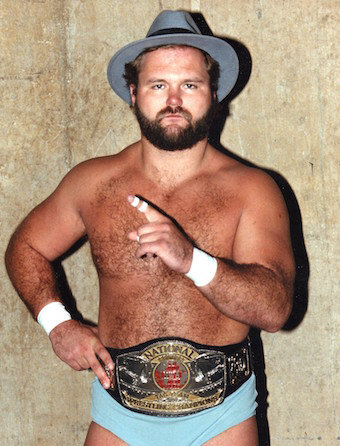 |
| The Enforcer, "Doube A" Arn Anderson One-half of the National Tag Team Champions with Ole Anderson (Eddie Cheslock Photo) |
And while "the Rock" (Ole's longtime nickname, long before that other guy named the Rock came along) served as part of the foundation of the Horsemen for only it's first full year, that foundation he helped build proved firm enough for him to walk away and leave a valuable spot open for younger, perhaps hungrier members to take his place, including Lex Luger in 1987 and Barry Windham in 1988.
Ole Anderson Returns to Full Time Action
Ole forming the team with Arn in the spring of 1985 meant a return to full time action in the ring. He had been retired from full time wrestling since the summer of 1983 when he devoted all of his energy into booking and promoting Georgia Championship Wrestling, in which was part owner, and later his own Georgia-based promotion after the takeover of the long-standing Georgia NWA office by the WWF that is part of the legend of Black Saturday. He wrestled sporadically in 1984 and early 1985, but more as a special attraction than as a regular part of any program or storyline. But when Jim Crockett, Jr. bought the TV time on the SuperStation in the spring of 1985 and basically absorbed Ole's struggling promotion, Ole committed to returning ot the ring full-time and finishing out the year of 1985, working to recoup some of his lost fortune that he has sunk into his promotion, but also to help develop Arn Anderson as a star for booker Dusty Rhodes. That later blossomed organically into the Four Horsemen with Ric Flair, Tully Blanchard and James J. Dillon. Ole took the late winter and spring of 1986 off to follow his son Bryant's amateur wrestling career. Business was so good for Jim Crockett Promotions that Ole came back for the balance of 1986 full-time as part of an amazing boom period for JCP. That would be his last full-time stint working in the ring, although he did come back for a part-time run, teaming with Arn in Ted Turner's WCW in late 1989 and 1990 as part of a reformation of the Horsemen.
"He was at the end of his career," Arn said on his podcast of his run with Ole in 1985. "He made that pretty clear when he
came back (to working a full schedule in 1985). He wasn't going to wrestle for years, but he helped give us a
launching pad."
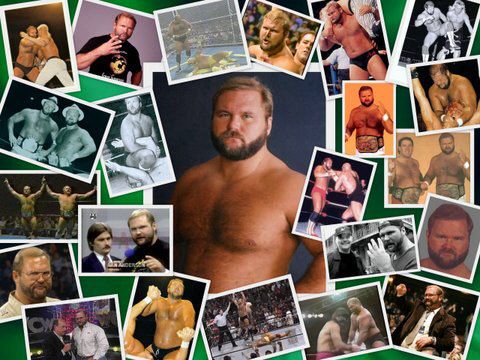 |
| Photo collage courtesy Mike Cline, Mid-Atlantic Grapplin' Greats |
Arn Anderson's Launching Pad
Ole Anderson providing a launching pad for Arn actually had it's roots two years earlier. Arn has spoken often about Ole launching his career into the big time by making him an Anderson in April of 1983, when Marty Lunde was dubbed Arn Anderson, the nephew of Ole Anderson. Ole (as booker for Georgia) teamed him with second generation wrestler Matt Borne and gave them a push as part of an early version of Paul Ellering's fledgling stable, the Legion of Doom.
Arn kept the Anderson name after leaving Georgia in Spetember of 1983 for the Southeast Wrestling territory (Alabama and panhandle of Florida) run by Ron Fuller, which was booked then by Bob Armstrong who gave Arn his first break as a main-event status wrestler, forming a team with "Mr. Olympia" Jerry Stubbs. The two were frequent Southeastern tag team champions. He made spot appearances back in Georgia during that time, returning to fight his "uncle" Ole Anderson in a few matches, who at that point was the babyface authority figure for Georgia Championship Wrestling. That additional exposure as a main-eventer on the nationally televised WTBS show gave Arn more recognition as a "top guy."
When NWA World Champion Ric Flair toured the Southeastern area, he became friends with Arn and subsequently recruited him to join Jim Crockett Promotions in the spring of 1985, where booker Dusty Rhodes quickly teamed him up with returning Ole Anderson to reform a new Minnesota Wrecking Crew, changing the family relationship to cousins.
The rest is history. How firm a foundation, indeed.
* * * * * *
The episode of the podcast with the discussion about Ole is "Ask Arn Anything #40" which originally aired April 27, 2021 and is available on all podcast platforms as well as the Westwood One website page for Arn's show.

Tuesday, May 04, 2021

Friday, February 26, 2021
Make it Good! - Dusty Rhodes Channels His Inner Marlon Brando
by Dick Bourne
Mid-Atlantic Gateway
On a long-ago episode of The J.J. Dillon Show podcast (mlwradio.com), J.J. and co-host Rich Bocchini discussed the infamous incident in October of 1986 where the Four Horsemen jumped Dusty Rhodes in the parking lot of Jim Crockett Promotions on Briarbend Drive in Charlotte. That ambush left the American Dream with a broken arm as he prepared for a big steel cage tag-team battle with the Horsemen that weekend in Charlotte.
As it played out, the Horsemen, in two separate vehicles, followed an unsuspecting Rhodes in his little red convertible to the offices of Jim Crockett Promotions where they attacked Rhodes in the parking lot, beat him down, and tied him to a ring-truck, arms stretched out as if he were to be crucified.
One of the most often-discussed moments in that big angle was when Dusty cried out three famous words just before the Horsemen whacked his right hand with a baseball bat - -
"Make it good!"
There was much discussion by fans at the time suggesting this was Rhodes' attempt to verbally direct the action in the skit taking place that he was a part of. But J.J. maintains that wasn't the case.
"There were critics that didn't like Dusty," Dillon told Bocchini, "who said, 'Oh, there's Dusty, he had to let everyone know that he was orchestrating everything' - - which was not true."
J.J. explained that it all had to do with Dusty's fondness for the cinema. Especially westerns.
"Dusty was somebody who loved the movies," Dillon said. "and he loved seeing moments in a movie and re-creating those moments. And one of those moments was in the movie 'One Eyed Jacks' where Marlon Brando was this gunslinger who was terrorizing this town."
In the movie, Marlon Brandon's character Rio had been betrayed by his partner and fellow-outlaw "Dad" Longworth (portrayed by Karl Malden) following a bank robbery the two had committed together. Many years later, Longworth had become Sheriff, and when Rio returns to town to confront Longworth, Rio is captured, tied to a hitching post and whipped. But the worst blow of all was still yet to come.

Edited from a post originally published on September 26, 2017 on the Mid-Atlantic Gateway.

Mid-Atlantic Gateway
On a long-ago episode of The J.J. Dillon Show podcast (mlwradio.com), J.J. and co-host Rich Bocchini discussed the infamous incident in October of 1986 where the Four Horsemen jumped Dusty Rhodes in the parking lot of Jim Crockett Promotions on Briarbend Drive in Charlotte. That ambush left the American Dream with a broken arm as he prepared for a big steel cage tag-team battle with the Horsemen that weekend in Charlotte.
 |
| Dusty got the inspiration for this scene where he is tied to Klondike Bill's ring truck from Marlon Brando in the movie "One Eyed Jacks." |
As it played out, the Horsemen, in two separate vehicles, followed an unsuspecting Rhodes in his little red convertible to the offices of Jim Crockett Promotions where they attacked Rhodes in the parking lot, beat him down, and tied him to a ring-truck, arms stretched out as if he were to be crucified.
One of the most often-discussed moments in that big angle was when Dusty cried out three famous words just before the Horsemen whacked his right hand with a baseball bat - -
"Make it good!"
There was much discussion by fans at the time suggesting this was Rhodes' attempt to verbally direct the action in the skit taking place that he was a part of. But J.J. maintains that wasn't the case.
"There were critics that didn't like Dusty," Dillon told Bocchini, "who said, 'Oh, there's Dusty, he had to let everyone know that he was orchestrating everything' - - which was not true."
J.J. explained that it all had to do with Dusty's fondness for the cinema. Especially westerns.
"Dusty was somebody who loved the movies," Dillon said. "and he loved seeing moments in a movie and re-creating those moments. And one of those moments was in the movie 'One Eyed Jacks' where Marlon Brando was this gunslinger who was terrorizing this town."
In the movie, Marlon Brandon's character Rio had been betrayed by his partner and fellow-outlaw "Dad" Longworth (portrayed by Karl Malden) following a bank robbery the two had committed together. Many years later, Longworth had become Sheriff, and when Rio returns to town to confront Longworth, Rio is captured, tied to a hitching post and whipped. But the worst blow of all was still yet to come.
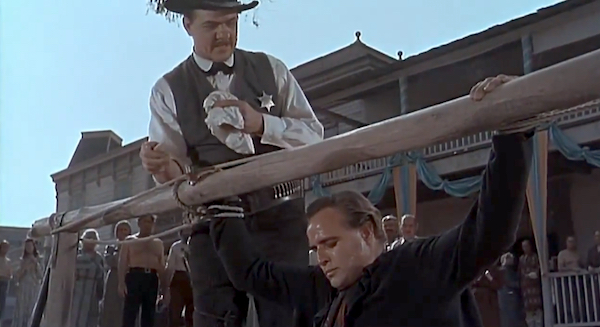 |
| Sheriff "Dad" Longworth (Karl Malden) taunts Rio (Marlon Brando) in the 1961 film "One Eyed Jacks." |
Rio, barely able to speak, tells Longworth, "You better kill me." His meaning was that after all you've done to me - - you've betrayed me, you've whipped me - - you might as well kill me. Because if you don't, I'll be back to kill you.
But Longworth says killing him isn't necessary. He picks up his rifle and smashes it down on Rio's right hand, the hand this gunslinger used to draw and shoot his gun. Without the use of that right hand, he would be no threat to anyone.
J.J. said it is this scene that Rhodes was channeling in the angle with the Horsemen. Rhodes was telling the Horsemen that if you are going to try and take me out, you better make it good.
In Dusty's recreation of the scene from "One Eyed Jacks" with the Horsemen, the rifle became Ole's baseball bat, and the hitching post became one of Klondike Bill's ring trucks. The Horsemen tied him to the truck, and you hear Ole telling J.J. to make sure his paid cameraman zooms in close. Even though Rhodes was tied to the truck, Ole and Arn held him tightly as Tully Blanchard wielded the blow of the baseball bat on Rhodes' right hand.
You better kill me. Make it good.
It was a bit of revenge for Blanchard in particular, who was on crutches due to an earlier injury from a match in Greensboro when Rhodes refused to release a figure-four leg lock.
At the very end of the video tape of the Horsemen angle, you hear J.J. Dillon tell Dusty, "I want this to serve as a warning, Rhodes. We'll see you tomorrow night in Charlotte, you cripple!"
At the end of the movie "One Eyed Jack," Longworth might have wished he had killed Rio because, with his drawing hand now healed, Brando returns to kill Malden in a final showdown.
And even though Rhodes had warned the Horsemen to "make it good", they didn't make it good enough. The next night in Charlotte, Ole and J.J. Dillon (substituting for the injured Blanchard) entered the cage in Charlotte. Rhodes, his right hand and arm in a cast, introduced his mystery partner - - - Nikita Koloff. The hated "Russian Nightmare" had joined the "American Dream" Dusty Rhodes to battle the Four Horsemen in the wake of Magnum T.A.'s career-ending automobile accident.
The huge crowd in Charlotte loved it. It wound up being one of the most dramatic, emotional moments of the year.
Edited from a post originally published on September 26, 2017 on the Mid-Atlantic Gateway.
Wednesday, January 29, 2020
The Women of the Four Horsemen
 At different points in time throughout the years, various women played important roles in support of the Four Horsemen. Most commonly referred to as valets, they were much more than that defined role. There are countless key moments throughout the in-ring history of the Four Horsemen where their actions had a decisive impact on match finishes and title changes. Baby Doll turning on Dusty Rhodes in 1986 to allow Ric Flair to retain his World championship is one example. Miss Elizabeth turning on Randy Savage is another, where she loaned Flair one of her high- heeled shoes as a foreign object to aid him in regaining the World title.
And make no mistake, all five of the women officially associated with the Horsemen were gorgeous and proved to be distractions to the Horsemen’s opponents. Sadly, some were also proven to be distractions within the Horsemen themselves. Benoit’s romantic relationship with Woman proved to exacerbate the Horsemen’s adversarial relationship with Kevin Sullivan. And there was always drama surrounding the actions of Debra McMichael, who encouraged bringing trouble-maker Jeff Jarrett into the Horsemen. She eventually left her husband for Jarrett in what was one of the worst periods of dissension within the ranks of the group.
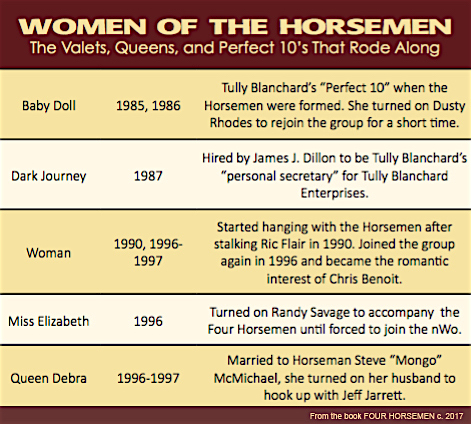
But regardless of how it played out, the women of the Four Horsemen were always an intriguing part of the story.
"... a nice slice of the apple pie that was Jim Crockett Promotions in the 1980s."
- Mike Johnson, PWInsider.com
- Mike Johnson, PWInsider.com
"...an authoritative volume on the history of The Four Horsemen."
- Mike Mooneyham, Charleston Post & Courier
"The book serves as a journal of my years with the Four Horsemen."
- James J. Dillon
"Four fingers up!"
- Bruce Mitchell, PWTorch.com
The article above is a brief excerpt from chapter seven, "Reflections," in the book "Four Horsemen: A Timeline History" (KDP Publishing). Further information on the book can be found in the Mid-Atlantic Gateway Book Store and the book can be purchased on Amazon.com.
Monday, January 29, 2018
Four Horsemen Reunion a Hit at Icons of Wrestling
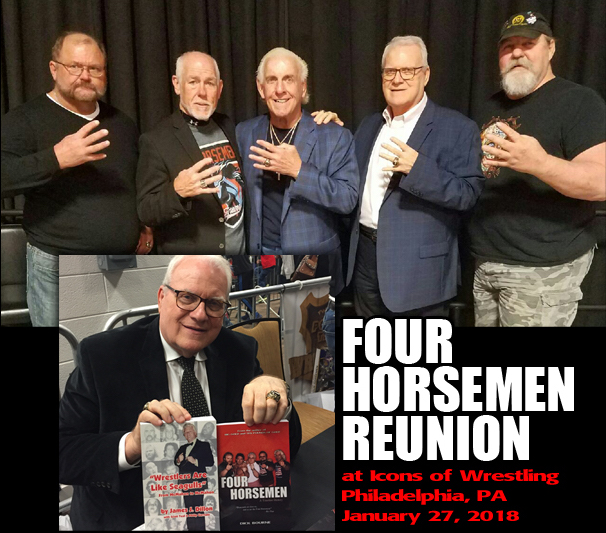
There was a great Four Horsemen reunion this past weekend at the huge Icons of Wrestling event in Philadelphia, PA.
Reuniting for photos and autographs were all members of the 1988 JCP version of the Horsemen: Arn Anderson, Tully Blanchard, Ric Flair, and Barry Windham, with the leader of the Four Horsemen James J. Dillon.

The next scheduled reunion of the Four Horsemen takes place February 17 at the MCW Pro Wrestling event in Joppa, MD. The event celebrates the 30th anniversary of the "Windham version" of the Four Horsemen. For more information, visit their Facebook Event Page.
When James J. Dillon makes an appearance, he has with him the book "Four Horsemen: A Timeline History" by the Mid-Atlantic Gateway's Dick Bourne. Of course, J.J. always has his autobiography for sale as well, "Wrestlers are Like Seagulls" co-written with Scott Teal of Crowbar Press.
Want to buy these books online? Visit the links below.
BUY ONLINE
Four Horsemen: A Timeline History by Dick Bourne
Wrestlers are Like Seagulls by James J. Dillon with Scott Teal
Reuniting for photos and autographs were all members of the 1988 JCP version of the Horsemen: Arn Anderson, Tully Blanchard, Ric Flair, and Barry Windham, with the leader of the Four Horsemen James J. Dillon.
The next scheduled reunion of the Four Horsemen takes place February 17 at the MCW Pro Wrestling event in Joppa, MD. The event celebrates the 30th anniversary of the "Windham version" of the Four Horsemen. For more information, visit their Facebook Event Page.
When James J. Dillon makes an appearance, he has with him the book "Four Horsemen: A Timeline History" by the Mid-Atlantic Gateway's Dick Bourne. Of course, J.J. always has his autobiography for sale as well, "Wrestlers are Like Seagulls" co-written with Scott Teal of Crowbar Press.
Want to buy these books online? Visit the links below.
BUY ONLINE
Four Horsemen: A Timeline History by Dick Bourne
Wrestlers are Like Seagulls by James J. Dillon with Scott Teal
Tuesday, September 26, 2017
Make It Good: Dusty Rhodes channels his inner Marlon Brando
by Dick Bourne
Mid-Atlantic Gateway
On a recent episode of "The JJ Dillon Show" podcast (mlwradio.com), JJ and co-host Rich Bocchini discussed the infamous incident in October of 1986 where the Four Horsemen jumped Dusty Rhodes in the parking lot of Jim Crockett Promotions on Briarbend Drive in Charlotte. That ambush left the American Dream with a broken arm as he prepared for a big steel cage tag-team battle with the Horsemen that weekend in Charlotte.
As it played out, the Horsemen, in two separate vehicles, followed an unsuspecting Rhodes in his little red convertible to the offices of Jim Crockett Promotions where they attacked Rhodes in the parking lot, beat him down, and tied him to a ring-truck, arms stretched out as if he were to be crucified.
One of the most often-discussed moments in that big angle was when Dusty cried out three famous words just before the Horsemen smashed his right hand with a baseball bat - -
"Make it good!"
There was much discussion by fans at the time suggesting this was Rhodes' exposed attempt to verbally direct the action in the skit taking place that he was a part of. But JJ maintains that wasn't the case.
 "There were critics that didn't like Dusty," Dillon told Bocchini, "who said, 'Oh, there's Dusty, he had to let everyone know that he was orchestrating everything' - - which was not true."
JJ explained that it all had to do with Dusty's fondness for the cinema. Especially westerns.
"Dusty was somebody who loved the movies," Dillon said. "and he loved seeing moments in a movie and re-creating those moments. And one of those moments was in the movie 'One Eyed Jacks' where Marlon Brando was this gunslinger who was terrorizing this town."
In the movie, Marlon Brandon's character Rio had been betrayed by partner and fellow-outlaw "Dad" Longworth (portrayed by Karl Malden) following a bank robbery the two had committed together. Many years later, Longworth had become Sheriff, and when Rio returns to town to confront Longworth, Rio is captured, tied to a hitching post and whipped. But the worst blow of all was still yet to come.
Mid-Atlantic Gateway
On a recent episode of "The JJ Dillon Show" podcast (mlwradio.com), JJ and co-host Rich Bocchini discussed the infamous incident in October of 1986 where the Four Horsemen jumped Dusty Rhodes in the parking lot of Jim Crockett Promotions on Briarbend Drive in Charlotte. That ambush left the American Dream with a broken arm as he prepared for a big steel cage tag-team battle with the Horsemen that weekend in Charlotte.
|
| Dusty got the inspiration for this scene where he is tied to Klondike Bill's ring truck from Marlon Brando in the movie "One Eyed Jacks." |
As it played out, the Horsemen, in two separate vehicles, followed an unsuspecting Rhodes in his little red convertible to the offices of Jim Crockett Promotions where they attacked Rhodes in the parking lot, beat him down, and tied him to a ring-truck, arms stretched out as if he were to be crucified.
One of the most often-discussed moments in that big angle was when Dusty cried out three famous words just before the Horsemen smashed his right hand with a baseball bat - -
"Make it good!"
There was much discussion by fans at the time suggesting this was Rhodes' exposed attempt to verbally direct the action in the skit taking place that he was a part of. But JJ maintains that wasn't the case.
"There were critics that didn't like Dusty," Dillon told Bocchini, "who said, 'Oh, there's Dusty, he had to let everyone know that he was orchestrating everything' - - which was not true."JJ explained that it all had to do with Dusty's fondness for the cinema. Especially westerns.
"Dusty was somebody who loved the movies," Dillon said. "and he loved seeing moments in a movie and re-creating those moments. And one of those moments was in the movie 'One Eyed Jacks' where Marlon Brando was this gunslinger who was terrorizing this town."
In the movie, Marlon Brandon's character Rio had been betrayed by partner and fellow-outlaw "Dad" Longworth (portrayed by Karl Malden) following a bank robbery the two had committed together. Many years later, Longworth had become Sheriff, and when Rio returns to town to confront Longworth, Rio is captured, tied to a hitching post and whipped. But the worst blow of all was still yet to come.
|
| Sheriff "Dad" Longworth (Karl Malden) taunts Rio (Marlon Brando) in the 1961 film "One Eyed Jacks." |
Rio, barely able to speak, tells Longworth, "You better kill me." His meaning was that after all you've done to me - - you've betrayed me, you've whipped me - - you might as well kill me. Because if you don't, I'll be back to kill you.
But Longworth says killing him isn't necessary. He picks up his rifle and smashes it down on Rio's right hand, the hand this gunslinger used to draw and shoot his gun. Without the use of that right hand, he would be no threat to anyone.
JJ said it is this scene that Rhodes was channeling in the angle with the Horsemen. Rhodes was telling the Horsemen that if you are going to try and take me out, you better make it good.
In Dusty's recreation of the scene from "One Eyed Jacks" with the Horsemen, the rifle became Ole's baseball bat, and the hitching post became one of Klondike Bill's ring trucks. The Horsemen tied him to the truck, and you could hear Ole telling JJ to make sure his paid cameraman zooms in close. Even though Rhodes was tied to the truck, Ole and Arn held him still as Tully Blanchard wielded the blow of the baseball bat on Rhodes' right hand.
Make it good. You better kill me.
It was a bit of revenge for Blanchard in particular, who was on crutches due to an earlier injury from a match in Greensboro when Rhodes refused to release a figure-four leg lock.
At the very end of the video tape of the Horsemen angle, you hear JJ Dillon tell Dusty, "I want this to serve as a warning, Rhodes. We'll see you tomorrow night in Charlotte, you cripple!"
In the movie "One Eyed Jack," Marlon Brando warns Karl Malden he'd better kill him. But Malden chose not to do so and at the end of the movie, his drawing hand healed, Brando returns to kill Malden in a final showdown.
And even though Rhodes had warned the Horsemen to "make it good", they didn't make it good enough. The next night in Charlotte, Ole and JJ Dillon (substituting for the injured Blanchard) entered the cage in Charlotte. Rhodes, his right hand and arm in a cast, introduced his mystery partner - - - Nikita Koloff. The hated "Russian Nightmare" had joined the "American Dream" Dusty Rhodes to battle the Four Horsemen in the wake of Magnum T.A.'s career-ending automobile accident. The huge crowd in Charlotte loved it. It wound up being the most dramatic and emotional moment of the year.
This post was republished in edited form on Friday, February 27, 2021.
Monday, September 11, 2017
Arn Anderson & James J. Dillon appear on the Peanut City Showdown
by Dick Bourne
Mid-Atlantic Gateway
This past Saturday night at the VCW (Vanguard Championship Wrestling) show in Suffolk, VA, two of the original members of the Four Horsemen made appearances for the group, signing autographs and taking photos with the fans. Both men had copies of their books and photos for sale, and Dillon also made available the book "Four Horsemen", seen in the photo above.
J.J. also got involved with the show itself, coming out of retirement to manage Caleb Konley who was challenging Brandon Scott for the VCW Heavyweight championship. Scott's manager, Jerry Stephanitsis, had been banned from ringside by commissioner George Pantas for his constant interference which had helped Scott keep his title. Dillon would manage Konley to insure he got a fair shot at the championship this time.
Or so we thought.

In a huge swerve, J.J. took off one of his famous loafers as the referee had been knocked down and whacked Konley in the head with it to help Scott retain his VCW championship yet again. Commissioner Pantas came in afterwards as Scott celebrated to investigate and he got whacked in the head by Dillon as well!
Post match video:
J.J. showed why he is associated with champions and lived up to his reputation as one of the shrewdest businessmen and managers of all time!
The photo of Pantas with Anderson and Dillon at the top of this page was taken before the show. One might imagine things weren't so friendly between Commissioner Pantas and James J. Dillon after the show.
It was a great night of VCW action in Suffolk presented by promoter Travis Bradshaw and crew, which benefited the Salvation Army. VCW returns to action on October 7 in Norfolk, VA at the Masonic Temple (1001 Granby St.) with Billy Gunn challenging Brandon Scott for the VCW championship (which he still holds thanks to the assistance of the leader of the Four Horsemen James J. Dillon!)

Mid-Atlantic Gateway
 |
| Arn Anderson, VCW Commissioner George Pantas, and James J. Dillon in Suffolk, VA for VCW Pantas is holding his copy of our book "Four Horsemen." |
This past Saturday night at the VCW (Vanguard Championship Wrestling) show in Suffolk, VA, two of the original members of the Four Horsemen made appearances for the group, signing autographs and taking photos with the fans. Both men had copies of their books and photos for sale, and Dillon also made available the book "Four Horsemen", seen in the photo above.
J.J. also got involved with the show itself, coming out of retirement to manage Caleb Konley who was challenging Brandon Scott for the VCW Heavyweight championship. Scott's manager, Jerry Stephanitsis, had been banned from ringside by commissioner George Pantas for his constant interference which had helped Scott keep his title. Dillon would manage Konley to insure he got a fair shot at the championship this time.
Or so we thought.
In a huge swerve, J.J. took off one of his famous loafers as the referee had been knocked down and whacked Konley in the head with it to help Scott retain his VCW championship yet again. Commissioner Pantas came in afterwards as Scott celebrated to investigate and he got whacked in the head by Dillon as well!
Post match video:
J.J. showed why he is associated with champions and lived up to his reputation as one of the shrewdest businessmen and managers of all time!
The photo of Pantas with Anderson and Dillon at the top of this page was taken before the show. One might imagine things weren't so friendly between Commissioner Pantas and James J. Dillon after the show.
It was a great night of VCW action in Suffolk presented by promoter Travis Bradshaw and crew, which benefited the Salvation Army. VCW returns to action on October 7 in Norfolk, VA at the Masonic Temple (1001 Granby St.) with Billy Gunn challenging Brandon Scott for the VCW championship (which he still holds thanks to the assistance of the leader of the Four Horsemen James J. Dillon!)
Friday, September 08, 2017
Action Figures Friday: The Four Horsmen (1986 and 1988)
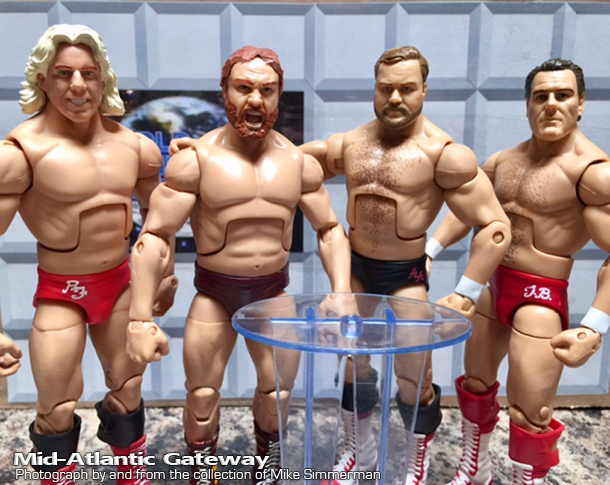 |
| Four Horsemen 1986: Ric Flair, Ole Anderson, Arn Anderson, and Tully Blanchard |
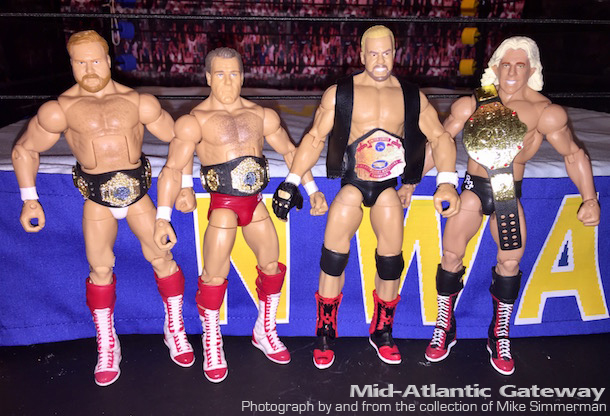 |
| Four Horsemen 1988: NWA World Tag Team Champions Arn Anderson and Tully Blanchard, United States Champion Barry Windham, and NWA World Heavyweight Champion Ric Flair |
Wednesday, July 12, 2017
James J. Dillon video-podcast interview with WrestlingINC.com
J.J. Dillon appeared today in a video-podcast interview with the good folks at WrestlingINC.com, talking about his history in the business as well as his upcoming appearance at the Trago/Thesz Pro Wrestling Hall of Fame Weekend in Waterloo, Iowa (July 20-22).

Friday, June 23, 2017
"What Happened When" Four Horsemen Podcast Part 2 This Monday

ENTER BARRY WINDHAM!
The series also celebrates the new book "Four Horsemen: A Timeline History", which has been an Amazon #1 bestseller in wrestling books most of the time since it's launch back on June 5th.
Part 1 that debuted on 6/19 (available for streaming or download now) covered the origins of the Four Horsemen, the original version with Ole Anderson, and the Lex Luger version of 1987. They left off with Lex being kicked out of the Horsemen, which sets the stage for Barry Windham joining the group in 1988. This is the version of the Horsemen that most fans pick as technically the best, but that will be an interesting point of discussion. Tony has already declared he thought the Ole Anderson version was the best. James J. Dillon has echoed those sentiments. At various times Ric Flair and Arn Anderson have also said the same. Conrad hasn't declared yet, so that particular topic will be fun this Monday.
Join Tony and Conrad as they continue to explore the early years of the Four Horsemen from their inception in 1985 through the bitter end of the Horsemen in 1999. Conrad will use the book as a road map for all the important events and happenings along the way, and Tony will fill us all in on everything that was happening behind the scenes
Tune in Monday to "What Happened When"!

Wednesday, June 14, 2017
"What Happened When" Four Horsemen Episode Monday 6/19
This coming Monday, June 19, Tony Schiavone and Conrad Thompson will present a special FOUR HORSEMEN episode of their popular "What Happened When" podcast on the MLW Radio Network.
The episode also celebrates the new book "Four Horsemen: A Timeline History", which has been an Amazon #1 bestseller in wrestling books since it's launch back on June 5th.
 Join Tony and Conrad as they discuss all things related to the Four Horsemen from their inception as a group in 1985 in Jim Crockett Promotions to their demise in WCW in 1999. Conrad will use the book as a road map for all the important events and happenings along the way, and Tony will fill us all in on everything that was happening behind the scenes.
Tony Schiavone was there holding the microphone on Briarbend Drive in Charlotte, NC, when Arn Anderson coined the phrase "four horsemen" as it related to the group. And he was heading up the broadcast team on Monday Nitro on TNT when the Horsemen fell apart. He saw it all in the 13-plus years in between and he will share it all with the loyal listeners of one of the most popular and successful pro wrestling podcasts today.
The Horsemen podcast drops this Monday, June 19 on the MLW Radio Network, iTunes, and wherever you get your podcasts. Tune in to "What Happened When"!
And buy your copy of the book now at WHW.midatlanticgateway.com.
Saturday, June 10, 2017
Saturday TV: World Championship Wrestling 1-4-86
This is one of my all-time favorite episodes of "World Championship Wrestling" from 1/4/86 and features the Four Horsemen reeling after Dusty Rhodes and the Road Warriors break the leg of Ole Anderson on New Year's Night in Atlanta's Omni. The Horsemen, who were really just coming to be known under that moniker, would be without Ole until his dramatic return later that June.
The program features some outstanding promos, including the famous (and hilarious) interview where Ric Flair winds up in the floor of the studio demonstrating what it would be like for Baby Doll if she ever rode Space Mountain.
The show also spotlights a major development for the Horsemen, as James J. Dillon becomes the Executive Director of Tully Blanchard Enterprises and soon after the de facto leader of the Four Horsemen.
The show also features a rare appearance by former NWA World champion and reigning Missouri State Champion Harley Race.
Tuesday, May 30, 2017
Best of the Gateway: Horsemen Origins
Mid-Atlantic Gateway
This story was originally published on Nov. 8, 2015.
The fall of 2015 marks the 30th anniversary of the origin of the Four Horsemen in wrestling. There is much discussion on exactly when the group got its name, but there is no longer any doubt of how it happened. Arn Anderson coined the phrase in the late fall of 1985 during one of the local promo tapings and it just sort of stuck. He said at that time something along on the lines of this:
"Not since the four horsemen of the apocalypse have so few wreaked so much havoc on so many." - Arn Anderson, Fall of 1985

THE LOCAL PROMOS
I have always thought it had to have happened in a local promo, one of the hundreds that were taped at the Briarbend Drive make-shift studio during each week and then inserted into one of the shows for the local markets. It was perhaps repeated in several promos in various forms before someone realized they were on to something.
Arn Anderson confirmed that in a recent conversation I had with him this past summer, and added further credit to an individual who had not been tied to the origin before that - Tony Schiavone.
"Yes, it was on a local promo," Arn told me (as outlined in my earlier article "Andersons Don't Wear Fedoras"). "And in fact, I just said it off the cuff, not really intending to be coming up with a name for us or anything like that. It was Tony Schiavone who actually validated the whole thing. He looked at me after the promo was over and said, 'I think you just named yourself.' And that led to us starting to refer to ourselves as the Four Horsemen."

TIMING
The question still remains, however, as to exactly when that happened. There is no doubt that the idea of the four wrestlers by that name gelled in November of 1985. As best as I have been able to determine, Arn first classified them as the Four Horsemen on regular TV (as opposed to local promos) on the November 9, 1985 Saturday night episode of World Championship Wrestling. As United States heavyweight champion Tully Blanchard waited in the ring with Baby Doll for his scheduled TV match, Arn was doing an interview at the podium with Tony Schiavone and said:
"What you've got right here in the ring, you've got a champion. You've got Tully Blanchard. You've got Ole Anderson. You've got myself, and last but by no means least, you've got Ric Flair, the world's heavyweight champion. You're talking about the four horsemen of professional wrestling - - the people that make things happen." - Arn Anderson 11/09/85 WTBS
But the idea had been incubating in Arn's mind much earlier than that and actually goes back to the middle of October. During this time, Tully Blanchard started to become aligned with the family of Ric Flair and his cousins Ole and Arn Anderson. Flair and the Andersons had just injured Dusty Rhodes in the cage in the Omni in that huge angle that led to the main event at Starrcade '85. There was no angle that brought Tully into that story, I think it just made sense that the top heels were all hanging together.
On the October 12, 1985 episode of World Championship Wrestling, after review of all the Omni footage, Arn says:
“As you know, Tony Schiavone, David Crockett - - I run with the world heavyweight champion Ric Flair, Tully Blanchard, and Ole Anderson. That’s an elite group in all the world.” - Arn Anderson 10/12/85 WTBS
Arn hadn't come up with the Horsemen name here yet, but the idea of the four of them as an elite group was clearly being conceptualized right there.
TULLY BLANCHARD'S TRANSITION
The whole marriage of Blanchard with Flair and the Andersons happened relatively quickly. But it hadn't looked that cozy to begin with. Just one month earlier than that 10/12 interview above, Blanchard and Flair would take shots at each other in interviews over silly things like their watches.
On the September 21, 1985 edition of World Championship Wrestling, Tully shows off a gold and diamond watch that Baby Doll had given him. Flair came out later and said:
"First of all we'll start the day off by telling you -- wooo! -- it is Rolex time, Tully Blanchard! So don't be bringing out one of those Mickey Mouse watches and trying to impress the world. You might be the U.S. heavyweight champion, Tully Blanchard, but you are still carrying around a silver belt -- wooo! - instead of the gold!" - Ric Flair 9/21/85 WTBS
This was during Flair's time as a "tweener" when he was feuding with Magnum T.A. and Dusty Rhodes on the babyface side and Buddy Landel and Nikita Koloff on the heel side - - all at the same time! Plus he was still a touring NWA world champion and would often times mention wrestlers in other territories such as Bob Armstrong in Southeastern Wrestling, Wahoo McDaniel in Florida, Harley Race in Kansas City, Kerry Von Erich in Texas, and others. He was was giving these great interviews every week where he would crack on the babyfaces and the heels all in the same promo!
Throughout that time, though, he was always aligned with his family, his cousins Ole and Arn Anderson. And less than one month later, Blanchard was aligned with them as well, as reflected by Arn's 10/12 interview above.
JAMES J. DILLON & BABY DOLL
Another thing forgotten in all of this history is that James J. Dillon was not part of this original unofficial grouping of the Four Horsemen. In fact, one could argue Baby Doll, by her association with Tully as his "Perfect 10" at the time) was part of the original group before Dillon.
|
| The Four Horsemen book goes on sale June 5, 2017 on the Mid-Atlantic Gateway and Amazon.com. |
And even that wasn't in a managerial sense yet. J.J. had become the "executive director" of Tully Blanchard enterprises and was really just Tully's manager early on. He morphed into manager of the whole group through the late winter and spring of 1986. By the time Ole Anderson had returned to action following a worked injury in June of 1986, Dillon was the official manager of the Four Horsemen.
WRECKING CREW HISTORY
In my book "Minnesota Wrecking Crew", a timeline history of the Anderson family in wrestling, I reference the the earliest mention of the "Four Horsemen" name by Arn as taking place in October. I firmly believe that earliest reference was during the promo tapings in one of the last two weeks of that month. In those days, I kept notes about the TV shows in a day planner. In the notes for the 10/26/85 World Wide Wrestling show I have written "the four horses" in quotes. This wound up being a loose reference by Arn to what would become "four horsemen" very soon in Arn's interviews. It is why I peg the month as October for the first mention of the name Four Horsemen, although none of us have ever found it yet.
Tuesday, May 16, 2017
Four Horsemen: A Timeline History

WIN IT BEFORE YOU CAN BUY IT.
Only on "What Happened When" with Tony Schiavone & Conrad Thompson.
Check out Episode #16 (Fall Brawl '97) for details.
Thursday, March 02, 2017
The Windham Brothers channel Anderson and Blanchard
The team of Barry and Kendall Windham very clearly mimic Arn Anderson and Tully Blanchard after forming their tag team in the wake of the Horsemen departures.
by Dick Bourne
Mid-Atlantic Gateway
In January of 1989, the Four Horsemen as they existed at that time were on their last legs as a unit. Tully Blanchard and Arn Anderson had jumped to the WWF a few months earlier. In the storyline, Hiro Matsuda would soon purchase the contracts of remaining members Ric Flair and Barry Windham from James J. Dillon, along with others under Dillon's managerial direction at that time. (Behind the scenes, Dillon also was leaving for the WWF.)
 Just before Matsuda entered the picture, Kendall Windham turned on tag-team partner Eddie Gilbert in a match against his brother Barry and James J. Dillon. it was a turn anyone should have seen coming a mile away, but apparently Gilbert missed it.
After making the turn, Kendall executed a surprising move on Gilbert - a "slingshot suplex." It was not a move he had used previously and of course immediately evoked images of the only other wrestler known to use that maneuver at the time - - a former Horseman - - Tully Blanchard.
After Kendall's heel turn, he and brother Barry Windham formed a regular tag-team for a short period of time, first managed by Dillon and then by Matsuda. In their first match together as a heel team on World Wide Wrestling on 1/28/89, they work the match in what can only be called "Anderson style", isolating one body part and continuing to work over that body part throughout the match. In this case, it was the arm.
Going back to Gene and Lars Anderson as the first combination of the Minnesota Wrecking Crew in the 1960s, the Andersons were famous for this style of work; pick one body part and stay after it until submission or the injured opponent is set up for pinfall. That approach became Anderson tradition through the subsequent pairings of various Anderson family members over the years, including Ole and Arn Anderson in the Four Horsemen.
It was striking to see The Windham brothers taking a page out of the book of the Anderson brothers in their first match together in 1989. They tagged in and out frequently while working over the arm. They even used the familiar "Anderson slam" on the arm, that famous hammerlock-style body slam where an opponent is body slammed on his own arm locked behind him. That had been one of the signature moves of the Andersons over the years. And Barry even added a new twist: adding a "power slam" when bringing his opponent down on the arm. It was awesome looking, indeed.
Added all together - - Tully's "slingshot suplex" and Arn's "Anderson slam" - - and it became clear that the Windhams were intentionally channeling Tully Blanchard and Arn Anderson. These new moves that the Windhams were doing for the first time weren't just a coincidence.
You have to wonder why, though. What was the point? All it did was remind fans of the two Horsemen who had left the NWA and were now wrestling for the WWF. And that didn't seem very wise to me - - then or now.
In the end, things were getting ready to change so quickly that it didn't really matter. Barry and Kendall didn't team regularly for too much longer, and both left the promotion in the following few months. Ric Flair renewed his old rivalry with the returning Ricky Steamboat and so the Horsemen were done for the time being.

by Dick Bourne
Mid-Atlantic Gateway
In January of 1989, the Four Horsemen as they existed at that time were on their last legs as a unit. Tully Blanchard and Arn Anderson had jumped to the WWF a few months earlier. In the storyline, Hiro Matsuda would soon purchase the contracts of remaining members Ric Flair and Barry Windham from James J. Dillon, along with others under Dillon's managerial direction at that time. (Behind the scenes, Dillon also was leaving for the WWF.)
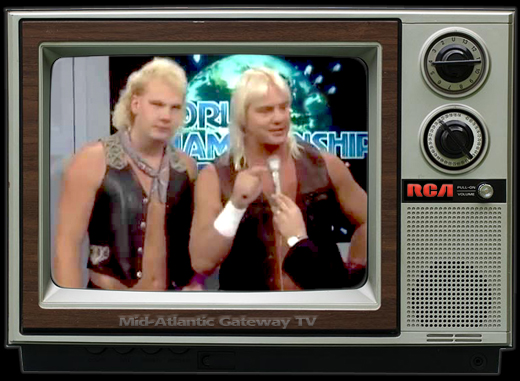
After making the turn, Kendall executed a surprising move on Gilbert - a "slingshot suplex." It was not a move he had used previously and of course immediately evoked images of the only other wrestler known to use that maneuver at the time - - a former Horseman - - Tully Blanchard.
After Kendall's heel turn, he and brother Barry Windham formed a regular tag-team for a short period of time, first managed by Dillon and then by Matsuda. In their first match together as a heel team on World Wide Wrestling on 1/28/89, they work the match in what can only be called "Anderson style", isolating one body part and continuing to work over that body part throughout the match. In this case, it was the arm.
Going back to Gene and Lars Anderson as the first combination of the Minnesota Wrecking Crew in the 1960s, the Andersons were famous for this style of work; pick one body part and stay after it until submission or the injured opponent is set up for pinfall. That approach became Anderson tradition through the subsequent pairings of various Anderson family members over the years, including Ole and Arn Anderson in the Four Horsemen.
It was striking to see The Windham brothers taking a page out of the book of the Anderson brothers in their first match together in 1989. They tagged in and out frequently while working over the arm. They even used the familiar "Anderson slam" on the arm, that famous hammerlock-style body slam where an opponent is body slammed on his own arm locked behind him. That had been one of the signature moves of the Andersons over the years. And Barry even added a new twist: adding a "power slam" when bringing his opponent down on the arm. It was awesome looking, indeed.
Added all together - - Tully's "slingshot suplex" and Arn's "Anderson slam" - - and it became clear that the Windhams were intentionally channeling Tully Blanchard and Arn Anderson. These new moves that the Windhams were doing for the first time weren't just a coincidence.
You have to wonder why, though. What was the point? All it did was remind fans of the two Horsemen who had left the NWA and were now wrestling for the WWF. And that didn't seem very wise to me - - then or now.
In the end, things were getting ready to change so quickly that it didn't really matter. Barry and Kendall didn't team regularly for too much longer, and both left the promotion in the following few months. Ric Flair renewed his old rivalry with the returning Ricky Steamboat and so the Horsemen were done for the time being.
Wednesday, January 13, 2016
The Symbol of Excellence
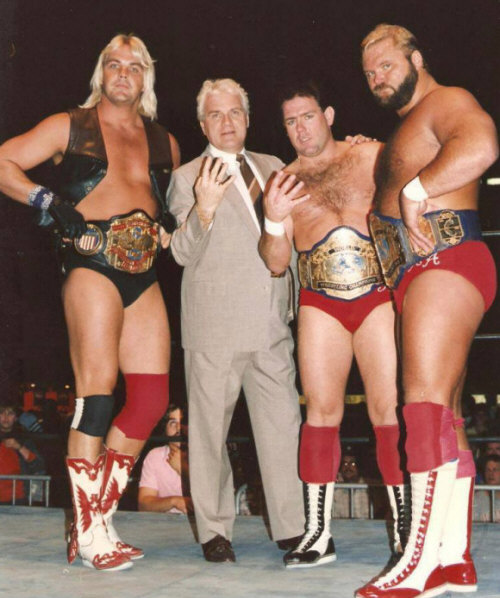
This was quite a team! Three of the Four Horsemen with all their hardware, flashing the four fingers, and accompanied as always by their manager James J. Dillon.
Arn Anderson and Tully Blanchard are wearing those beautiful blue NWA world tag team belts. Barry Windham is wearing the 5th version of the United States heavyweight championship belt. (Learn all about those 5 belts and the champions who wore them in the new book on the championship - info here.)
Photographer and location unknown, but a great photo of what many consider three of the greatest wrestlers of that era.

Thursday, December 10, 2015
Crockett Foundation T-Shirt Commemorates the Original Four Horsemen
***WHO'S ON YOUR WRESTLING RUSHMORE?***We've commemorated the original 4 Horsemen with this limited edition 2016...
Posted by Crockett Foundation on Wednesday, December 9, 2015
Wednesday, November 18, 2015
The Earliest Origins of the Four Horsemen
Mid-Atlantic Gateway
The fall of 2015 marks the 30th anniversary of the origin of the Four Horsemen in wrestling. There is much discussion on exactly when the group got its name, but there is no longer any doubt of how it happened. Arn Anderson coined the phrase in the late fall of 1985 during one of the local promo tapings and it just sort of stuck. He said at that time something along on the lines of this:
"Not since the four horsemen of the apocalypse have so few wreaked so much havoc on so many." - Arn Anderson, Fall of 1985
|
| 30th ANNIVERSARY |
THE LOCAL PROMOS
I have always thought it had to have happened in a local promo, one of the hundreds that were taped at the Briarbend Drive make-shift studio during each week and then inserted into one of the shows for the local markets. It was perhaps repeated in several promos in various forms before someone realized they were on to something.
Arn Anderson confirmed that in a recent conversation I had with him this past summer, and added further credit to an individual who had not been tied to the origin before that - Tony Schiavone.
"Yes, it was on a local promo," Arn told me (as outlined in my earlier article "Andersons Don't Wear Fedoras"). "And in fact, I just said it off the cuff, not really intending to be coming up with a name for us or anything like that. It was Tony Schiavone who actually validated the whole thing. He looked at me after the promo was over and said, 'I think you just named yourself.' And that led to us starting to refer to ourselves as the Four Horsemen."
TIMING
The question still remains, however, as to exactly when that happened. There is no doubt that the idea of the four wrestlers by that name gelled in November of 1985. As best as I have been able to determine, Arn first classified them as the Four Horsemen on regular TV (as opposed to local promos) on the November 9, 1985 Saturday night episode of World Championship Wrestling. As United States heavyweight champion Tully Blanchard waited in the ring with Baby Doll for his scheduled TV match, Arn was doing an interview at the podium with Tony Schiavone and said:
"What you've got right here in the ring, you've got a champion. You've got Tully Blanchard. You've got Ole Anderson. You've got myself, and last but by no means least, you've got Ric Flair, the world's heavyweight champion. You're talking about the four horsemen of professional wrestling - - the people that make things happen." - Arn Anderson 11/09/85 WTBS
But the idea had been incubating in Arn's mind much earlier than that and actually goes back to the middle of October. During this time, Tully Blanchard started to become aligned with the family of Ric Flair and his cousins Ole and Arn Anderson. Flair and the Andersons had just injured Dusty Rhodes in the cage in the Omni in that huge angle that led to the main event at Starrcade '85. There was no angle that brought Tully into that story, I think it just made sense that the top heels were all hanging together.
On the October 12, 1985 episode of World Championship Wrestling, after review of all the Omni footage, Arn says:
“As you know, Tony Schiavone, David Crockett - - I run with the world heavyweight champion Ric Flair, Tully Blanchard, and Ole Anderson. That’s an elite group in all the world.” - Arn Anderson 10/12/85 WTBS
Arn hadn't come up with the Horsemen name here yet, but the idea of the four of them as an elite group was clearly being conceptualized right there.
TULLY BLANCHARD'S TRANSITION
The whole marriage of Blanchard with Flair and the Andersons happened relatively quickly. But it hadn't looked that cozy to begin with. Just one month earlier than that 10/12 interview above, Blanchard and Flair would take shots at each other in interviews over silly things like their watches.
On the September 21, 1985 edition of World Championship Wrestling, Tully shows off a gold and diamond watch that Baby Doll had given him. Flair came out later and said:
"First of all we'll start the day off by telling you -- wooo! -- it is Rolex time, Tully Blanchard! So don't be bringing out one of those Mickey Mouse watches and trying to impress the world. You might be the U.S. heavyweight champion, Tully Blanchard, but you are still carrying around a silver belt -- wooo! - instead of the gold!" - Ric Flair 9/21/85 WTBS
This was during Flair's time as a "tweener" when he was feuding with Magnum T.A. and Dusty Rhodes on the babyface side and Buddy Landel and Nikita Koloff on the heel side - - all at the same time! Plus he was still a touring NWA world champion and would often times mention wrestlers in other territories such as Bob Armstrong in Southeastern Wrestling, Wahoo McDaniel in Florida, Harley Race in Kansas City, Kerry Von Erich in Texas, and others. He was was giving these great interviews every week where he would crack on the babyfaces and the heels all in the same promo!
Throughout that time, though, he was always aligned with his family, his cousins Ole and Arn Anderson. And less than one month later, Blanchard was aligned with them as well, as reflected by Arn's 10/12 interview above.
JAMES J. DILLON & BABY DOLL
Another thing forgotten in all of this history is that James J. Dillon was not part of this original unofficial grouping of the Four Horsemen. In fact, one could argue Baby Doll, by her association with Tully as his "Perfect 10" at the time) was part of the original group before Dillon.
J.J. Dillon was managing "Nature Boy" Buddy Landel during this time, and was involved in leading him in his chase of the National heavyweight championship that fall that culminated at Starrcade '85. He wasn't involved in any storyline with Blanchard or the Andersons, and only a peripheral story with Ric Flair. Landel and Flair had several "Battle of the Nature Boys" matches before Flair turned hardcore heel in the cage angle with Dusty. It wasn't until Landel was fired in mid-December that J.J. was put with Tully in a big angle at the Greensboro TV tapings right before the Crockett Promotions Christmas break. It was when those tapings aired right after the New Year holiday (the weekend of 1/4/86) that J.J. began to be associated with those who by then were loosely known as the Four Horsemen.
And even that wasn't in a managerial sense yet. J.J. had become the "executive director" of Tully Blanchard enterprises and was really just Tully's manager early on. He morphed into manager of the whole group through the late winter and spring of 1986. By the time Ole Anderson had returned to action following a worked injury in June of 1986, Dillon was the official manager of the Four Horsemen.
WRECKING CREW HISTORY
In my book "Minnesota Wrecking Crew", a timeline history of the Anderson family in wrestling, I reference the the earliest mention of the "Four Horsemen" name by Arn as taking place in October. I firmly believe that earliest reference was during the promo tapings in one of the last two weeks of that month. In those days, I kept notes about the TV shows in a day planner. In the notes for the 10/26/85 World Wide Wrestling show I have written "the four horses" in quotes. This wound up being a loose reference by Arn to what would become "four horsemen" very soon in Arn's interviews. It is why I peg the month as October for the first mention of the name Four Horsemen, although none of us have ever found it yet.
HOPE FOR DISCOVERY
I still believe that one day that lost promo with Arn referencing the four horsemen of the apocalypse will surface. Someone will find it on a video cassette they've had packed away for years. Someone might also find an earlier regular TV (non local promo) reference than the 11/09/85 WTBS interview referenced above.
If anyone reading this has more information they think can help flesh this out, I'm always anxious to learn more. Contact me through our "Contact Us" page, always linked from the menu bar at the top of the website.
In the meantime, let us all celebrate this anniversary of the Four Horsemen, 30 years ago this month! Where were you in November of 1985? For those of us lucky enough to be wrestling fans at the time, we were, as the great Dusty Rhodes might have put it, riding on the edge of that lightnin' bolt that is the wonderful story of the Four Horsemen.

 |
| The Crockett Foundation Four Horsemen T-Shirt |
The 2015 shirt is apparently sold out, but the 2016 shirt is on sale now! A Portion of all sales goes towards helping a veteran or retired service dog in need. Support these great causes and the work of the Crockett Foundation and get your Crockett Foundation Four Horseman t-shirt today - - available in 3 different color combinations!
Wednesday, October 21, 2015
Excellence: Three of the Four Horsemen
This was quite a team! Three of the Four Horsemen with all their hardware, accompanied as always by their manager James J. Dillon.
Arn Anderson and Tully Blanchard are wearing those beautiful blue NWA world tag team belts. Barry Windham is wearing the 5th version of the United States heavyweight championship belt. (Learn all about those 5 belts and the champions who wore them in the new book on the championship - info here.)
Photographer and location unknown, but a great photo of what many consider three of the greatest wrestlers of that era.
Subscribe to:
Posts (Atom)