Showing posts with label Wayne Brower. Show all posts

Thursday, June 16, 2022

Cowboy Bob Ellis, Rip Hawk and the Birthday Cake

The Birthday Cake
by Wayne Brower
Special to the Mid-Atlantic Gateway

Another weekend visit around 1960 to the grandparents afforded me the opportunity to watch wrestling and be a part of a birthday celebration – at the same time.

“Welcome to this week’s Championship Wrestling.” The announcer declared with authority.  He gave the run down of matches on the show and also told of a special event that we wouldn’t want to miss.

Cowboy Bob Ellis
from "Mid-Atlantic Grapplin' Greats"
It was the typical wrestling show of the era with two singles matches followed by a tag team battle to close the program.  However, an added treat occurred after the second match.  Coming back from commercial messages promoting live events in the viewing area, the announcer appeared with a rather large cake that sat atop his broadcast desk.  “Folks, we have a very special presentation today for a man who is loved by all, especially the children.  Cowboy Bob Ellis, will you please come out now and join us?  Let’s get him out here ladies and gentlemen.”

Taking their cue, the studio audience began to applaud and became louder when the popular Texan walked in.  Cowboy Bob was dressed to impress, with wardrobe accented in fancy western boots, vest and white Stetson.

“This is a very special day, Cowboy Bob Ellis, and we want to share it with everyone.  As you know Bob, the youngsters really look up to you.  When the kids at our local Crippled Children’s Home found out about today being your birthday, they saved their pennies to buy this cake for you.”  Cowboy Bob was noticeably moved.  A tear came to his eye and his voice quivered as he poured out his heart:  “…I’ve always tried to stand for what is right…and set a good example in everything I do…for those crippled children to remember me…”

BOOOOOO!

The crowd erupted with a volume that I had never heard and continued as a young, stocky man wearing a crew-cut and a scowl appeared on camera.  It was Rip Hawk.

"The Profile" Rip Hawk

The studio audience was still voicing their displeasure of Rip’s appearance at such a touching moment.  The announcer forcefully stated “We don’t want any trouble here; this is from the crippled children to Cowboy Bob.”  Hawk yells “I have birthdays too…and those stinking kids never did anything for me!”

Instantly upon finishing his insult he sucker punched Ellis and smashes him head first into the cake.  Icing, candles and other decorations explode over the desk, announcer and the combatants.  A brawl breaks out between Rip and Cowboy Bob.  The announcer is shouting into his microphone “I’ve never seen anything like this!  We must restore order here!  We’ll be back following the station break!”

Grandma was visibly shaken by Rip’s evil actions.  “The crippled children saved their pennies…” her voice trailed off.  My aunt came into the room wanting to know what was going on.  After getting a vivid description of the incident, she proclaimed “He must be the devil.”  For the sake of the television set, I’m glad grandpa wasn’t there.

The program returns to the studio where our host, desk and floor are covered with cake.  The announcer apologizes for what he describes as the single worst thing that had ever happened in wrestling.  He also tells us Cowboy Bob Ellis is so upset he cannot appear on camera for fear of what he may say, but Bob wants to assure the kids at the Crippled Children’s Home that he would avenge the loss of their life savings.

Rip Hawk’s horrific actions completely overshadow the main event.  As the Kentuckians were dominating a couple of heel jobbers, our TV host broke in with an important bulletin: “The promoter, Mr. Jim Crockett, has ordered Rip Hawk to meet Cowboy Bob Ellis on the next card at the Lexington YMCA!  Tickets will be on sale at the box office, and at the usual locations!”

I had no idea how much Rip Hawk and the Lexington YMCA would factor into my wrestling entertainment in the future years.

Originally written and published on the old Mid-Atlantic Gateway in March 2004
Republished here December 2015
Thanks to Wayne Brower


Friday, October 04, 2019

Fox Affliate WGHP in High Point/Greensboro Does History Feature with Gateway Contributor Wayne Brower

by Dick Bourne
Mid-Atlantic Gateway

In advance of tonight's debut of WWE Smackdown on the Fox broadcasting network, local Fox affiliate WGHP channel 8 out of the Greensboro/High Point/Winston-Salem market did a nice feature on the history of pro-wrestling at that station going back to the 1960s.

Morning anchor Brad Jones found our Gateway article on broadcast Hall-of-Famer Charlie Harville written by Gateway contributor Wayne Brower back in 2005 and had us get him in touch with Wayne for an interview for this morning's Friday morning news broadcast on WGHP. Fortunately, the video can also be found on the Fox8 website:


https://myfox8.com/2019/10/04/walk-through-wrestling-history-ahead-of-wwes-friday-evening-kickoff-on-fox8/

Walk through wrestling history ahead of WWE’s Friday evening kickoff on FOX8 

Wayne's article is one of my favorites ever submitted here, and I am thrilled WGHP came across it. Wayne did an outstanding job with them and it really takes you back to see the old photos of host Charlie Harville with wrestling legends like George Becker, Johnny Weaver, Rip Hawk, Swede Hanson, and others. Be sure to check out Wayne's article, as well as our Studio Wrestling page on wrestling at WGHP on the Mid-Atlantic Gateway Archive website.


Thursday, June 01, 2017

Live and in Person

You Never Forget Your First Live Wrestling Event
by Wayne Brower
Special to the Mid-Atlantic Gateway

Getting to see a wrestling show in person became a priority thing for me to accomplish.  As most kids would naturally do, I started with the parents.  Dad was no wrestling fan, although he always let me watch it on television. 

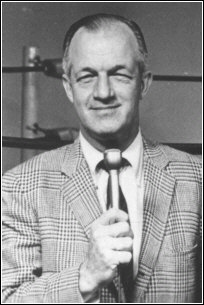
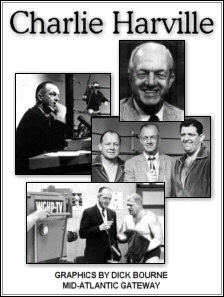
Charlie Harville
Host of "Championship Wrestling" on
WGHP Channel 8 in High Point, NC
Nevertheless, my desire to experience the spectacle grew.  There were occasional matches in Winston-Salem and Greensboro, but almost always there was a card on Saturday nights in Lexington at the YMCA.  Lexington matches at the time were advertised on the Charlotte broadcasts but primarily promoted on High Point’s Channel 8 wrestling by Charlie Harville.  Charlie was outstanding in his role as announcer as he could describe the maneuvers and holds of the matches, and then further advance storylines with the wrestlers during interviews.  Lexington matches were sold as major events you must see.

The turning point occurred in the fall of 1964 when I was visiting an aunt and uncle who lived near us in Trinity.  Somehow the conversation turned to my enjoyment of wrestling.  My aunt said that they watch it, and also went to the matches in Lexington.  I didn’t have to say anything since I’m sure my facial expression spoke volumes.  She then asked me to go with them.

Wow.  It was the opportunity of a lifetime.  The chance of going to wrestling while hanging out with an aunt, uncle and cousin that I really liked.  I asked her to call the next time they planned to go.

The call came the following Saturday afternoon.  I was expecting it and had obtained prior approval to go from my Dad.  He made sure that I was taking enough money as not to be a financial burden to my hosts.  He also reminded me to “behave myself.”  I privately wondered how a person could do that at wrestling.

Shortly thereafter we were on the way.  My cousin and I rode in the back seat of her parents’ Ford Galaxie as I listened intently to her stories of previous matches.  Normally a 13 year old boy would ignore a younger girl, but I thought that she was cool and besides, she was already a Lexington veteran. 

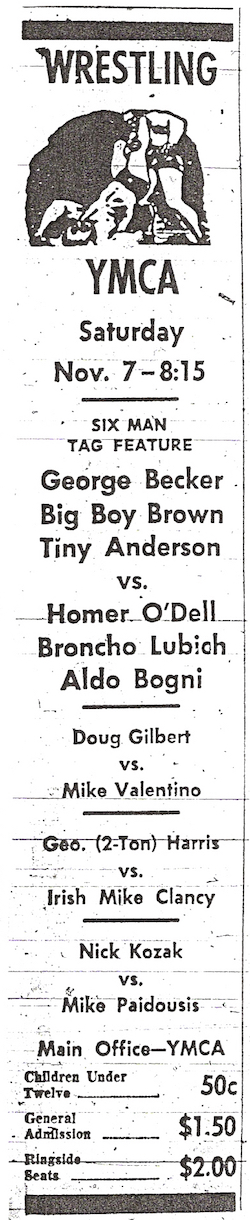
Arriving at the YMCA was quite an experience.  The building was much larger than I had imagined, and so was the crowd.  We stood in line for a short time to buy our tickets.  My uncle told me to get one for general admission as it was cheaper than ringside and you could actually see better from the elevated stands.  He was right.

The experience began as quite a humanity lesson for me.  As the arena filled before bell time a great cross section of the community came in and began to take their seats.  All socio-economic classes appeared to be represented.  A well dressed older couple walked to the ringside chairs, taking their seats as they shook hands with fans nearby.  Sitting throughout that section and most of the general admission area were various families and groups.  Their general appearance and conduct was just like that of the majority of patrons.  Two other factions in attendance also had distinctive representation.  One could be best described as belonging to the crimson collar category.  They were very friendly, loud, full of excitement, and seemed to be really enjoying the action – even though the matches had not even started.  Then there were the others, a small but distinct clan that would now be best described as the depraved hillbilly characters in the movie Deliverance.  But no matter, everyone in the arena was a wrestling fan.

To prepare ourselves for the festivities, my cousin and I visited the concession stand.  The selections available were hotdogs, popcorn, and a choice of three drinks – Nehi Grape, Nehi Orange or Coca-Cola.  I got popcorn and a Coke and was set for the evening.

Returning to our seats we found that several people around us had also gotten refreshments and were supplementing their drinks with liquids from odd shaped bottles brought in under their coats.  Throughout the evening these fans appeared to be very thirsty and made several return trips to the concession stand for as long as their supplemental beverages held up.

Minutes before the 8:15 pm starting time the crowd had already become restless.  Boos, yells and various catcalls echoed throughout the gymnasium.  Many people began to clap and stomp their feet in unison.

The audience began to cheer as Wally Dusek came out of a side door, walked to the ring and rang the bell loudly.  Several people, mostly children, ran to the end of the building where there were two separate entrance ways for the wrestlers.  More cheers came from the crowd as Nick Kozak walked out to a rousing approval. He strolled to the ring acknowledging the fans while signing autographs for those in step with him.

The opposite scene was played out when Mike Paidousis came out of the heels’ locker room.  He motioned for fans to get away while shouting towards them and kept up the tirade all the way into the ring, eliciting much disapproval from the audience.  Mike was not to be denied as he continued to taunt individual fans at ringside during the introductions. 

The match was a tremendous spectacle.  Kozak and Paidousis really put on a show.  The noise from the grapplers’ kicks, chops and slams, especially as compared to wrestling on TV was astounding.  The fans, including my cousin and me, reacted to almost every twist and turn of the match, although not as much as some at ringside who appeared as wanting to physically involve themselves in the action.  A massive roar erupted when Kozak rolled up Paidousis for the pin.  The good guy had won my first attended match, and all was well in the world.

The next bout of the evening involved two gladiators that I had seen often on television.  Similar crowd reactions as before greeted the hero, Mike Clancy.  He was really over, and worked it during his entrance.  His opponent received the worst so far.  It was George “Two Ton” Harris.  Two Ton was a real heel at this time, not the comedy figure he became later in his career.  There was no smile on his face, especially during his ring introduction as he brushed back his hair and yelled “Shut up!”  Harris was in control for the much of the match and was eventually disqualified, giving the win to Clancy.

A fifteen minute intermission was a welcome break in the action.  We got to talk about the matches so far, while the thirsty group beside of us got up and pronounced loudly that they had to go to the restrooms.  Announcements were made to the audience thanking us for our attendance, and outlining the card for next week’s matches.  North Carolina’s agricultural economy was in full strength as the entire upper portion of the building was now full of smoke.

The semi-final pitted the popular Doug Gilbert against Mike Valentino.  Another good back and forth match of action kept the audience interest going.  Neither held a clear advantage for any length of time.  The ring announcer reported “10 minutes – 10 minutes to go in the match!”  The crowd reactions, including my cousin’s and mine, picked up.  Wanting Doug to win, we decided that if we ran down to ringside and yelled a reminder for him to use his “Victory Roll” maneuver, he could overcome Valentino.  My aunt found this idea to be rather humorous and suggested to us that Mr. Gilbert was fully capable of winning without our advice.  “5 minutes – 5 minutes remaining in the time limit!” stated the announcer forcefully.  The grapplers picked up the pace in a final flurry.  But alas, the match ended in a draw.  As typical adolescents, we decided that we were probably right all along.

The main event was figured by all to be a classic for the ages.  As hyped repeatedly on the Saturday afternoon wrestling shows, it was a return bout where Bronco Lubich, Aldo Bogni and Homer O’Dell couldn’t run from sure defeat as they did last week in Lexington.  Their opponents, tonight in a Lumberjack Match, were again George Becker and the Kentuckians – Big Boy Brown and Tiny Anderson.   

The lumberjacks were all of the combatants from the prior matches: Nozak, Paidousis, Clancy, Harris, Gilbert and Valentino.  Even before the match started these guys were arguing and shoving to the point that the referee had to restrain some of them.   

Lubich, Bogni and O’Dell were the first out from their entrance and were greeted by a monumental heel response, and it was not all vocal.  Many fans chose to share items purchased at the concession stand with them, only not in the way which one would prefer to receive those refreshments.  Quick response by the Lexington Police officers in attendance slowed down much of the aerial bombardment being given to the trio.

The Kentuckians
(Mid-Atlantic Grapplin' Greats)
Becker and the Kentuckians were hailed as the conquering heroes as they came out to a gigantic pop.  Becker was the consummate wrestler loved by fans, and the Kentuckians were huge mountain men who looked and performed the part.  They even brought along a large cow horn which they hung on the ring post during their matches.

Introductions were not even completed when the contest began as wrestlers from both teams were tossed out to the lumberjacks, and vice versa.  Once the referee got things somewhat in order Tiny Anderson won the first fall with a “bear hug” over Bogni.  The crowd reaction almost shook the building.  This was no comparison to the emotions seen on TV from a studio audience, along with this live crowd’s reaction to every punch “ooh, ooh, ooh” when the good guy was pummeling the heel.

A restart of the match for the second fall saw continued action, both in and out of the ring.  O’Dell played his cowardly persona by only tagging in when his team had a complete beat down on an opponent.  To massive heat from the crowd, he would leap in, deal out a few stomps and quickly tag out. Lubich won the second fall over Becker to even the match.  This set the crowd off to the point that some within our hearing distance were questioning the heels’ ancestry, while others had even more distinct descriptions of Lubich, Bogni and O’Dell’s mothers.

Bronco Lubich and Aldo Bogni
with manager Homer O'Dell

(WrestlingMemories.com via WCCW Memories)
The deciding fall came in a most bizarre way.  Wrestling in the ring had the usual give and take, along with both sides getting time tossing opponents to the lumberjacks.  Only this time when tossed out, Bronco Lubich defended himself by slugging Nick Kozak, and then got back into the ring on his own.  Kozak took exception and went over to the ringpost, grabbed the Kentuckian’s cow horn, leapt up on the ring apron and proceeded to clobber Lubich over the head with it while the referee’s back was turned.  Becker covered him for the victory, followed by massive celebrating throughout the arena.  Good had triumphed over evil.

There was no doubt that this spectacle was everything, plus many times more than anything I had expected.  The pomp and pageantry, seeing those in person that I had admired on television, the size and behaviors of the crowd, along with my ability to conduct myself the same way and feel normal about it were just a few of the many reasons that I had to return.

As we filed out of the YMCA with several thousand other spectators, people were commenting on the matches, about the good time they had, but most of all about the outcome of the main event.  “O’Dell’s bunch got theirs!”; “It served ‘em right!”; “I liked what Kozak did with that horn!” etc.  

Yet another wrestling lesson for my youthful mind – it must be OK to cheat, as long as those doing it are popular.


http://www.midatlanticgateway.com/p/book-store.html

Sunday, March 06, 2016

Beautiful Noise: First Recollections of Wrestling

FIRST RECOLLECTIONS
by Wayne Brower
Special to the Mid-Atlantic Gateway

It was the sounds that drew me. Little did I know that what I was about to witness would hold my interests over the next fifty plus years.

In the late 1950s my grandparents moved to a new home in the rural community of Sophia, North Carolina. Spending a weekend there was fun for a curious kid who got to play in the pasture and be around the farm animals.

Walking into their house on that fateful Saturday afternoon, I heard noises coming from the den. The television was loud, and Grandpa was louder. The sounds of a crowd included boos, cheers, and assorted yelling. Entering the room I could see on the black and white Zenith two guys fighting in a ring, involved in a spectacle of action and drama. The audience on the show liked one of the men, but not the other. I didn’t know who those guys were, but they and grandpa sure put on a show.

It was wrestling. To the best of my memory, it was the first time I ever saw it. At the end of the match, a commercial appeared telling about matches we could attend in person somewhere in the area. I wanted to go there and see it myself.

Angelo Martinelli
from the Mid-Atlantic Grapplin' Greats site.
The next match was somewhat like the first in that it involved another good guy and bad guy against each other, but this time I remembered the name of the young man who won - Angelo Martinelli. Angelo would appear in many matches as a wrestler and a referee well into the 1970s.

Grandma and one of my aunts came in to watch. My aunt told me that she had been to wrestling at a live event, and that she would take me sometime. She never did.

The main event was announced as an “Australian tag team match, two out of three falls” that later got the crowd, both in the studio and the room where we sat, under near riot conditions. The heels causing the commotion were Mike and Doc Gallagher. In my child’s mind I decided these guys were truly evil – and smart. They taunted the crowd before and during the match, all the while performing their dastardly deeds that somehow were never seen by the referee. Their signature maneuver was Mike distracting while Doc grabbed his opponent in a headlock and stabbed the guy in the throat with an outstretched thumb. And they got away with it!

“Them cheatin’ (expletives deleted)!” Grandpa said as he stomped the floor. What an educational weekend. I received an introduction to professional wrestling, along with new words for my vocabulary.

The match was a two straight fall squash against jobbers whose identities escape me. Thankfully, the announcer assures us that justice will prevail next Saturday night in a nearby town when the Gallaghers will have to face the team of George Becker and Billy Two Rivers.

“Becker and that Indian will get ‘em.” My aunt assures me.

Later that evening grandma watched the Lawrence Welk Show on the same channel. But neither Mr. Welk nor his Champagne Music Makers could equal the spectacle I had experienced earlier that afternoon.


Originally published on the Mid-Atlantic Gateway February 2004
Photo from Mid-AtlanticGrapplinGreats.blogspot.com

Saturday, December 12, 2015

Cowboy Bob Ellis, Rip Hawk and the Birthday Cake

The Birthday Cake
by Wayne Brower
Special to the Mid-Atlantic Gateway

Another weekend visit around 1960 to the grandparents afforded me the opportunity to watch wrestling and be a part of a birthday celebration – at the same time.

“Welcome to this week’s Championship Wrestling.” The announcer declared with authority.  He gave the run down of matches on the show and also told of a special event that we wouldn’t want to miss.

Cowboy Bob Ellis
from "Mid-Atlantic Grapplin' Greats"
It was the typical wrestling show of the era with two singles matches followed by a tag team battle to close the program.  However, an added treat occurred after the second match.  Coming back from commercial messages promoting live events in the viewing area, the announcer appeared with a rather large cake that sat atop his broadcast desk.  “Folks, we have a very special presentation today for a man who is loved by all, especially the children.  Cowboy Bob Ellis, will you please come out now and join us?  Let’s get him out here ladies and gentlemen.”

Taking their cue, the studio audience began to applaud and became louder when the popular Texan walked in.  Cowboy Bob was dressed to impress, with wardrobe accented in fancy western boots, vest and white Stetson.

“This is a very special day, Cowboy Bob Ellis, and we want to share it with everyone.  As you know Bob, the youngsters really look up to you.  When the kids at our local Crippled Children’s Home found out about today being your birthday, they saved their pennies to buy this cake for you.”  Cowboy Bob was noticeably moved.  A tear came to his eye and his voice quivered as he poured out his heart:  “…I’ve always tried to stand for what is right…and set a good example in everything I do…for those crippled children to remember me…”

BOOOOOO!

The crowd erupted with a volume that I had never heard and continued as a young, stocky man wearing a crew-cut and a scowl appeared on camera.  It was Rip Hawk.

"The Profile" Rip Hawk
The studio audience was still voicing their displeasure of Rip’s appearance at such a touching moment.  The announcer forcefully stated “We don’t want any trouble here; this is from the crippled children to Cowboy Bob.”  Hawk yells “I have birthdays too…and those stinking kids never did anything for me!”

Instantly upon finishing his insult he sucker punched Ellis and smashes him head first into the cake.  Icing, candles and other decorations explode over the desk, announcer and the combatants.  A brawl breaks out between Rip and Cowboy Bob.  The announcer is shouting into his microphone “I’ve never seen anything like this!  We must restore order here!  We’ll be back following the station break!”

Grandma was visibly shaken by Rip’s evil actions.  “The crippled children saved their pennies…” her voice trailed off.  My aunt came into the room wanting to know what was going on.  After getting a vivid description of the incident, she proclaimed “He must be the devil.”  For the sake of the television set, I’m glad grandpa wasn’t there.

The program returns to the studio where our host, desk and floor are covered with cake.  The announcer apologizes for what he describes as the single worst thing that had ever happened in wrestling.  He also tells us Cowboy Bob Ellis is so upset he cannot appear on camera for fear of what he may say, but Bob wants to assure the kids at the Crippled Children’s Home that he would avenge the loss of their life savings.

Rip Hawk’s horrific actions completely overshadow the main event.  As the Kentuckians were dominating a couple of heel jobbers, our TV host broke in with an important bulletin: “The promoter, Mr. Jim Crockett, has ordered Rip Hawk to meet Cowboy Bob Ellis on the next card at the Lexington YMCA!  Tickets will be on sale at the box office, and at the usual locations!”

I had no idea how much Rip Hawk and the Lexington YMCA would factor into my wrestling entertainment in the future years.


Originally written and published on the Mid-Atlantic Gateway in March 2004

Tuesday, September 15, 2015

My Heel Turn

by Wayne Brower


Becoming a surly teenager was probably no different for me than most others.  You remember the routine - hormones going crazy; too old to be a child; too young to be an adult; looking for hypocrisy in others while ignoring your own; questioning authority.  All of the typical emotions while being a rebellious youth.

It was about this time when I began to view wrestling in a somewhat different light.  As most young fans I started out liking what people knew as the good guy or babyface characters.  But at this age I found myself in the “leave me alone” state of angst that infects many adolescent minds.

Wrestling in those days was a fun athletic play where everything is obvious.  My frustrations were brought out by certain good guys who in my opinion were condescendingly explaining to us what the bad guys, or heels, had just done and we had clearly seen:  “He cheated!”; “It’s not fair!”; “I’m going to the promotion with this!”  What a bunch of whiners.  They reminded me of the kid in class that was always crying “I’m going to tell on you!”

My sarcastic mindset was:  Hey guys, we get the picture.  We know right from wrong.  We have to obey our parents, teachers and the rules.  We don’t want to hear that stuff when we are being entertained.

When not preaching during their interviews, many of the babyfaces enjoyed telling us about their stature among the citizenry.  “I’m a common man” some would say to draw adoration from the viewers.  “I’m the average guy, just like you” others would state while looking directly into the camera.  Nothing wrong with that, I thought – as long as your goal in life was to be common or average.  

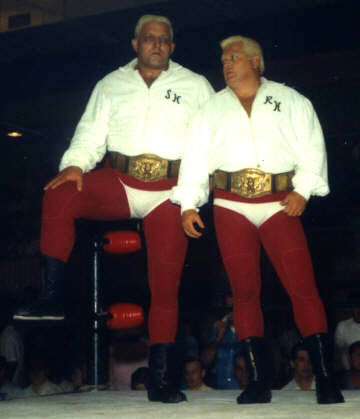
Swede Hanson & Rip Hawk (© Scooter Lesley)
In contrast the heels usually came across as cool, confident operators; just like us teenage boys thought we were.  Rip Hawk would turn slightly to the side, lift his head and proudly say that he is to be known as “The Profile.”  Rock Hunter, being complimented by his tag team partner after destroying a couple of good guys in a television match, answered with “You are right, I am great.”  The Great Bolo minced no words when describing in detail what he was going to do to his next opponent, then would top it off by saying in a most serious tone “And there is nothing you can do about it.”

The bad guys always talked about their luxury cars, fine homes, exquisite dining, beautiful women, but more importantly their wrestling championships.  “I’ll do anything…I’ll stop at nothing to keep this title!” they would proclaim into the microphone while pointing at the belt which defined supremacy.  Like any real men would do, the heels defended what was theirs.

The babyfaces were always getting out-smarted by the bad guys.  A heel would challenge a good guy to an impromptu match when he had the obvious advantage of his associates lurking nearby.  The good guy, all alone, would unbelievably accept.  I don’t need to tell you what would happen next.  Anytime the favorites were presented with an award or other tangible gift they always seemed to leave it sitting just outside of the ring as they climbed in for the next bout.  Once the match started other heels came from back stage and took great pleasure in destroying the property, all while the television host would be ranting “I can’t believe this is happening…I’ve never seen anything so despicable!”

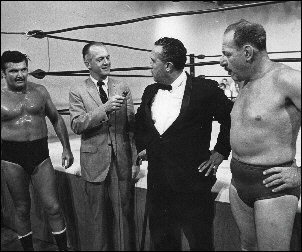
Charlie Harville interviews manager Homer O'Dell
with Bronko Lubich and Aldo Bogni
Many of my friends and relatives strongly voiced their displeasure about my cheering for the bad guys.  It got tough at home, even to the point I had to conceal some of my overt appreciation for the antics of Brute Bernard and Skull Murphy to retain my television privileges.  Some of my buddies at school got so upset they wouldn’t speak to me for several days after Aldo Bogni and Bronco Lubich defeated the popular George and Sandy Scott in an extensively hyped match on WGHP-TV.

In frustration one of my best pals finally came to me and said “How can you like those cheaters?”   I explained with my then passionate thoughts that the heels were the true definition of success.  “Look, they’ve got the titles, the money, and everything that goes with it.  They don’t care what anyone thinks about them, so they are never on a guilt trip.  They ask permission from no one for anything.  They never complain or explain themselves.  The good guys are saps.  They get the same tricks pulled on them each week on different channels.  Their so-called friends never come to help them.  You’ve heard their boring interviews.  Some of them even say they are proud of being mediocre like the people in the audience.  Now, who would you rather be like?”

A few weeks later the same friend and I were talking and he delivered my first wrestling associated compliment.  “I’ve been watching for what you told me.  You were right; the bad guys are the best.”

It was his heel turn, and I was so proud.


Originally Posted on the Mid-Atlantic Gateway
May 2004


Thursday, August 27, 2015

Asking For More

by Wayne Brower

Another opportunity to attend wrestling matches in Lexington occurred during the spring of 1965.  Since my school grades and steadily worsening teenage behavior were not yet to a level that would prohibit extra-curricular entertainment, my cousin and I had plotted various ways for her parents to take us to a return engagement at the YMCA arena.  We found them willing to do so since they continued to be fans, and Channel 3 and Channel 8 television wrestling shows kept everyone up to date on storylines and matches in the viewing area.  This was a great time for the region as a rotation of top grapplers worked interesting feuds that continued until a definite conclusion.  You could actually miss a week and still know what was going on.

George "Two Ton" Harris
(mid-atlanticgrapplingreats.blogspot.com)
Before we departed to attend the Blue Collar Ballet, I confided to my cousin that I now preferred the heel characters over the increasingly wimpy babyfaces.  To my pleasure she admitted liking Rip Hawk and Swede Hanson, and also thought Two Ton Harris was funny.  Rip and Swede were my favorites, so we had a lengthy conversation about how enlightened we were in comparison to the typical wrestling fans.

Upon our arrival at the YMCA a large crowd was gathering at the entrance.  As creatures of habit we bought general admission tickets and sat in the same area as before.  I even recognized some people in the section that had been at previous events.  There were also new fans, especially one nearby group that I was sure were the Darlins from the Andy Griffith Show.  The overall action and activities were similar to those at other wrestling cards:  people in outlandish costumes, performing bizarre acts that were highlighted with boisterous behaviors – and all this was before any of the wrestlers appeared.

The crowd broke into sustained applause and cheers as Charlie Harville walked to the ring.  In addition to hosting WGHP-TV sports and wrestling shows, Charlie was often the ring announcer at wrestling events throughout the area.   As he picked up the microphone, on cue rang the bell…DING DING DING DING DING DING DING DING. “Ladies and Gentlemen, welcome to the Lexington YMCA for the best in professional wrestling from Jim Crockett Promotions…our first event of the evening… one fall with a twenty minute time limit…entering the ring…from Concord, North Carolina…Ken Yates.”  Yates got a good pop from the audience which he acknowledged with a nice wave and nod of the head.  “And his opponent, from…” BOOOOOOO!  The fans’ displeasure was so loud you could barely hear the remaining portion of the introduction - “Jack ‘The Neck’ Vansky…Jack Vansky, ladies and gentlemen.”

Sunday, July 19, 2015

Wrestling 101

by Wayne Brower
Originally published on the Mid-Atlantic Gateway, March 2004

My desire to watch wrestling was limited only by our television’s ability to receive the distant signals. In the early 1960s there was neither cable nor satellite TV available. Most reception was either through “rabbit ears” – with or without tin foil – or from a roof mounted antenna.

Growing up in Trinity, North Carolina did not allow for reception of numerous stations. The area programming of that time was from WFMY Channel 2 in Greensboro and WSJS Channel 12 in Winston-Salem. Neither broadcast wrestling. The best we could occasionally receive with ideal atmospheric conditions was WDBJ Channel 7 of Roanoke and Charlotte’s WBTV Channel 3.

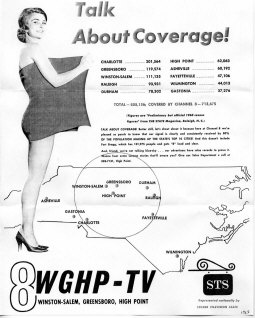
Two events would occur that had a significant impact on my viewing habits. In October 1963 WGHP Channel 8 in High Point signed on the air. Shortly thereafter wrestling was held in their studio on Tuesday nights for broadcast the following Saturday afternoon. Next, my dad purchased an antenna rotator connected by wire to a control box that sat on top of our television. With a turn of the dial pointing to the preferred direction we now had clear signal access to the aforementioned stations, plus another wrestling provider, WRAL Channel 5 in Raleigh. Talk about sensory overload. And it was so much more interesting than anything I was being taught in school at the time.

Viewing multiple hours of wrestling each weekend was not the most accepted form of character development for an adolescent, but I did learn the simple and straight forward good versus evil pugilistic play. The babyfaces always obeyed the rules and listened to the referee’s commands. They acknowledged the fans and signed autographs. The good guys usually had names like friends or family members – George, Sandy, Johnny, Jesse or Bobby. Even their female counterparts were called Penny, Susan or Pat. These folks were so pure that they would occasionally end their interview time by saying “We want to say hello to our sick and shut-in friends” or “Please take time to go to church this Sunday.”

Saturday, June 27, 2015

Charlie Harville: Remembering His Remarkable Journey

by Wayne Brower
Exclusive to the Mid-Atlantic Gateway
from the Mid-Atlantic Gateway Archives


In the spring of 1954 Jim Crockett spoke before an audience in the City of Lexington, North Carolina to publicize the debut of professional wrestling at the local YMCA gymnasium. He announced an agreement that he had entered with the organization whereby a portion of the proceeds would go towards funding the newly constructed arena. Crockett also told the assembled group about his plans for weekly shows if the initial matches drew adequate crowds.

Marketing the wrestling matches would be through advertisements in local newspapers, along with display cards in store fronts and on utility poles at strategic intersections. Since locally affiliated wrestling was not televised in the immediate area, Crockett described the need for a strong connection with the population in the Piedmont section of the state. He then advised the attendees about his new association with a prominent sports authority who would play a significant role in providing a major event atmosphere, while drawing sports fans not previously interested in wrestling. That prominent authority was Charlie Harville.

Charles Edward Harville was born December 15, 1918 in High Point, North Carolina. From an early age he had a tremendous interest in playing various sports that progressed into his college years. Not being as successful as he had envisioned in football, Charlie turned to baseball but failed to make the High Point College team. Showing his lifelong ability to overcome setbacks through trust in his own self-reliance, he would later tell a newspaper reporter that being cut during the baseball tryouts made him strive to succeed in his second ambition – being a sports broadcaster.

So while still in college, Charlie went to his hometown WMFR radio and boldly offered his services as a substitute play-by-play announcer for the Thomasville Tommies baseball games. The station manager was impressed by the articulate young man and decided to give him an opportunity in an on-the-job audition on April 28, 1938. The next day he was hired as their full time play-by-play announcer for baseball and football games.

World War II interrupted his career, but after an honorable tour of duty in the Army Air Corps, Charlie reemerged in radio working at stations in Martinsville, Virginia, Goldsboro, North Carolina and then LaSalle, Illinois. During his time at WLPO in LaSalle he created the unique closing phrase that would always end his future sportscasts: “That’s the best in sports today.”

In 1949 WFMY Radio in Greensboro provided an opportunity for him to return to his home area. The station had made the effort to broadcast the new medium of television and obtained the license to do so later that year. Charlie was selected as host of what is believed to be the first live local sports show broadcast in North Carolina. Almost fifty years later he would tell a staff writer for the Greensboro News & Record “It was a gamble on the part of the station. I practiced by pretending I was looking at a camera during my radio broadcasts. I had no doubt I’d succeed at it, but I didn’t know if it would go over with the public. I was surprised at the speed and breadth of its acceptance. By 1953 WFMY’s venture into TV was so successful that it closed the radio station.”

However, radio continued to be a significant part of Charlie’s career. Through the late 1940s and into the 1950s, he was a part of the Tobacco State Network that broadcast big four Atlantic Coast Conference basketball. For the next three decades he was the play-by-play announcer for numerous universities’ football and baseball programs, including East Carolina, Appalachian State, Virginia, Virginia Tech and Florida State.

* * * * * * * * * *

On Saturday night, May 1, 1954 Charlie Harville walked toward the ring, through the then record setting attendance of 4,300, for the first professional wrestling matches ever held at the Lexington YMCA. Neither he nor those in the arena knew that they were a part of events that would significantly impact him and wrestling in the region for the next thirty years.