Showing posts with label Mid-Atlantic Magazine. Show all posts

Friday, November 11, 2022

Figure Friday: Canadian Champ Dino Bravo

https://twitter.com/wrestlerweekly


From our friends over at Wrestler Weekly, "Action Figures Friday" features a look at mid-to-late 1970s Dino Bravo, who held the Canadian Heavyweight Championship in Toronto, but just prior to that was one half of the NWA World Tag Team and Mid-Atlantic Tag Team champions with Mr. Wrestling Tim Woods.

On the magazine cover above far left you see an art depiction of Bravo wearing the NWA World Tag Team title belt. In the center and far right, you see photos of Bravo wearing the Canadian title.

The magazine on the right, featuring a cover photograph shot by Jackie Crockett, was a special photo-album issue of Mid-Atlantic Wrestling Magazine. Bravo appeared in the Mid-Atlantic area throughout his reign as Canadian champion as a result of a working/business/booking relationship Toronto promoter Frank Tunney had with Jim Crockett, Jr. and George Scott at Jim Crockett Promotions.

2022 Edits: Andrew Calvert at MapleLeafWrestling.com published an outstanding book on the history of the Canadian Heavyweight championship that existed during that era. The book looks at all the Canadian champions including Dino Bravo, Greg Valentine, Dewey Robertson, Angelo Mosca, the Iron Sheik, Sgt. Slaughter and many others. It includes some pretty rare photographs and a great collection of memorabilia.   You can find out all about that book on the Maple Leaf Wrestling website or in our Mid-Atlantic Gateway Book Store.

Andrew also has a new book out on the Toronto wrestling territory called "Quick Bits: The best (and rest) of Toronto Wrestling."


Edited from an August 2019 post on the Mid-Atlantic Gateway.


http://bookstore.midatlanticgateway.com

Friday, September 30, 2022

Action Figure Friday: Valentine and Raschke - World Tag Champs!


Another great presentation from our friends Scottie and Reggie at Wrestler Weekly.

This time they feature the NWA World Tag Team Champions Greg Valentine and Baron Von Raschke in front of one of the classic issues of Mid-Atlantic Wrestling Magazine from that era.

Man, these little belts make the whole thing work!  Check out the Wrestler Weekly twitter feed for more great wrestling memories, tributes, and memorabilia.


Originally published in May 2019 on the Mid-Atlantic Gateway

Saturday, January 01, 2022

Wrestling Art: Arn Anderson on the cover of Mid-Atlantic Magazine

Art by Robby Bannister

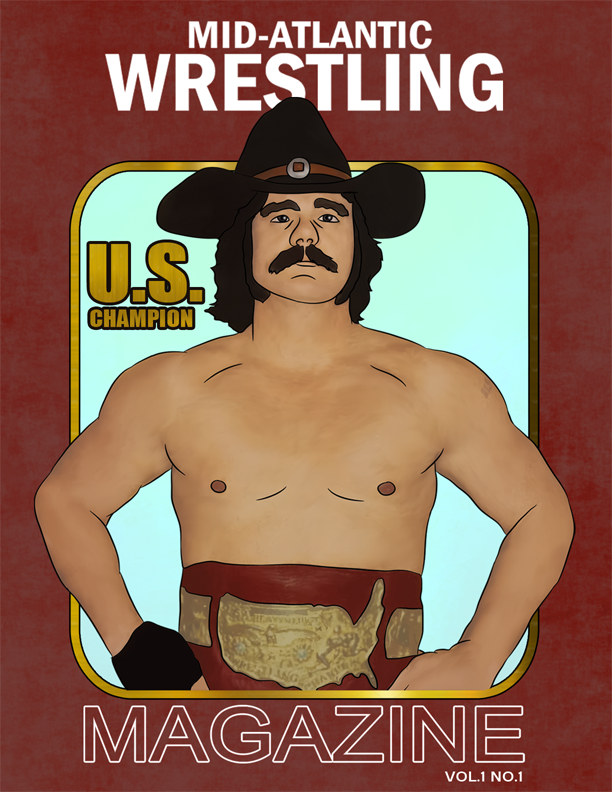
Back on November 27, Robby Bannister presented his first throwback-style art cover to the Mid-Atlantic Gateway, a tribute to the old issues of Mid-Atlantic Wrestling Magazine sold at arenas back in the 1970s and 1980s. 

The first one featured Blackjack Mulligan as United States champion back in 1976, when Mulligan was the top heel in the Mid-Atlantic territory for Jim Crockett Promotions.

The second installment jumps ahead almost a full decade and features the wrestler who would become known as "the enforcer" Arn Anderson. 

A member of the legendary Anderson family in wrestling, Arn was a cousin of Gene, Lars, and Ole Anderson in Anderson mythology, although he was briefly recognized at times as a brother, and even initially a nephew when Ole Anderson first introduced him in Georgia Championship Wrestling in 1983. 

I like to think this could have been a cover in the spring of 1985 when Arn was relatively new in the territory. It wouldn't be long before Arn would have always had a title belt around his waist, whether it be the National Tag Team title, NWA World TV title, or NWA (or WCW) World Tag team title. 

Arn was a great singles competitor as TV champion, and was most famously a member of the legendary Four Horsemen. But he is best remembered for his tag team success, holding the Southeastern tag team titles with "Mr. Olympia" Jerry Stubbs, the National Tag titles with Ole Anderson, and the NWA/WCW World Tag team titles with Tully Blanchard, Bobby Eaton, Larry Zbyszko, and Paul Roma.

Arn sadly never had a cover of Mid-Atlantic magazine, but With Robby's artistic vision we can now imagine what such a cover would have looked like. 

* * * * * *

Check out more of Robby Bannister's art on his Facebook page featuring wrestlers from various territories over different eras. 

NO. 2 IN A SERIES

Saturday, November 27, 2021

Wrestling Art: Blackjack Mulligan on the Cover of Mid-Atlantic Wrestling Magazine

Art by Robby Bannister

Last week, we told you about a forthcoming series of artistic faux magazine covers based on 1970s and 1980s designs of Mid-Atlantic Wrestling Magazine, published at the time by Jim Crockett Promotions and sold in arenas as the event program. The art is courtesy of Robby Bannister.

The first in that series celebrates one of the great U.S. Champions of that era, Blackjack Mulligan. It's based on one of the classic images of Mulligan wearing the famous Unites States Heavyweight championship belt that appeared in one of the 1976 magazines. The cover design, fonts, header, etc. are based on the original 1976 issue with Paul Jones on the cover (Vol. 2 No. 4.) 

Mulligan's only appearance on of the original art covers of that era was a 1978 issue where he shared the cover with Dick Murdoch. The two were the Texan tag team combination that called themselves the M&M Boys. I've always thought there should have been a cover with Mulligan as U.S. champ. He dominated the territory as the top heel in 1976 and 1977, feuding with Paul Jones, Dino Bravo, Bobo Brazil, and Ricky Steamboat over the title belt. 

With Robby's artistic vision, we can now imagine what such a cover would have looked like.

* * * * * *

Check out more of Robby Bannister's art on his Facebook page featuring wrestlers from various territories over different eras. 

NO. 1 IN A SERIES

Friday, August 30, 2019

Action Figures Friday: Canadian Champion Dino Bravo

https://twitter.com/wrestlerweekly

From our friends over at Wrestler Weekly, this weeks "Action Figures Friday" features a look at mid-to-late 1970s Dino Bravo, who held the Canadian Heavyweight Championship in Toronto, but just prior to that was one half of the NWA World Tag Team and Mid-Atlantic Tag Team champions with Mr. Wrestling Tim Woods.

on the magazine cover far left you see an art depiction of Bravo wearing the NWA World Tag Team title belt. in the center and far right, you see photos of Bravo wearing the Canadian title.

The magazine at right, featuring a cover photo shot by Jackie Crockett, was a special photo-album issue of Mid-Atlantic Wrestling Magazine. Bravo appeared in the Mid-Atlantic area throughout his reign as Canadian champion as a result of a working/business/booking relationship Toronto promoter Frank Tunney had with Jim Crockett Promotions.

Andrew Calvert at MapleLeafWrestling.com recently announced a new book forthcoming on the history of the Canadian Heavyweight championship that existed during that era. Details to be announced in the coming months.

http://bookstore.midatlanticgateway.com

Friday, May 17, 2019

Action Figures Friday: Roddy Piper

@wrestlerweekly


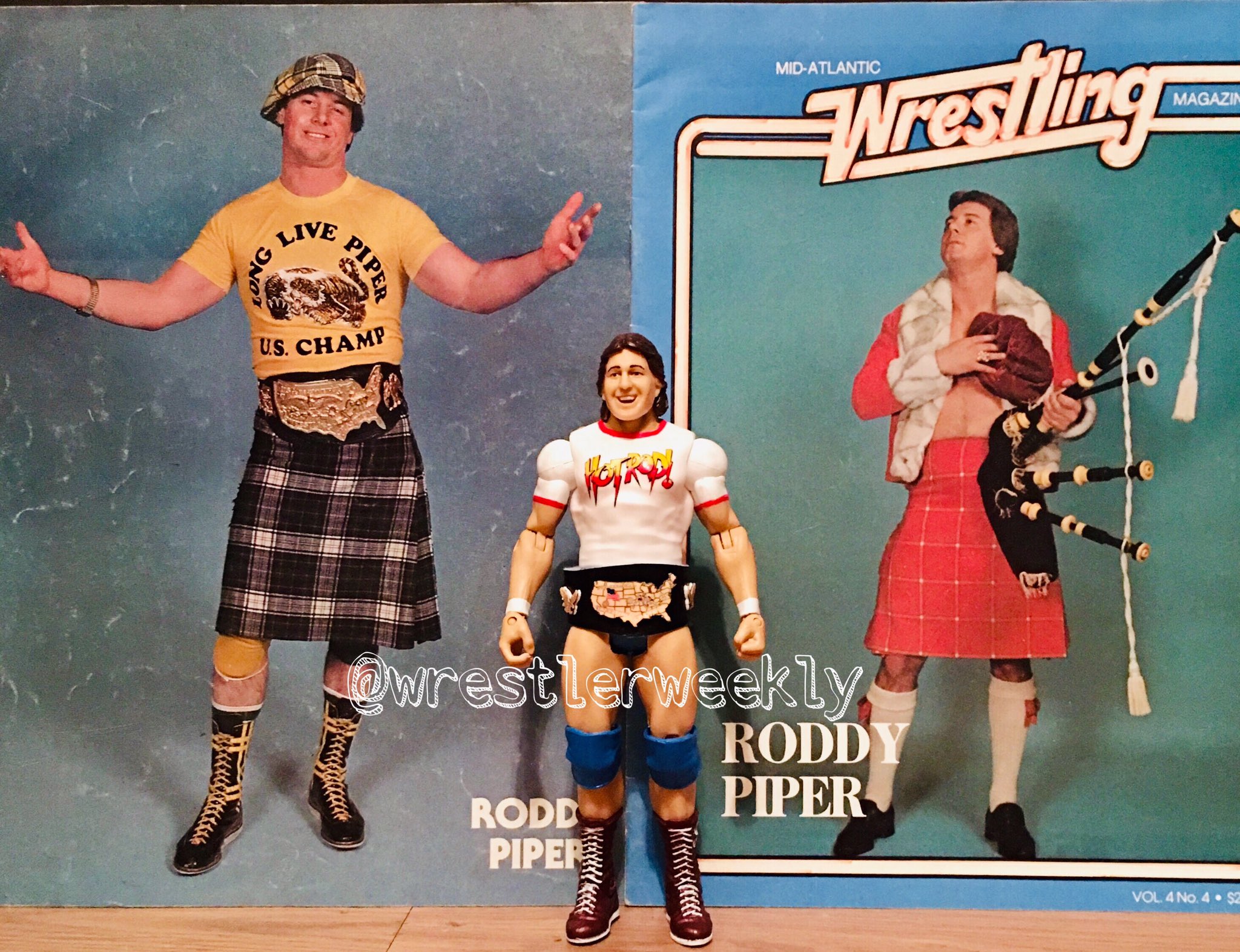
Another nice staging for Action Figures Friday by our friends Scottie and Reggie at @wrestlerweekly featuring United States Heavyweight Champion Roddy Piper in 1981. All that's missing are the bagpipes and a kilt!

Piper was a two-time U.S. champion, first winning the strap on 1/27/81 from Ric Flair at the Dorton Arena in Raleigh, NC. He lost the title on 8/8/81 to Wahoo McDaniel in Greensboro.

His second title reign came two years later when he defeated Greg Valentine on 4/16/83 in Greensboro, NC, only to lose the title back to "the Hammer" two weeks later on 5/1/83 in the same city.

Republished in October 2022 on the Mid-Atlantic Gateway.

http://www.midatlanticgateway.com/p/us-title-book.html

Thursday, April 18, 2019

The "Red Cover"


This is the cover of a photo album sold at the wrestling events in 1974, one of two distinct issues that year with this theme. Known to collectors as "the Red Cover", there was also a second photo album released that year (known as "the Blue Cover").

The album featured about 16 pages of black and white promotional photos of the wrestlers of that era including Johnny Valentine, Rip Hawk, Swede Hansen, Johnny Weaver, Jack Brisco, Jerry Brisco, and many others. Even a very young Ric Flair, his first year in the territory.

One of the distinguishing features of this issue that makes it special to collectors is the designation on the cover "Produced by Ringley and Crockett." John Ringley, then married to Frances Crockett, had been pegged to run the company following the death of Jim Crockett Sr. in 1973. Up until that point, the company Ringley & Crockett, Inc. had handled all the non-wrestling related promotions of Jim Sr.'s empire including concerts, Globetrotters basketball, fishing tournaments, etc. It appeared that perhaps now that company name would absorb the wrestling related business as well, or maybe not. Perhaps it was just going to undertake the publishing of the photo albums, magazines, and programs.

Regardless, it wasn't long after this particular album was published that John Ringley and Frances Crockett divorced, and the wrestling business was known from that point forward solely as Jim Crockett Promotions, Inc.

Sunday, April 14, 2019

Best of the Gateway: Les Thatcher's Peacock Masterpiece

THE PRIDE OF THE PEACOCK
by Dick Bourne
From the Mid-Atlantic Gateway Archives


          “The pride of the Peacock is the glory of God.”
                     
                            – William Blake, 19th Century English Poet


Nineteenth century poet William Blake may have been onto something here in this line from a proverb he wrote on expression and relationships. The relationship between Ric Flair and his fans has indeed been a glorious manifestation of the unique way he has connected with them over his long career. Even as a “bad guy”, most fans have never been able to escape the irresistible bad-boy charms of the Nature Boy.

One of those charms has always been his collection of resplendent robes, especially in the 1970s, early in his career, something in which he took great pride. It wasn’t long into Flair’s career that Les Thatcher recognized that Flair’s colorful robes had become his signature, and he put that to work in one of his projects.

Les Thatcher
Les Thatcher is known within the wrestling industry as one of the most versatile and creative minds in the business. For over four decades, he has literally done it all: wrestler, television announcer, television producer, magazine editor, magazine writer, promoter, booker, trainer - - you name it, he’s done it, and done it pretty darn well.

In the 1970s, Thatcher’s work in television and magazine publishing was cutting edge for the wrestling business at that time. He hosted and produced the “Southeastern Championship Wrestling” program in Knoxville TN for Ron Fuller, and created unique segments for the show, such as the “Personality Profile”, ideas that had never really been tried before on wrestling programs. He convinced Jim Crockett Jr. to allow him to publish an in-house full color wrestling magazine, a risky prospect unheard of at the time primarily because of the additional costs involved. Within the pages of those magazines, he would come up with increasingly clever ideas to feature the wrestlers.

When Ric Flair exploded onto the national wrestling scene in the mid-1970s, he had successfully crafted the image of the “Nature Boy”. It wasn’t always going to be that way. Flair originally wanted to be a cowboy, asking promoter Verne Gagne if he could be “Cowboy” Ricky Rhodes, and be billed as the younger brother of his idol at the time, Dusty Rhodes. In a moment of great wisdom and judgment, Gagne emphatically told him “no”.

The “Nature Boy” was born a few years later when booker George Scott had a vision of Flair as the second coming of the flamboyant “Nature Boy” Buddy Rogers, a former world heavyweight champion and one of wrestling’s top stars in the 1960s. Rogers made famous the peacock-like strut that Flair would later adopt and custom in his own image.

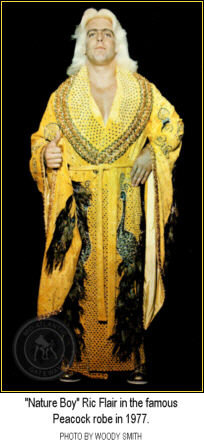
Flair carried Scott’s vision, not to mention Roger’s style, to an entirely different level. He became a peacock, embodied in the colorful robes he quickly collected in the years following his return from the 1975 plane crash. Flair commissioned his robes crafted by the great Olivia Walker who made some of the most famous robes in wrestling for some of the greatest names in the business. In fact, one of his most popular robes was a gorgeous creation adorned in colorful peacock feathers. Sadly (and infamously) that robe was destroyed in the “hat and robe” angle in 1978; Blackjack Mulligan ripping it to shreds in response to Flair destroying Mulligan’s cowboy hat given to him by Waylon Jennings.

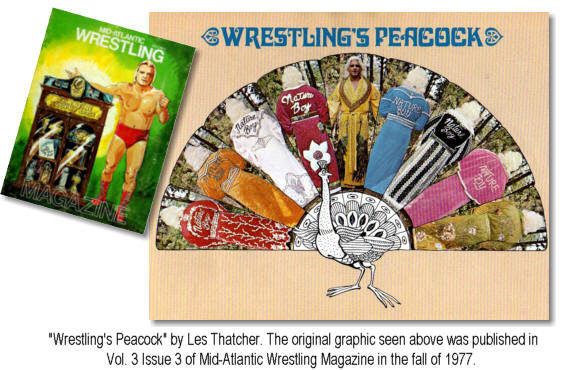
In 1977, Les Thatcher came up with an idea for Mid-Atlantic Wrestling magazine to further allow Ric Flair his expression as the most colorful wrestler in the territory. The famous peacock graphic was born.

Flair at this point had amassed an impressive collection of robes in many different designs and colors. Thatcher conceived of a montage of photographs of Flair in each of his robes, each representing a single feather in a peacock’s plumage.

Thatcher brought photographer Woody Smith into the project. They met at Flair’s house one afternoon and set up a tripod in the backyard. Smith had Flair stand in the same spot so that he would be in identical proportion in each shot. Flair would put a robe on, Smith would take a photo, Flair would change into the next robe, hit his mark, next photo taken, and so forth. In all of the photos Flair had his back turned to the camera, showing off the “Nature Boy” inscribed on each, except for one. The one photo where Flair faced forward was the one where he wore that now famous peacock robe. Flair squared with the camera, arms open wide, seemingly ready at any moment to break into that famous strut. You can almost hear the “Wooooo!”


Thatcher and art director Cal Byers took a drawing of a peacock and placed the photos of Flair inside each of the peacock’s feathers. It was the perfect way to highlight Flair’s colorful, cocky character and to feature the robes which had quickly become his trademark.

It was a very creative idea (as most of Les's ideas were) that resulted in a special graphic image that is still enjoyed today, and kept alive forever here on the Mid-Atlantic Gateway.

See also: The Hat & The Robe


This feature was originally published on the old Mid-Atlantic Gateway 
in February 2009 and was republished on the new 
website on July 27, 2015.


http://bookstore.midatlanticgateway.com

Friday, April 12, 2019

Action Figure Friday: The Iron Sheik


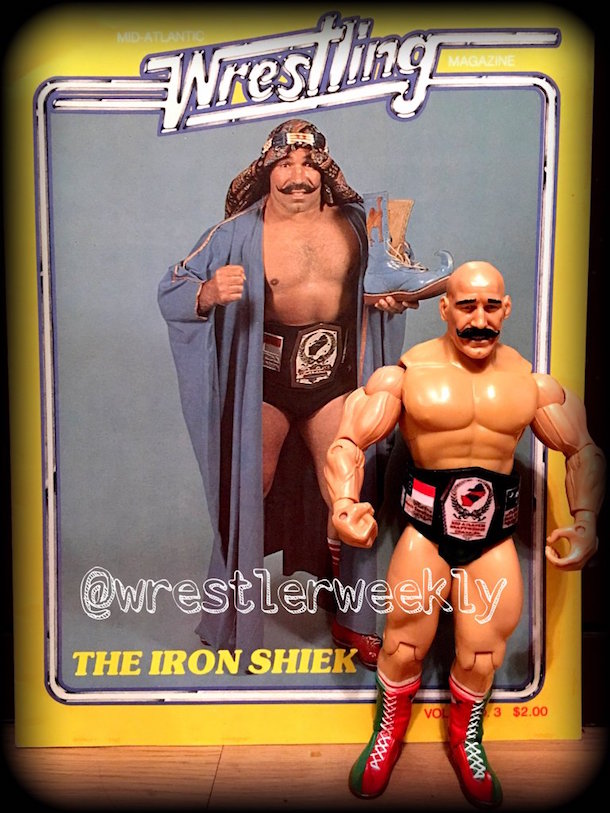
Another classic staging from Reggie Richardson over at Scottie Richardson's Wrestler Weekly. A great Sheik figure wearing a custom Mid-Atlantic title belt standing in from of an old 1980 issue of Mid-Atlantic Wrestling Magazine.


I love these set ups that Reggie is doing with the magazines. Keep 'em coming!

Friday, March 08, 2019

Action Figures Friday - No. 1 Paul Jones


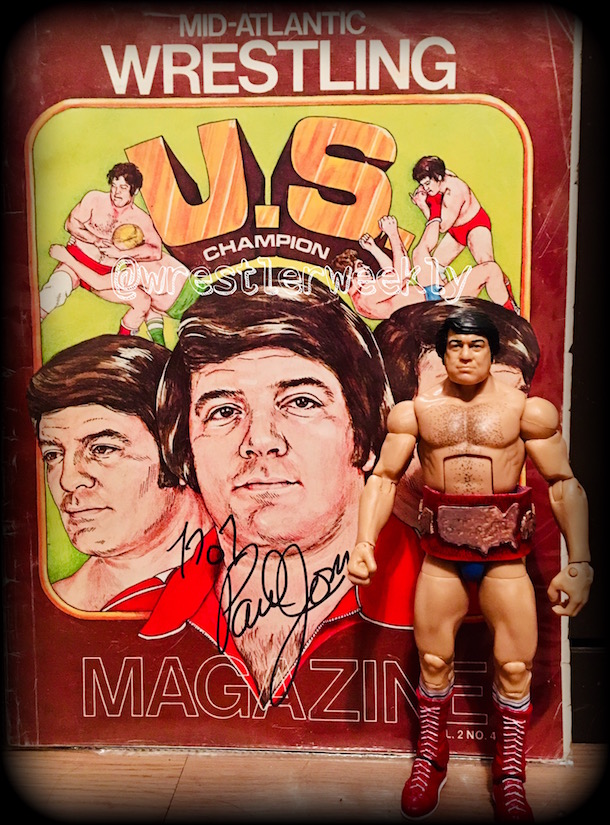
What a great custom action figure of one of the real legends of Mid-Atlantic Championship Wrestling, No. 1 Paul Jones.

The figure, and the awesome presentation here with the custom U.S. belt and a 1976 issue of Mid-Atlantic Wrestling Magazine, are part of a series of posts by our friends at Wrestler Weekly. You can follow all of their great posts of classic wrestling memorabilia on Twitter at @wrestlerweekly. Reggie Richardson (brother of Scottie who publishes Wrestler Weekly) had the figure custom made and arranged this very cool presentation.

Some random info about the magazine cover you see here. It was Vol. 2 Issue 4 of a series of in-house magazines that served as the program at arena events for Jim Crockett Promotions in the mid-1970s through mid-1980s. The early issues of the magazine, including this one, were written and produced by Les Thatcher when he worked as a jack-of-all-trades for the JCP office.

In the artists rendering on the cover, you'll see two wrestling holds being applied just above Paul's head. Both were drawn from photographs taken during the legendary one-night tournament on November 9, 1975 in Greensboro to crown a new U.S. Champion following the Wilmington plane crash in October of that year that ended the career of then-champion Johnny Valentine. At left Paul grabs a headlock on "Handsome" Harley Race, who he defeated in the semi-finals of the tournament. On the right you see Paul working over the leg of Terry Funk, who defeated Paul in the finals. Paul went on to defeat Funk three weeks later on Thanksgiving night to claim his first U.S. championship, commemorated on the cover of this magazine.

Another great addition to our line-up of classic Mid-Atlantic Wrestling custom action figures.

http://www.midatlanticgateway.com/p/us-title-book.html

Friday, February 17, 2017

NWA Champions for Jim Crockett Promotions - Summer 1978

by Dick Bourne
Mid-Atlantic Gateway

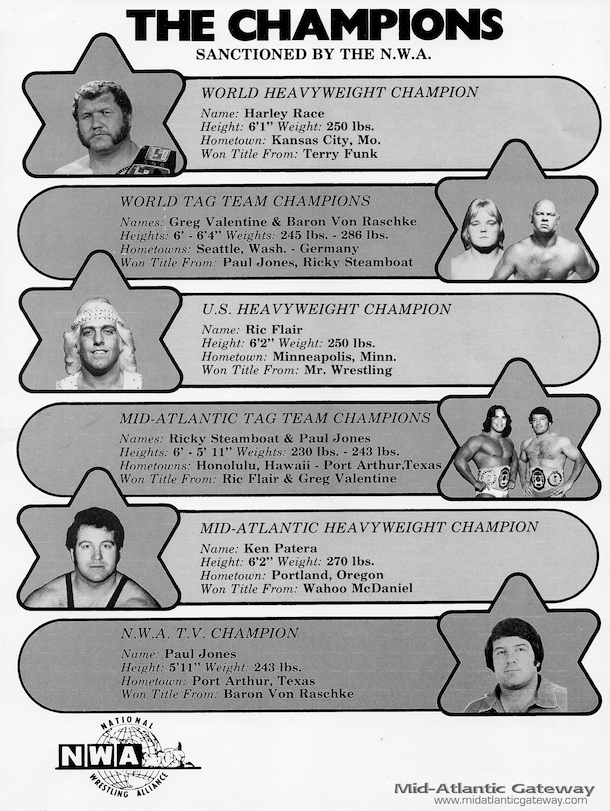
In the mid-1970s, one of the weekly rituals on "Mid-Atlantic Championship Wrestling" each week was when Bob Caudle or Les Thatcher would read over the list of current champions as recognized by the National Wrestling Alliance. Ed Capral would do the same thing on "Wide World Wrestling." It was one of my favorite parts of the program and was a tradition in those days. The practice ended sometime in the late 1970s.

In by the late 1970s when I finally got to attend some of the Crockett shows in Asheville, NC and Spartanburg, SC, I started buying "Mid-Atlantic Wrestling Magazine" which was published by the promotion and served as a program at the local arena events. I was delighted to see that each issue featured that same list of champions that they once read on television. 

Below is a sample of that list which always filled a page of those magazines and featured photos of the champions, along with their height, weight, hometown, and who they defeated for their title.

It's usually the smallest things I miss the most, and the roll call of champions is near the top of that list. It was important who held the championships. The championships (and the belts that represented them) were important in those days, and presented in an important way.  


http://www.midatlanticgateway.com/p/us-title-book.html

Friday, February 10, 2017

Charlotte's C. J. Underwood

by Dick Bourne
Mid-Atlantic Gateway

I recently came across a nice memorial to Charlotte news personality C.J. Underwood on the BT Memories website (link at the bottom of this post), a website devoted to memories and memorabilia from WBTV-TV and WBT radio in Charlotte over the years. It got me to thinking about the one time I had a brush with C. J. as a teenager going to matches at the old Charlotte Coliseum

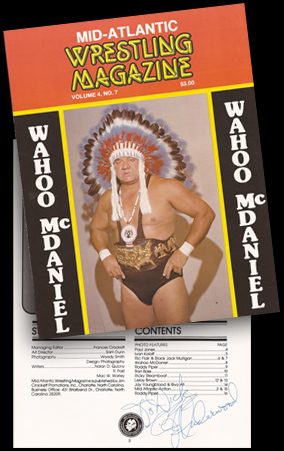
C.J. was the longtime ring announcer at the Charlotte Coliseum in the late 1970s and early 1980s. He was very friendly with fans at the shows. Once between matches, I walked up to ringside and asked him for his autograph. He had just stepped back into the ring, but he took a moment and got down on one knee and signed the table of contents page of my copy of "Mid-Atlantic Wrestling Magazine."

"Are you having a good time tonight?" he asked as he signed his name.

He had a great smile and was a favorite local personality on the Charlotte TV airwaves. For many years he hosted a segment on WBTV news called "Carolina Camera" which was a human interest piece in the tradition of "On The Road" with Charles Kuralt.

In early September 1981, following a big labor day show at the Charlotte Coliseum, and only weeks before Ric Flair would win the NWA World Heavyweight championship, Underwood did a "Carolina Camera" profile on the "Nature Boy" that was one of his most popular segments ever. (Video embedded below.)

The segment is included below, and includes footage from a show at the Charlotte Coliseum earlier that summer featuring Flair against Roddy Piper is 'Texas street fight." Plus, you'll also get a glimpse of future wife Beth and his son David, who was only 2 years old at the time. 


Check out this fond farewell to C.J. from his good friend and fellow WBTV alumni Bill Ballard on the BT Memories website:  First Person | C. J.'s Last Days (BT Memories / Bill Ballard)

Republished February of 2023 on the Mid-Atlantic Gateway.

https://crockettfoundation.com/store/?model_number=1554959

Friday, March 11, 2016

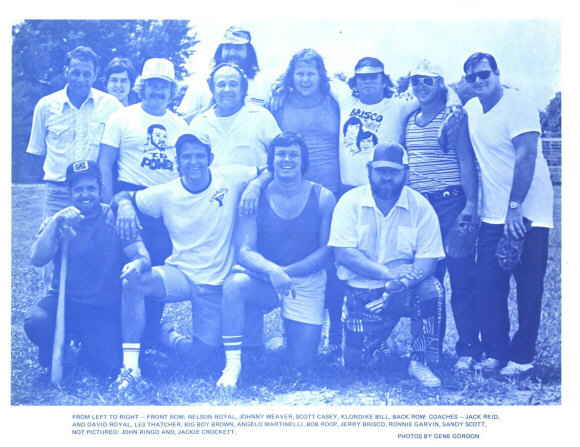
1973 JCP Softball Team

UPDATED 3/12 with identification of those in the photo.

With Major League Baseball's spring training underway and the 2016 baseball season right around the corner, we thought it would be fun to take a look at the 1973 JCP softball team!

This photo is from the July 1973 issue of "Mid-Atlantic Wrestling Magazine" and was taken by legendary wrestling photographer Gene Gordon.


This was an amazing gathering of top wrestling talent, not to mention top talent on the diamond!

Front row (L-R): Nelson Royal, Johnny Weaver, Scott Casey, Klondike Bill.

Back Row (L-R): Jack Reid (Coach), David Royal (Coach), Les Thatcher, Big Boy Brown (very back), Angelo Martinelli, Bob Roop, Jerry Brisco, Ronnie Garvin, Sandy Scott.


http://www.midatlanticgateway.com/p/us-title-book.html

Monday, July 27, 2015

The Pride of the Peacock

by Dick Bourne
From the Mid-Atlantic Gateway Archives


          “The pride of the Peacock is the glory of God.”
                     
                            – William Blake, 19th Century English Poet


Nineteenth century poet William Blake may have been onto something here in this line from a proverb he wrote on expression and relationships. The relationship between Ric Flair and his fans has indeed been a glorious manifestation of the unique way he has connected with them over his long career. Even as a “bad guy”, most fans have never been able to escape the irresistible bad-boy charms of the Nature Boy. One of those charms has always been his collection of resplendent robes, especially in the 1970s, early in his career, something in which he took great pride. It wasn’t long into Flair’s career that Les Thatcher recognized that Flair’s colorful robes had become his signature, and he put that to work in one of his projects.

Les Thatcher
Les Thatcher is known within the wrestling industry as one of the most versatile and creative minds in the business. For over four decades, he has literally done it all: wrestler, television announcer, television producer, magazine editor, magazine writer, promoter, booker, trainer - - you name it, he’s done it, and done it pretty darn well.

In the 1970s, Thatcher’s work in television and magazine publishing was cutting edge for the wrestling business at that time. He hosted and produced the “Southeastern Championship Wrestling” program in Knoxville TN for Ron Fuller, and created unique segments for the show, such as the “Personality Profile”, ideas that had never really been tried before on wrestling programs. He convinced Jim Crockett Jr. to allow him to publish an in-house full color wrestling magazine, a risky prospect unheard of at the time primarily because of the additional costs involved. Within the pages of those magazines, he would come up with increasingly clever ideas to feature the wrestlers.

When Ric Flair exploded onto the national wrestling scene in the mid-1970s, he had successfully crafted the image of the “Nature Boy”. It wasn’t always going to be that way. Flair originally wanted to be a cowboy, asking promoter Verne Gagne if he could be “Cowboy” Ricky Rhodes, and be billed as the younger brother of his idol at the time, Dusty Rhodes. In a moment of great wisdom and judgment, Verne emphatically told him “no”.

The “Nature Boy” was born a few years later when booker George Scott had a vision of Flair as the second coming of the flamboyant “Nature Boy” Buddy Rogers, a former world heavyweight champion and one of wrestling’s top stars in the 1960s. Rogers made famous the peacock-like strut that Flair would later adopt and custom in his own image.

Flair carried Scott’s vision, not to mention Roger’s style, to an entirely different level. He became a peacock, embodied in the colorful robes he quickly collected in the years following his return from the 1975 plane crash. Flair commissioned his robes crafted by the great Olivia Walker who made some of the most famous robes in wrestling for some of the greatest names in the business. In fact, one of his most popular robes was a gorgeous creation adorned in colorful peacock feathers. Sadly, and famously, that robe was destroyed in the “hat and robe” angle in 1978; Blackjack Mulligan ripping it to shreds in response to Flair destroying Mulligan’s cowboy hat given to him by Waylon Jennings.

In 1977, Les Thatcher came up with the idea for Mid-Atlantic Wrestling magazine to further allow Flair his expression as the most colorful wrestler in the territory. The famous peacock graphic was born.

Flair at this point had amassed an impressive collection of robes in many different designs and colors. Thatcher conceived of a montage of photographs of Flair in each of his robes, each representing a single feather in a peacock’s plumage. Here is how Les told me it came together:

Thatcher brought photographer Woody Smith into the project. They met at Flair’s house one afternoon and set up a tripod in the backyard. Smith had Flair stand in the same spot so that he would be in identical proportion in each shot. Flair would put a robe on, Smith would take a photo, Flair would change into the next robe, hit his mark, next photo taken, and so forth. In all of the photos Flair had his back turned to the camera, showing off the “Nature Boy” inscribed on each, except for one. The one photo where Flair faced forward was the one where he wore that now famous peacock robe. Flair squared with the camera, arms open wide, seemingly ready at any moment to break into that famous strut. You can almost hear the “Wooooo!”


Thatcher and art director Cal Byers took a drawing of a peacock and placed the photos of Flair inside each of the peacock’s feathers. It was the perfect way to highlight Flair’s colorful, cocky character and to feature the robes which had quickly become his trademark.

It was a very creative idea that resulted in a special graphic image that is still enjoyed today, and kept alive forever here on the Mid-Atlantic Gateway.


This feature was originally published on the Mid-Atlantic Gateway in February 2009


Speaking of Ric Flair's robes and peacocks, our huge look back at the famous "Hat and Robe" angle of 1978 will go up tomorrow (Tuesday 7/28/15.) The robe that was destroyed in that angle was Ric's prized peacock robe. It was one of the most popular articles on the old Mid-Atlantic Gateway website.

Friday, June 19, 2015

Mid-Atlantic Magazine Covers in 1975


In 1975, Jim Crockett Promotions began publishing a program in the form of a magazine that could be sold at the arenas where the local matches were held. The in-house publication was designed, edited, and written by Les Thatcher, who by that time was a major support player in the Crockett front office.

These four issues made up Volume 1 and were all published in 1975. Volume 2 began in 1976.