Showing posts with label George Scott. Show all posts

Tuesday, November 08, 2022

The Swedish Killers!

by Dick Bourne
Mid-Atlantic Gateway

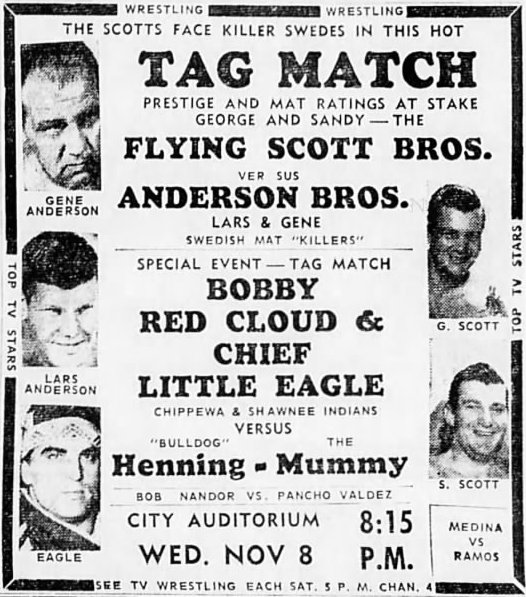
What a great old newspaper ad this is from Asheville, NC, in 1967, written by promoter Paul Winkhaus. Winkhaus was the local promoter for Jim Crockett Promotions in the Greenville and Asheville area, and he put a lot of thought (and drama) into his newspaper advertisements at the time.


The main event was the team of George and Sandy, the popular "Flying Scott Brothers" versus the "Swedish Mat Killers" Lars and Gene Anderson.

THE SCOTTS FACE KILLER SWEDES IN THIS HOT TAG MATCH! PRESTIGE AND MAT RATINGS AT STAKE!

Killer Swedes! Can Flying Scotts compete with Killer Swedes? The card also featured Chippewas, Shawnees, Bulldogs, Mummies, and Panchos!

What a great main event featuring brother team vs. brother team. We're big fans of the Minnesota Wrecking Crew (and the Scott brothers for that matter), so we loved seeing this ad.

A great period in the 1960s and a hot card at the old Asheville City Auditorium.

See T.V. Wrestling each Saturday 5 PM on channel 4!

Thanks to Andy McDaniel for forwarding this newspaper ad to us. 


Originally Published in November of 2018 on the Mid-Atlantic Gateway

http://bookstore.midatlanticgateway.com

Saturday, October 01, 2022

Poster: Infernos vs. Flying Scotts in Lexington NC

Click for larger Image
by Brack Beasley
Mid-Atlantic Gateway Contributor

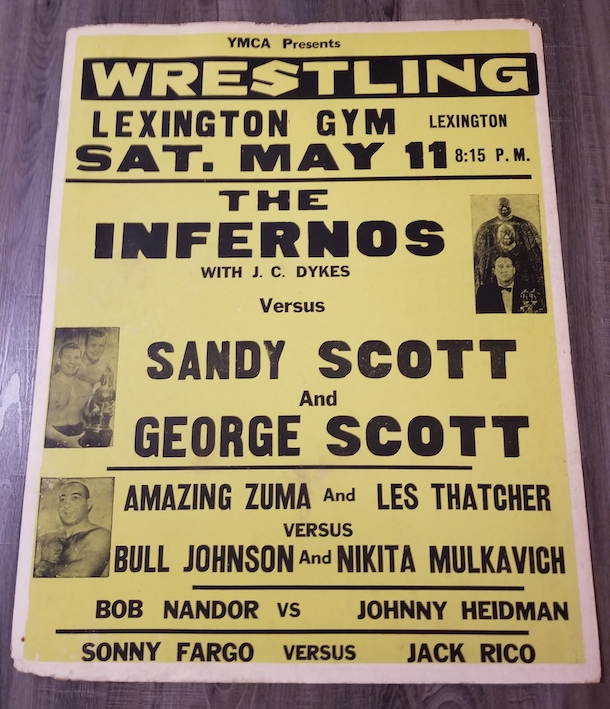
This poster takes us back to Saturday, May 11th, 1968 and promotes a card held at the YMCA Gymnasium in Lexington, NC. Featured are several wrestlers that would later have significant contributions to Jim Crockett Promotions behind the scenes in the years to come. 

George and Sandy Scott became influential figures behind the scenes and on this night they faced off with the menacing masked team, The Infernos with manager J.C. Dykes in the main event. 

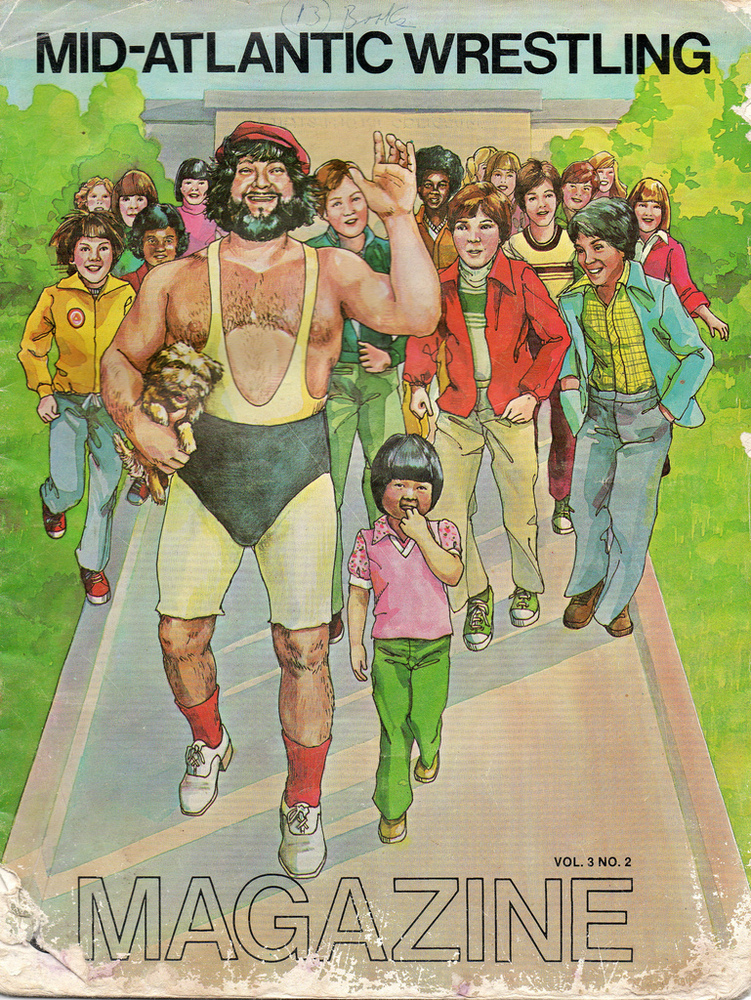
Les Thatcher would become responsible for creating the great Mid Atlantic Wrestling magazines in the late 70s and teamed with Amazing Zuma in the semi against Nikita Mulkavich (maker of many famous wrestling belts of the day) and Bull Johnson. 

In the opener was none other than "Roughhouse" Sonny Fargo from nearby China Grove, NC who later became a referee for JCP. With a vertical layout, the poster has all black print over a bright yellow background and images of the main event teams and Zuma.

Poster No. 39 in the Beasley Poster Series 

Friday, March 18, 2022

Poster: Huge Triple Main Event in Greensboro (1977)


HARLEY RACE vs. WAHOO MCDANIEL
RIC FLAIR vs. RICKY STEAMBOAT
BLACKJACK MULLIGAN vs. DUSTY RHODES & GEORGE SCOTT

By Brack Beasley
Mid-Atlantic Gateway Contributor

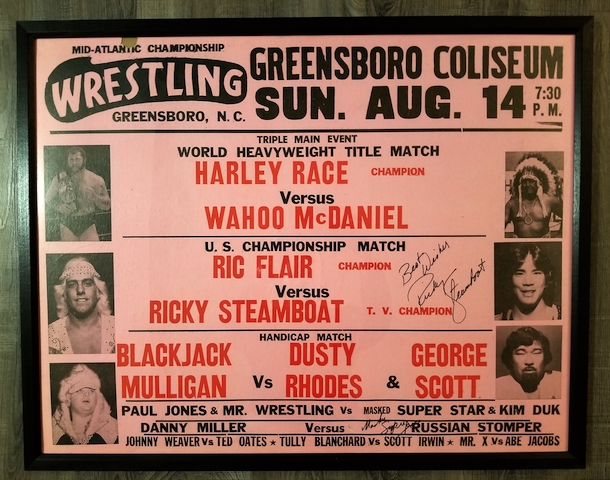
I chose to highlight this particular poster primarily due to the number of Mid Atlantic Wrestling legends it features. By my count, no less than 14. It promotes a card held on Sunday night, August 14th, 1977 at the famed Greensboro Coliseum headlined by an NWA World Heavyweight title match with Harley Race defending against Wahoo McDaniel. 

In one of the most revered rivalries in the history of professional wrestling, Ric Flair defended his United States title against TV champ Ricky Steamboat while Blackjack Mulligan took the challenge of a handicap match against the team of Dusty Rhodes and George Scott.

Fans didn't have to wait until the main events for great action as the undercard consisted of stars such as Paul Jones, Mr. Wrestling, the Masked Superstar, Kim Duk, Johnny Weaver, Danny Miller, Abe Jacobs, and a young Tully Blanchard. 

Other than the main event names in high impact red (and in a smaller font than normally seen due to space constraints), the poster has black print over a bright pink background and images of Race, Flair, Dusty, Wahoo, Steamboat, and Duk on the sides. 

Signatures by Ricky Steamboat and the Superstar add a nice touch to this representation of a great era in Jim Crockett Promotions, and professional wrestling as a whole. 

NO. 30 IN A SERIES


* * * * * * * * * * *

MID-ATLANTIC GATEWAY NOTES
by Dick Bourne

Mid-Atlantic Wrestling's hottest feud of the decade, Flair vs. Steamboat, and one of Harley Race's toughest contenders in our territory and others includiong Florida, Georgia, and Houston, Whaoo McDaniel, topped this amazing card in Greensboro.

But the match that fans might have anticipated the most due its unusual nature and the story leading up to it, was the handicap match between Blackjack Mulligan and George Scott, with Scott's partner that night Dusty Rhodes. Mulligan had roughed up Scott a bit on a TV interview, and although retired from the ring at this point (and the booker of the territory behind the scenes), Scott wanted in the ring one more time with Mullgian. Mulligan was so sure he could whip the retired Scott under any circumstances, allowed Scott to pick a partner and he would face them in a handicap situation. 

This set up a series of matches around the territory where Scott picked various opponents around the horn including Rhodes, Ricky Steamboat, Mr. Wrestling Tim Woods, and even his own brother, the semi-retired Sandy Scott. The latter reformed the famous 60s tag team of the "Flying Scotts."


Friday, November 26, 2021

Paul Jones Reflects on Thanksgiving Night 1975

U.S. Champion Paul Jones

by Dick Bourne
Mid-Atlantic Gateway

Paul Jones still gets angry when he looks at the poster promoting the annual Thanksgiving wrestling card in Greensboro for 1975.

"Terry Funk and I worked so hard the night of the [11/9/75] U.S. tournament in Greensboro," Jones told me in a phone conversation in November 2005. I called him to specifically ask him about htis night for a feature on the Gateway. "We both wrestled four times that night, none of them quick matches. That tournament drew a record house and a record gate, and we had this memorable match that had the whole territory talking."

Indeed they did. One only needs to listen to the audio tapes of the tournament matches that were broadcast on Mid-Atlantic television in the weeks following the tournament to know just how into that show Greensboro fans were. And make no mistake about it, fans were shocked that an outsider such as Terry Funk had won the tournament and the U.S. title. Fans had gotten comfortable with the U.S. title now being their title after Johnny Valentine won it from Harley Race earlier that summer. The U.S. title had been a Mid-Atlantic-based title ever since. Now this brash young Terry Funk was promising to take the title back to Texas, telling the Greensboro Record that future contenders would have to come to the panhandle of Texas to vie for the title.

But as the story played out, promoter Jim Crockett, Jr. and booker George Scott along with Paul Jones himself, lobbied NWA President Jack Adkisson for a rematch at the upcoming annual Thanksgiving wrestling extravaganza. Minutes before Funk cradled Jones for the tournament victory, Jones had covered Funk for an apparent three-count, only referee Greg Peterson was unable to make the count due to be knocked off his feet moments earlier. Adkisson himself, at ringside for the big event, was on his feet as Jones covered Funk. It was based on this fact that Adkisson forced Funk to return to Greensboro on Thanksgiving night for the rematch with Paul Jones.

The stage was set. Paul Jones and Terry Funk were set to draw another record gate in Greensboro. The advance was huge based on this match as the main draw alone.

It's here where Paul Jones still holds a small grudge against booker George Scott.

"George had Brisco booked in the territory the week of Thanksgiving and decided to have him defend the NWA title against Wahoo on the Thanksgiving night show. But this show didn't need that match. Terry and I were the draw and deserved to be on top of that card."

Paul is likely pointing to the fact that having Brisco on the show meant 10% of the house gate would automatically go to him,  as well as a fee back to the St. Louis office that booked him. This was was the norm for the NWA champion at that time. Having that match with Wahoo on top of the card also meant Wahoo would receive a high percentage of the gate, watering down what would have gone to Funk and Jones had they been on top of the card. Paul firmly stands by his assertion that the show would have sold out without the addition of the NWA title match on the card.  One would find it hard to credibly argue against that claim based on the interest in the U.S. title and his re-match with Funk, both set up by the memorable tournament three weeks earlier.

"When I see that poster, I get hot because it was Terry and I that drew that house, not Jack and Wahoo. That would be lost on someone today looking at that old poster and not knowing the history."

For the casual fan, that's likely so. For the die-hard Mid-Atlantic Wrestling fans that grew up in that era, the month of November 1975 and the two Greensboro cards held that month will always be remembered for the outstanding matches fans witnessed between Terry Funk and Paul Jones.

"I guess it's a small thing, really," Paul Jones told me as he laughed. "But I wanted to set the record straight!"

Edited from a post originally published in November of 2015 on the Mid-Atlantic Gateway


For more on the U.S. championship tournament that Paul mentioned, take a moment to check out the 5-part series we did commemorating the 40th anniversary of that big event in Greensboro. Lots of memorabilia and sound clips there from 40 years ago this month!

Thursday, November 15, 2018

Swedish Killers!

by Dick Bourne
Mid-Atlantic Gateway

What a great old newspaper ad this is from Asheville, NC, in 1967, written by promoter Paul Winkhaus. Winkhaus was the local promoter for Jim Crockett Promotions in the Greenville and Asheville area, and he put a lot of thought (and drama) into his newspaper advertisements at the time.


The main event was the team of George and Sandy, the popular "Flying Scott Brothers" versus the "Swedish Mat Killers" Lars and Gene Anderson.

THE SCOTTS FACE KILLER SWEDES IN THIS HOT TAG MATCH! PRESTIGE AND MAT RATINGS AT STAKE!

Killer Swedes! Can Flying Scotts compete with Killer Swedes? The card also featured Chippewas, Shawnees, Bulldogs, Mummies, and Panchos!

What a great main event featuring brother team vs. brother team. We're big fans of the Minnesota Wrecking Crew (and the Scott brothers for that matter), so we loved seeing this ad.

A great period in the 1960s and a hot card at the old Asheville City Auditorium.

See T.V. Wrestling each Saturday 5 PM on channel 4!

Thanks to Andy McDaniel for forwarding this newspaper ad to us. 
Also published in November 2022 on the mid-Atlantic Gateway.

http://bookstore.midatlanticgateway.com

Tuesday, November 14, 2017

Crockett TV in Texas (1977-1978)

TEXAS CONNECTIONS IN THE MID-ATLANTIC AREA
PART THREE  
by Dick Bourne
Mid-Atlantic Gateway

Did you miss our earlier installments? Check out PART ONE and PART TWO now.


Previously in PART TWO of our "Texas Connections" feature, we took a look at the stars of Mid-Atlantic Championship Wrestling that were making trips in 1978 to the "Southwest Championship Wrestling" territory promoted by Joe Blanchard. These included Ric Flair, Greg Valentine, Blackjack Mulligan, Wahoo McDaniel, Ricky Steamboat, and Tiger Conway, Jr.

In PART THREE, we take a look at the Crockett Promotions TV shows that aired on local TV in that area, as well as in the Amarillo Territory promoted by the Funks, and Crockett's U.S. championship appearing on Amarillo TV during that time as well.


U.S. CHAMPION RIC FLAIR
WRESTLES ON AMARILLO TV (1977)


In 1977, Ric Flair made an appearance on the Amarillo promotion's television program during his first reign as United States Heavyweight Champion. Not only did the match air on Western States Wrestling's "All Star Wrestling" show, but it also aired nationally on Superstation WTCG-17 out of Atlanta. (WTCG would later change its call letters to WTBS.)

The action in the match was called by legendary Texas wrestling announcer Steve Stack, who also later called matches for Joe Blanchard on his "Southwest Championship Wrestling" show. His color commentator was former NWA World Heavyweight Champion Terry Funk, a member of the legendary Funk family that promoted the Amarillo territory for over two decades.

Flair was in prime form during his 5-minute TV match against Gary Star, even leaving the ring to come over to the broadcast position and jaw a little bit with Terry Funk.

Here is a rare audio of the ring introductions, Flair's appearance at the desk, and brief commentary by Steve Stack and Terry Funk as U.S. Champion Ric Flair wrestles on Amarillo TV:


Flair defended the U.S. title in the Amarillo territory in August of 1977 against Abdullah the Butcher and Ricky Romero (father of Ricky Jr., and Jay, Mark, and Chris Youngblood), and returned in September to defend against former NWA World champion Dory Funk, Jr.


GEORGE SCOTT AND JOHNNY WEAVER DISCUSS "WIDE WORLD WRESTLING" APPEARING ON CORPUS CHRISTI AIRWAVES (1978)

On the 2/18/78 broadcast of "Wide World Wrestling" host George Scott and co-host Johnny Weaver passed on greetings to all the wrestling fans in the Corpus Christi, Texas area who were now watching their show on their local airwaves. They don't mention the specific station, but Mid-Atlantic Gateway visitor Jeff Baxter wrote us and let us know that Crockett's "Wide World Wrestling" show aired on KRIS TV channel 6, an NBC affiliate in Corpus Christi.

Here is the transcript of their discussion:

George Scott: "You know, we've got a lot of friends down there in Corpus Christi, Texas, and I want to say hello to everybody down there, our friends who are watching the wrestling from here now. I know you like to go down there yourself sometimes, John. It's great country.

Johnny Weaver: "We certainly do, we're starting to get mail from the people down there, George, and this is the only way right now for us to say hello to them is right here on this program.

George Scott: That's very true, and I know Mulligan is from Texas, I know he's been down there defending his belt, that U.S. heavyweight championship. And also, Wahoo has been going down there, Wahoo McDaniel. And I guess Wahoo's a legend in Texas, as he is all over the country.

Johnny Weaver: Well it will certainly make for some great matches in that area, and you fans - when you see us down there, be sure and come out, because we'd like to say hello to you in person. You're going to see some great matches, just like George said, Wahoo's been going down there and Mulligan has been defending his belt down there. I know they're going to have great matches, just like you see right here.

George Scott: Also, you know, Tully Blanchard was here, he made a big name for himself around this area, he's down there now, so let's just say a salute to Texas, we love it down there.


BOB CAUDLE AND DAVID CROCKETT 

WELCOME AUSTIN, TEXAS TO THE MID-ATLANTIC NETWORK (1978)


A few months later, Bob Caudle and David Crockett welcomed Austin, Texas television station KTVV to the Mid-Atlantic Wrestling network. (KTVV-36 is now KXAN in Austin.)

Listen to this short audio clip of Bob Caudle and David Crockett:


This announcement took place on the 5-13-78 broadcast of "Mid-Atlantic Championship Wrestling", and that very next Wednesday night, Ricky Steamboat traveled to San Antonio from the Mid-Atlantic area to challenge Tully Blanchard for his Southwest Heavyweight Championship belt. (It was a loaded card. See the details in PART TWO of this series.)

With both of Jim Crockett Promotion's television programs airing in the south Texas territory, Joe Blanchard booked many of Crockett's top stars to appear on some of big cards. His home base of San Antonio fell in between Corpus Christi and Austin and so much of the main territory fell with in broadcast range of these two shows.


Next time in PART FOUR, we'll take a look at one of the most famous nights in Mid-Atlantic Wrestling history, the night in November 1975 Terry Funk won the United States Championship in a huge one night tournament in Greensboro and threatened to took the U.S. title out of the Mid-Atlantic area back to Texas. Thanks to another Texan, Paul Jones, that didn't last for long.

All the details next time in "Texas Connections."

Did you miss our earlier installments? Check out PART ONE and PART TWO now.


http://horsemen.midatlanticgateway.com

Wednesday, August 31, 2016

Bill Murdock Remembers George Scott

by Dick Bourne
Mid-Atlantic Gateway

Bill Murdock recently wrote a wonderful piece remembering the late, great George Scott.

Scott was the booker for Jim Crockett Promotions from 1973 through 1981 and was responsible creatively for most of what wound up being a huge boom period for the company during that time.

Although we've only gotten to know each other in recent years, Bill and I grew up watching "Mid-Atlantic Championship Wrestling" on the same TV station each Saturday back in the day - WFBC (now WYFF) channel 4 out of Greenville, SC. Every Saturday at 1:00 PM.

I like Bill's writing very much. His book "Brisco" (Jack Brisco's autobiography that Bill helped Jack write, and recently re-published by Crowbar Press) is one of my favorite books.

I always seem to gravitate to sentimental, nostalgic writing about wrestling, especially Mid-Atlantic Wrestling, and his piece on Scott resonated with me.

An excerpt:

Countless heroes adorned our bedroom walls in posters and pictures in our youthful days filling us with admiration and fueling our young dreams and aspirations. My friends’ heroes came mostly from the football field, the basketball court, the boxing ring, or the baseball diamond.

They came from the Green Bay Packers, the New York Jets, and the Miami Dolphins. They came from the Boston Celtics, the Milwaukee Bucks, and the Los Angeles Lakers. And they came from the Atlanta Braves, the Oakland A’s, and the Cincinnati Reds. Mine came from the ring in the old Asheville City Auditorium.

My first hero was George Scott.

George Scott was a professional wrestler.

George Scott was my friend.

The article also informs about George Scott's supportive role in the early days of Eblen Charities, an organization in Asheville, NC that assists families in western North Carolina in times of need. Bill serves as CEO of Eblen Charities.

Read "Remembering George Scott" by Bill Murdock.
(Edit: Sadly, this original article is no longer available.)


https://www.linkedin.com/pulse/remembering-george-scott-bill-murdock?articleId=6175796016252534784#comments-6175796016252534784&trk=prof-post
George Scott with Andre the Giant on the set of "Mid-Atlantic Championship Wrestling, circa 1975

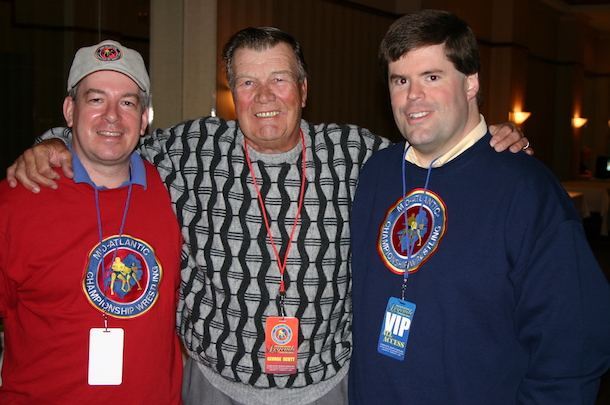
The "Gateway Boys" with George Scott at the 2004 Mid-Atlantic Wrestling
Legends Fanfest in Charlotte.


http://www.midatlanticgateway.com/p/us-title-book.html

Friday, August 12, 2016

Mulligan & Flair Win the NWA World Tag Team Titles

by Dick Bourne
Mid-Atlantic Gateway


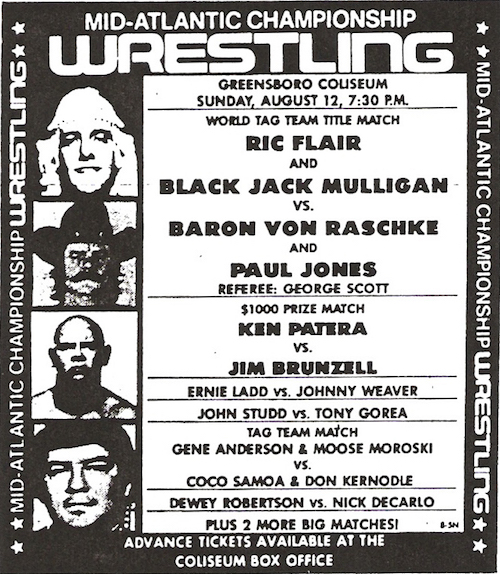
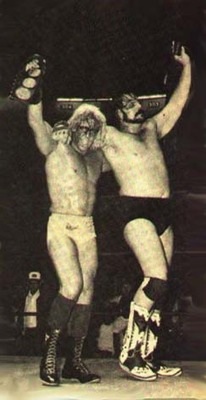
On this day, August 12, 1979, Blackjack Mulligan and Ric Flair won the NWA World Tag Team Championships from Paul Jones and Baron Von Raschke.

It was a big deal at the time. This was Ric's first championship win since first turning babyface earlier that summer after an angle with Paul Jones (as well as a separate angle with Buddy Rogers.) Flair had enlisted the aid of several wrestlers as his tag team partners (including Ricky Steamboat) in his quest to topple Jones and Von Raschke, but it was Mulligan who proved to be the right choice.

The match is remembered as much for the celebration afterward as for the match itself. A very bloody Ric Flair actually leapt into the arms of Mulligan as they held their titles over their heads in victory. It was an emotional scene in the Greensboro Coliseum seeing Flair and Mulligan with such camaraderie, especially given their long, violent, bloody feud just a year earlier.

Who would have thought at the time of the famous "Hat & Robe" angle that these two would hold the world tag team titles just over one year later.

37 years ago today! Good memories!

Wednesday, May 11, 2016

Opposites Attract: Masked Superstar vs. Mighty Igor

PART ONE

by David Chappell
Mid-Atlantic Gateway

Mighty Igor cover
Mid-Atlantic Wrestling Magazine
One of the more entertaining feuds during the Mid-Atlantic Championship Wrestling era occurred during eight months in 1977, and it featured the Masked Superstar battling the Mighty Igor. These two grapplers couldn’t have been more polar opposites, but their stark differences made for compelling theater from February through September of 1977.

The Superstar entered the Mid-Atlantic area in September of 1976, and was a force to be reckoned with from the get-go. Extremely articulate, the Superstar came to the area boasting of having two doctorate degrees, and a gold medal from the Olympics! With his vicious “clothesline” move, and “cobra” finishing maneuver, the Superstar got off to a great start in the territory during the remainder of 1976. Along with his wily manager, “Professor” Boris Malenko, this dastardly duo put up $5,000.00 and the Superstar’s mask if any wrestler could defeat him by pinfall or submission in a single match. By the end of 1976, no consistent challenger had emerged for the Superstar.  But that was about to change.

At the tail end of 1976, a colorful newcomer entered the Mid-Atlantic area named the Mighty Igor. Wearing unusual ring attire, this bundle of muscle from Krakow, Poland was a particular favorite of younger fans. Coming to the ring dancing the Polish polka, carrying his garlic laden kielbasa, professing his love for his “momma” and kissing unsuspecting television announcers, the smiling and child-like Igor was certainly a unique addition to the Mid-Atlantic Championship Wrestling scene. Initially, Igor was accompanied by a manager, Ivan Kalmikoff, who assisted Igor in performing some impressive feats of strength. Kalmikoff would exit the area after about a month, leaving Igor to fend for himself.

The Mighty Igor and the Superstar squared off for the first time in Asheville, North Carolina as part of an afternoon card that was held on February 6, 1977. The first bout between the two was not particularly eventful, but the next meeting would define the feud in stark terms. The two combatants met each other in Charlotte, North Carolina on February 21, 1977 at the Park Center. The match was a tag team elimination match, where Igor and Wahoo McDaniel battled the Superstar and his partner, the “Korean Assassin,” Kim Duk, accompanied by their manager Boris Malenko.

On the Mid-Atlantic Championship Wrestling television show that was taped on February 23, 1977, NWA “troubleshooter” George Scott came on the set with announcers Bob Caudle and David Crockett, along with the “Malenko family,” the Masked Superstar, Kim Duk and Boris Malenko.  Scott was there to show the fans a film from the match in Charlotte two days earlier, where the Superstar badly injured the Mighty Igor by sticking Malenko’s lit cigar in Igor’s eye, causing serious eye damage. The “troubleshooter” began, “There’s been a lot of conferences going on about this the last couple of days. I believe we have some film that we want to show, and I think these gentleman better watch it because there’s gonna be some decision coming up that you’re gonna know about.”

The Masked Superstar and Kim Duk
with manager Boris Malenko
George Scott started commentating over the arena footage saying, “As you can see, Igor is in the ring here with Superstar, and he’s got the bear hug on him, and I think Superstar was beat. And if you’ll watch here; here comes Kim Duk in. This was a match that occurred in Charlotte, North Carolina, that took place last Monday. As we go along here, he took that cigar right out of Malenko’s mouth, deliberately stuck it in Igor’s eye. And which caused, we don’t know the damage yet, the extents of the damage, but it could have blinded this man.”

Scott clearly believed the egregious actions called for discipline against Superstar explaining, “And to me, this is uncalled for in professional wrestling. Which we’ve been doing, as the time goes on, we take a lot of these films and they go down in front of Eddie Graham of the National Wrestling Alliance, and they come back, and through Jim Crockett Promotions, and myself; you can see here Igor is in definite, definite pain…definite pain. And I feel if these men gotta resort to tactics like this, I feel we do not need them in the National Wrestling Alliance, or in the Mid-Atlantic area. As you can see, Igor was finished for the night, now he’s wearing a patch on his eye, and the pain this man has gone through is unbelievable.”

Bob Caudle chimed in, “And the film doesn’t lie, George. It shows exactly what happened, and how it came about, and just who did it…and how it happened to him.” Scott continued, “Ah, yes, and as you can see, this was the end of the night for Igor.” Caudle agreed, noting, “The pain here has to be unreal; this guy is so big and so strong, he can stand a lot of pain anyway, George. But here, this must have been tremendous pain for him.”

George Scott then turned his attention to the wrongdoers. “Now, Boris Malenko, I’ve talked to Eddie Graham, I’ve talked to the National Wrestling Alliance, Superstar has been suspended indefinitely…” A flabbergasted Superstar interrupted, stammering, “Wait, wait, wait a minute!!”  Undeterred, Scott continued, “Wait a minute, you just be quiet, or a $10,000.00 fine.” Superstar shot back, “What do I have to pay a $10,000.00 fine for, it was an accident, I didn’t do anything on purpose!” Scott was not convinced by Superstar’s explanation, and matter of factly said, “Yes, it was done on purpose.”

The Superstar continued to try to state his case. “If I pay a fine, I’d be admitting I’m guilty, and I’m not guilty of anything!” Scott remained unmoved, contending, “The film shows it.” A combative Superstar then boldly exclaimed, “We won’t pay a fine!” Scott had an answer for that saying, “Well, then you’re definitely suspended. All we ask is that you finish…”   Superstar again interrupted, and noted, “I’ve already got some matches; I’ve already signed a contract for two matches.” A now exasperated George Scott responded, “Well, you finish them then you can get out of here…you’re finished.” The masked man then hollered, “Wait a minute…wait a minute!”

Professor Malenko joined the fray, asserting, “This is a miscarriage of justice, and my lawyers…” But Superstar was so angry that he interrupted his own manager, pleading, “I’m not gonna pay a $10,000.00 fine for something I didn’t do purposely! It was an accident; I did not do it on purpose. If I paid $10,000.00, I’d admit to something I didn’t do.” Trying to reassure Superstar, the Professor stated, “My lawyers will take care of the National Wrestling Alliance and George Scott too; this was an accident, it was not done intentionally!” Superstar concluded by alleging, “They’ve tampered with this film, they’ve tampered with this film. They’ve been trying to get me out of this area for some time now, and they come up with some fabrication. I’m not gonna pay a fine, they can’t suspend me indefinitely, what am I supposed to do?” Malenko, trying to calm down the situation, ended by saying, “My lawyers will take care of that.”

At the end of the same show, Igor appeared on the set with a patch over his injured eye, and he told Bob Caudle that he did not want Superstar suspended, that he wanted to wrestle him. Igor continued, “My mother taught me to wrestle fair, and I never dream or think a man would put cigar in a man’s eye. With that Malenko too…he help him. But Star I will get you somewhere, the people will support me so you will give me a match. Because that’s the only way I’m gonna get it. Look at my eye…look at my eye!! Doctors say maybe I cannot see again. I maybe lose part of vision.  This is something that my mother’s crying all the time, and I just don’t know what to say…I want match with this Star!”

Igor’s match with Superstar would have to wait, as the suspension of the masked man lasted for five and a half weeks into early April of 1977, before Malenko’s lawyers were able to get Superstar reinstated.

TO BE CONTINUED IN PART TWO
What happens when the Superstar returns? Find out in "Opposites Attract: Part Two."

http://midatlanticwrestling.net/nwabelt.htm

Monday, March 28, 2016

Booking Changes at Jim Crockett Promotions (Early 1970s)


by Dick Bourne
Mid-Atlantic Gateway

I recently had the pleasure of a casual conversation with John Ringley, at one time the most trusted confidant of promoter Jim Crockett, Sr. He had graciously agreed to talk with me for a feature I am constantly working on and updating related to the old TV studio tapings of Mid-Atlantic Wrestling as well as some information on the various local promoters that worked with Jim Crockett Promotions in the 1960s and 1970s. But we also touched on a few other subjects, one being the major booking change in 1973 that changed the face of the Mid-Atlantic territory.

Ringley was the man who recruited and hired George Scott to take over the booking responsibilities of the promotion, a move which changed the face of the company in the coming years. He and Scott immediately brought in Johnny Valentine, Wahoo McDaniel, and Don Jardine to the territory, which shook things up on top of the cards and began to redefine the territory as a "singles territory" at least in terms of the main events.

This was the booking change in the company that is most remembered and discussed historically. But before hiring George Scott, Ringley had pushed Jim Crockett, Sr. into making another major change in booking a few years earlier.


David Crockett, Charleston promoter Henry Marcus, and John Ringly (circa 1973)

Ringley told me he felt things had become a little stale with long-time booker George Becker in the late 1960s.

"(Becker) had started regularly booking 6-man tags as the main events, and I was frustrated with that direction," he told me, as an example. "What was next? 8-mans? 10-mans?"

Ringley began lobbying Crockett Sr. to make a change. Crockett resisted at first, but they finally came to a compromise. Becker would step down as booker to be replaced by the tandem of Johnny Weaver and Rip Hawk. Both Weaver and Hawk had assisted Becker with finishes and other booking chores for years. This change took place in late 1969 or early 1970.

But Ringley explained that he always saw wrestling in 7-year cycles, and felt that the company was in the bottom of one of those cycles at that time. He still felt that the company needed a more significant change in direction.

"After Mr. Crockett died (in April of 1973), I decided to make a wholesale change," he said. That's when John Ringley hired George Scott.

Scott immediately began making changes, the most significant being changing a tag-team driven territory to one with more singles-oriented main events. He was given full reign to make those changes by Crockett Sr. and Ringley. Scott's changes in booking strategy, as well as bringing in a whole slate of new talent, including a promising rookie named Ric Flair, eventually went on to set the territory on fire again.

Ringley, however, wasn't around to see those changes pay off. He left the company not long after Scott was hired.

"Jim Crockett was like a father to me," he told me. "He had a big heart and helped a lot of guys out when they first came to into territory." Ringley's own father died when he was young.

Ringley went to work for Eddie Graham in Florida. While there he was recruited by music promoter Buddy Lee to come work for him in Nashville, Tennessee. It was a good fit given Ringley's vast experience working for Jim Crockett Promotions as a promoter of music events and such attractions as the Harlem Globetrotters. Lee had been a wrestler who worked for Jim Crockett, Sr. back in the 1950s and formed a music promotional company in Nashville in the 1960s. The company he started, Buddy Lee Attractions, is still one of the largest talent agencies in Nashville. Ringley later worked for wrestling promoter Leroy McGuirk in Oklahoma.

John Ringley's push to change the booking direction of Jim Crockett Promotions had lasting effects on that family's business, and the wrestling business in general,  for years to come.

I'll have more tidbits from my conversation with John Ringley in future posts.
 

Wednesday, March 23, 2016

Falls Count Anywhere

The "Flying" Scott Brothers and the Anderson Brothers battle all over the
Memorial Auditorium for a four week period in Greenville, SC.

by Dick Bourne
Mid-Atlantic Gateway

There's very little I enjoy more than talking old school wrestling with some of my friends who are familiar with wrestling from an era just before I started watching as a regular fan. For me, that's the late 1960s and early 1970s. From Carroll Hall to Mike Mooneyham to Chuck Thornton and Don Holbrook, these guys have taught me so much about a time I just missed out on.

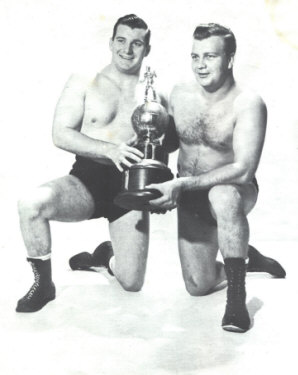
George and Sandy, the "Flying Scotts"
What I wouldn't give to be able to hear those "Two Ton" Harris promos when he complained to the NWA president Sam "Munch-nick" or to see the fiery red-headed manager J.C. Dykes and his team of the masked Infernos. I was just born about 10 years too late.

I was recently having one of those discussions, via email, with my friend Don Holbrook who grew up in Greenville, SC and attended most Monday night cards at the Greenville Memorial Auditorium in the late 1960s and 1970s. Don was telling me another tale of a wild night of wrestling at the GMA.

"I remember one time (promoter) Paul Winkhaus told me on the previous Tuesday in Columbia, SC, Brute Bernard was chased all over the building and out the front door into the street and back to the ring by George Scott during a main event," Don wrote me. "I asked Wink a couple weeks later whatever happened next, and he said the next week they had a "falls count anywhere" rematch. Can you imagine 9:45 at night driving down Taylor Street in Columbia and seeing George Scott chasing Brute down the sidewalk?"

Don continued: "Funny thing is, a few months or so after he told me this, George Scott chased Gene Anderson all through the lobby and back to the ring in Greenville, followed the next week by a "falls count anywhere" bout between the Scotts and the Andersons."

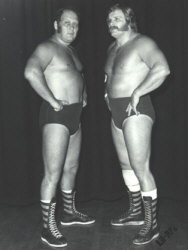
Gene and Ole Anderson
"The Minnesota Wrecking Crew"
I loved that story. I thought I'd try and track down the newspaper clipping for that show and post it here, and asked Don if he remembered exactly when that was.

"By now you know I'm terrible with dates and time-frames," he wrote, "but I'm going to try to figure out a date or at least a year for you. I do remember Sam "Lucky" Roberts was the referee because he was running behind George and Gene with his face all red and his pot-belly, trying to keep up with them as they ran around the building. Also, the cops were going nuts because people were trying to follow them."

Mark Eastridge has an amazing collection of newspaper clippings we are blessed to be able to present here on the Mid-Atlantic Gateway, but without a year to at least narrow it down by, and with Greenville running around 50 shows a year in those days, it would be like looking for the proverbial needle in the haystack.

So I called Carroll Hall, who is a as close to walking, talking encyclopedia on 1960s Crockett wrestling as you will ever find. I told him Don's story and he immediately was able to give me a year.

"1969 was the only year Brute Bernard, the Scotts, and the Andersons would have all over-lapped in main events," he told me. he popped that off without even a hesitation. I'm telling you, Carroll Hall is other-worldly when it comes to that stuff.

So I went to the Eastridge archives kept hidden away in the back of the batcave and started looking through Greenville newspaper ads for 1969.

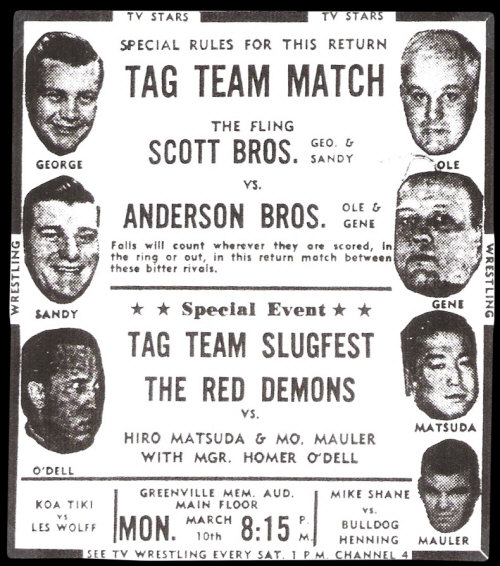
And there it was - on a Monday night as usual, March 10, 1969. George and Sandy Scott vs. Gene and Ole Anderson.


The Greenville ads in those days, written by local promoter Paul Winkhaus who was one of Jim Crockett, Sr. and John Ringley's trusted lieutenants. Winkhaus took great care in including a brief bit of info in each add that gave some matter of context to the main event. For this week it was written:
  
"Falls will count wherever they are scored, in the ring or out, in this return match between bitter rivals." 

As I looked at other adds around that same time, I discovered that Greenville ran this match as their main event for four -- yes, four! -- weeks in a row! Each week built on what happened the previous week, and each week added a different stipulation. It's a great look into how wrestling was booked back in those days when you had to draw a house every single week.


THE SCOTT BROTHERS VS. THE ANDERSON BROTHERS

Match #1 - Monday, February 24, 1969
The "Flying" Scott brothers meet the Anderson brothers. The ad proclaims "Ranking teams meet in a tag team match." The newspaper result says the Andersons won that bout in two out of three falls. This would have been the show Don remembers where George Scott chased Gene Anderson around the building. it set up the "fall count anywhere" affair two weeks later.


Match #2 - Monday, March  10, 1969
With no wrestling card held the following week 3/3, wrestling returned on 3/10. After last week's chase around the Greenville Memorial auditorium, the Scotts met the Andersons in a falls-count- anywhere stipulation. (See the newspaper ad above.) The ad read "Falls will count wherever they are scored, in the ring or out, in this return match between bitter rivals." The newspaper reports that once again the Andersons were victors in the 2-of-3 fall contest.


Match #3 - Monday, March  17, 1969
Apparently the Andersons continued to use under-handed antics to win these matches, because the following week, the two teams met for the third straight show with Texas Death match rules in effect. The ad read: "In a Texas-style DEATH MATCH the falls scored do not determine the outcome of the match. There is NO TIME LIMIT and the two teams wrestle until one or the other cannot answer the bell for the next fall or concedes the victory to the other." The newspaper result states the Scotts outlasted the Andersons in this contest. We're guessing that the Anderson ran from the ring at the end of this brutal affair, because these two teams were going to meet one more time.


Match #4 - Monday, March  24, 1969
Two weeks later, the two teams met for the final time. This time the stipulation was a "LOGGER TAG TEAM MATCH." A logger match was another name for a lumberjack match. The newspaper ad read: "Eight big wrestlers will surround the ring with orders to immediately throw back onto the mat anybody who attempts to run away. There will be NO ESCAPE FOR ANYBODY in this match." Lumberjacks were Abe Jacobs, Les Wolff, Billy and Jimmy Hines, Bobby Paul, El Gaucho, Randy Curtis, and Pancho Valdez. The newspaper results report that the Scotts were victorious in this final chapter in their month long saga.

See TV Wrestling every Saturday at 1 PM on channel 4! 

Saturday, August 01, 2015

Blackjack and Ric Reflect on the "Hat & Robe"

by Dick Bourne
Mid-Atlantic Gateway

We recently posted a complete summary of the 1978 angle between Ric Flair and Blackjack Mulligan famously known as The Legend of the Hat and the Robe.

In a conversation for a follow-up story after the article was originally published back in 2004,  Blackjack Mulligan and I got to chatting about the Hat and Robe angle and he discussed some of things going on behind the scenes during that time.  The following are excerpts from that conversation.


REFLECTIONS

Dick Bourne: Who came up with the idea for the actual angle to tear up a hat and tear up a robe? Was that George Scott or did you and Ric come up with that?

Blackjack Mulligan: Well, it was George's idea to turn me, but we all came up with ideas on how to do it. I had this hat maker down in Austin, they were called Texas Hatters, they made my hats and my hat bands. They made Willie Nelson’s hats, too, and Willie had given me this hat, and Ric had heard about it. And so it was just sort of this spontaneous thing where we figured, what really do people get the most mad about when two lovers split? Your stuff, right? And Ric and I were a lot closer than a lot of couples were, believe me, we shared a lot of things, well, I won’t go into all that! (Laughs)

Bourne: So the hat was a shoot? The one that Ric tore up on TV, was that one that Willie had actually given you?

Mulligan: Oh, yes, and it broke my heart to see that hat torn up.

Bourne: I can imagine! And Ric having that $7,500 robe that Olivia Walker made completely destroyed.

Mulligan: He hated it, he nearly cried! But it was going to be so big.

Bourne: It sure made the whole thing work.

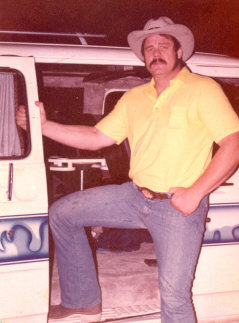
Mulligan: Problem was, I had heat when I went back to get another hat made, people had not only heard about this in Mid-Atlantic, they had heard about it all over the world, man! (laughs). I still had a home down in Austin, and my wife would go into that hat store, Texas Hatters, and the guy said “Hey, that hat I made for Willie, I understand it got tore up down there.” They had actually heard about it at Texas Hatters. But all of that was so real. We had this van that we and our wives shared it, too. And my wife was getting ready to take the kids to church in this van. And I panicked! And I ran out there, because, my God, from the night before, there were pantyhose and crap laying all over the place and paraphernalia lying everywhere, and I started throwing all this stuff in a bag.

Blackjack stands outside the van he and Ric
owned together. He's wearing the hat Willie Nelson
gave him that would soon be destroyed in the angle.
Bourne: This was part of the angle...

Mulligan: Yes! It was a shoot! And so I’m cleaning out this closet - - we each had a closet in the van, - - and I look in Flair’s closet, and said “Wow, this is some weird stuff, Flair really is over the edge!”

Bourne: (laughs)

Mulligan: And of course, at the same time, I’m raking up all my crap, too. (laughs)

Bourne: But I guess that went into another bag, huh?

Mulligan: Well, it’s my story, so I’m not telling you about my stuff. (laughing) So it was so natural, here was his closet and all this stuff in there, it just worked. I mean, this was real. We were breaking up for real.

Bourne: How so?

Mulligan: We lived two houses down from each other, there was one house in between us. There should have been twenty of them in between us, but that’s another story. So this is all coming down. George Scott has all of this pre-planned, pre-programmed, he is going with this guy: Flair is it. He's going to be the top guy. It had all been planned for so long, I was the main guy, and now it was Flair’s time to move to the top spot, and I was kind of wearing down a little bit, and George says, "I’m going to turn you babyface." And I said “That’s impossible!” And he said “I’m going to do it like it’s never been done, I’m going to cool you for awhile, I’m going to put you with Tim Woods.” And believe me, that would cool anybody off. (laughs) Timmy and I were working every night.

Bourne: And Tim Woods won the U.S. belt from you, and Flair worked that into his promos when he got the belt from Woods, that you were getting soft.

Mulligan: Right, the whole thing with Timmy Woods was starting to turn me. And George got ready, and said “You guys are going to have to move now.” And we were like, oh no! But Flair goes and buys a new mansion, you know, across town. And I went and bought a place in Matthews, about five acres there. Now it’s probably worth a fortune. But we actually had to sell our houses and buy new houses.

Bourne: So they didn’t want you living near each other?

Mulligan: That’s right, it had become so real. Scott said, "You guys can’t live on the same street in Charlotte!" (laughing) And he was right!


Ric Flair mentioned the Hat and Robe Angle as one of his most memorable angles at WRAL television. Here is a brief excerpt from the interview that Flair did with David Chappell on the Mid-Atlantic Gateway, prior to the publication of Flair's book.


Ric Flair: We did a lot of great stuff at WRAL. The angle with Blackjack Mulligan was huge…where I took his Cowboy hat that Waylon and Willie had given him, and tore it up and stomped on it. And a little later on, I was wresting somebody and Mulligan comes out wearing my robe, and he tore up my robe in front of me…

David Chappell: That was an unforgettable Mid-Atlantic moment, Ric!

Ric Flair: And then I put a bounty out on Mulligan. I left for Japan, and when I came back, we were selling out everywhere! (laughing) And of course back then, everything played off the weekly TV show in your market. And that got the fans out to their local arena. So those TV angles like the Hat and Robe were really, really important then. There was hardly any cable TV and certainly no satellite dishes in those days. And Pay Per View events were years off.


Read "The Legend of the Hat and the Robe" on the Mid-Atlantic Gateway.