Wednesday, December 14, 2022

Jim Cornette Explains All About the TV Distribution Process for JCP in the 1980s

Crockett TV Production / Local Promos

Arcadian Vanguard  
The following is a transcript from a brief segment of the popular "Cornette Drive Thru" podcast where Jim Cornette shed light on the process Jim Crockett Promotions went through to duplicate and distribute their TV shows in the 1980s, and also how they inserted the local TV promo segments each week. 

The discussion took place on Episode #261 of the podcast, about 55 minutes in:

"The way they duplicated their television shows, now this is primitive, but remember this is 40 years ago, and it is actually the way that, you know, small budget promotions operated like this in house up until the times that the territories went away. 

Let's say we go to Gaffney, SC, on a Tuesday night and we'd do the syndicated television taping at the college gym there in Gaffney. It's 60 miles from Charlotte, so it's about an hour drive. They owned their own television truck, the NEMO truck - - National Electronics Mobile Operation. They'd drive the truck an hour down to one of these high school or college gym around Charlotte. They'd set up the lights, they'd wire everything, they'd run the cables - - they shoot two hours of television: NWA Worldwide and NWA Pro. And that goes from 7:30 to 10:00. And each show they role live-to-tape, and you know they're gonna put a VTR in, they roll it in the truck. They leave black holes for the commercial spots and for the local promos.* 

Then they'd drive the truck back to Charlotte and they'd park it back behind the office at Briarbend. And they'd take the two master tapes in, and - - remember ol' Leonard? The guy that did the night work there that alerted me that they were throwing away the entire film archive of Mid-Atlantic Wrestling when Turner broadcasting took over and bought everything.** Leonard would put the dadgum tapes on, and I don't know how many they could make at the same time, and this was the old one inch video reels, right? So you can imagine, you gotta unroll those and put them on the spool, and get 'em all synced up and everything. And then he would hit the button and they would make multiple duplicates of that master tape at one time. And then he'd do nothing all night but just run 'em back and copy the tapes over and over - - however many they could make at a time times however many, because Wednesday morning about 9:00, Gene Anderson would be in there with Jackie Crockett on the camera and all the top babyfaces and heels would come in and do local promos, from 9:00 in the morning until 3:00 or 4:00 sometimes. And then you'd immediately hop in the car and drive three hours to Raleigh or go to the airport to fly somewhere, whatever the case. 

But, what they would do, honest to God, is they would sync the tape up for let's say Philadelphia, we got local promos to do for Philadelphia because we got a show coming up at the Civic Center. So whatever tape was going to the TV station in Philadelphia, they would reel it up to the exact point of the babyface interview segment that needed to be inserted and we'd record those interviews right onto the tape that was actually going to the TV station. And as soon as we did that interview then they'd jump ahead to the heel segment, you know, in between segments 5 and 6 or whatever, and they'd do the two minute and twenty eight second interview for them. 

The interviews were 2:28 because they left a second to get in and a second to get out, else wise they're rolling over program***, right? Once the Philly interviews were done, they'd stick it back in the case, put a label on it, and whether it was Klondike Bill or Bunk Harris, whoever that day wasn't going to get chicken at Price's Chicken Coop for lunch****, they would take the tapes to the bus station and put them on a bus to the television station in the city that was going to air it that weekend. 

So it went out on Wednesday evening and it got there on Thursday. A lot of promotions did this, they would put posters and fliers for sponsors in small towns, they'd put 'em on a bus in those days, they'd put the TV tape on a bus. And they used to have a thing called Delta Dash where before these overnight services were just common in every city in America, they would take it and put it in a box, and take it the airport and they would put it on a Delta plane. You could Delta Dash something for something like $99, and it would go on a plane, and somebody had to pick it up at baggage claim at the other end. 

But that's what they would do, they would roll these interviews into the actual tape to the TV station that weekend, there was no post production per se in terms of "OK we're going to shoot all these interviews and were gonna slate them and then were going to go back and insert them, blah, blah, blah." No, that's why the local interviews don't exist anywhere else except in tapes of the television program that aired in that specific market. 

So when you see these local promos with Tony Schiavone and the orange background or sometimes the blue background, they had and the chyron, 'Tonight! Charlotte! Tonight Greenville, Chicago!' or whatever the case from Crockett Promotions, that has to be off the actual air broadcast of that television program that weekend [that was taped at home by a fan on a VCR] because they didn't exist anywhere else."


Footnotes:

*This was the big revelation for me: I had always assumed the local promos were sent to stations on a separate tape that would be inserted into the local brodcast by the station like any other local commercial. 

**I'm assuming this actually happened when Crockett and Dusty moved the head office from Charlotte to Dallas in 1987 or 1988 and closed down Briarbend Drive, but perhaps the TV work Jim describes above continued in Charlotte at Briarbend after the move to Dallas until the sale to Turner in late 1988.

***It absolutely now makes sense why there was always this short time gap before and after local interview spots where you would see the show's logo or whatever and could hear the crowd noise in the background of the studio going back to those days. They left room for the local promo to be a second or two early or late when taped directly into the master tape. 

****George South was the one who first told us about the weekly Chicken Coop ritual back in the day, and how he along with Bunk Harris or Klondike Bill, would sometimes make the pick-up, earning more tips from the boys than he made wrestling at the time.


PODCAST INFORMATION

Visit JimCornette.com for complete information including links on both of his wildly popular podcasts on the Arcadian Vanguard Podcasting Network.

Monday, December 12, 2022

Promoter Joe Murnick Was Key to Crockett TV Business

By Dick Bourne
Mid-Atlantic Gateway

In an article about wrestling promoter Joe Murnick in the Raleigh papers in the early-1980s, Murnick explained how it came to pass he wound up in the wrestling business and shed light on the origins of TV wrestling in Raleigh which would become the center of the TV aspect of Crockett's business.

Promoter Joe Murnick

"I worked in Norfolk after serving there in the Navy, and later moved to Charlotte, where I bought a paint store," he said. "Jim Crockett was promoting wrestling matches in Charlotte and I used to go watch them every Monday night." 

Murnick stayed in Charlotte for the decade of the 1950s and became very active in the community and in civic life. It was there that he also formed a friendship with - - and became a business ally of - - the biggest event promoter in the Southeast, Jim Crockett, Sr.

"I loved wrestling, and I thoroughly enjoyed the friendship that developed between Crockett and me," he continued. "This was in the early 1950s when pro-wrestling was just beginning to be on television. Jim knew I had friends in the media in Raleigh and he suggested that I might get a television package for wrestling there. That's how I got into it."

Later in 1961 following the death of eastern Virginia/North Carolina promoter (and Crockett business partner) Bill Lewis, Crockett sent Murnick to Raleigh to take over Lewis's part of the vast Crockett wrestling empire, a territory which stretched from Raleigh eastward to the coast of North Carolina, and included eastern Virginia and the key cities of Richmond, Norfolk, Hampton and that area. Murnick became a huge promoter in Raleigh, not only of wrestling but, like Crockett, of concerts and other events.

Crockett was also able to establish local television wrestling in Charlotte and the Greensboro/High Point market in the 1960s, but it was Murnick's early arrangement with WRAL television in Raleigh that would make Raleigh the TV hub for the organization. 

"We'd go to a city that had television and supply the Raleigh tape [to the local station]," Murnick recalled. "The station would use it to collect the advertising." The barter arrangement allowed the Crocketts to significantly grow their business through the exposure of the growing TV industry. By the mid-1970s, all of Jim Crockett's TV production was merged into the weekly Wednesday night TV tapings at WRAL. The shows were syndicated to TV markets blanketing North and South Carolina, Virginia and also selected markets in West Virginia, Georgia, Florida and even Texas.

It was just another example of how Joe Murnick was a pioneer in the wrestling business for Jim Crockett Promotions in the 1950s until his death in 1985.

Friday, December 09, 2022

Flair and the Andersons: Blood is Thicker Than Water


by Dick Bourne
Mid-Atlantic Gateway


It is one of the great chapters in Anderson family history and a high point in the up-and-down relationship between Ric Flair and his cousins the Anderson Brothers.

July 16, 1978. Ric Flair defends the United States Heavyweight championship against Ricky Steamboat. The special referee appointed by the NWA is Gene Anderson. 

It was on this night that Gene Anderson reunited the family after an 18-month bloody war with cousin Ric Flair and Flair's partner Greg Valentine over the NWA World Tag Team titles.

The family split up in late 1976 when Flair fell out with Gene and Ole over wanting a shot at the Anderson's NWA World Tag Team titles. The Andersons had taken the titles to Georgia in the fall of 1976 and Flair and Valentine intended on bringing them back to the Mid-Atlantic area. Add to add to that, Ric Flair badly wanted to step out of the shadow of his cousins. Over the next year and a half, they traded the titles back and forth. Both Andersons wound up in the hospital at various points in the feud, resulting in major bad blood between the two teams. With Gene out of action in late 1977, Ole Anderson even enlisted the aid of rival Wahoo McDaniel to battle Flair and Valentine in the late months of 1977.

In 1978 things began to cool down with Gene out of action and Ole focusing on the Georgia tag team titles with the other Anderson brother, Lars Anderson. When Gene finally returned to action in the Mid-Atlantic in the April of 1978, he worked a restricted schedule, teaming with Sgt. Jacques Goulet.

Meanwhile, Ric Flair was fending off the challenge of Ricky Steamboat in the middle of a white-hot feud over the United States championship. NWA referees Tommy Young, Sonny Fargo, and Stu Schwartz were unable to control the action in the ring between the two as most of their matches were ending in double disqualifications. Flair was champion, so he continued to maintain the title as the championship couldn't change hands on a DQ. The NWA needed a special referee who could physically handle the two in the ring, and give Steamboat a fair shot at the title. But they also needed someone who would remain impartial. They chose Gene Anderson.

On the surface, Gene Anderson seemed like the perfect choice. Currently working out of the "bad guy" locker room, he had no love for Ricky Steamboat, and given the bloody history with his cousin Ric Flair, he would welcome the opportunity to keep Flair in line in his title defense against Steamboat.

The match was set for the Greensboro Coliseum on July 16, 1978. Believing Gene Anderson's antipathy towards his young cousin was stronger than that for Steamboat, many fans were hopeful to see the U.S. title change hands that night.

But as the old proverb goes, blood proved thicker than water, and in the closing moments of the match, Gene Anderson interfered to aid Flair in retaining the title. The shocking turn of events went down like this:

The battle had been back and forth and Anderson had basically called the match right down the middle. On several occasions Flair tried to physically intimidate Anderson to no avail. Had it been one of the regular referees, another disqualification might have occurred. But as the match approached the twenty minute mark, it appeared that the NWA had made an excellent choice in their special referee.

But as the match wore on, there were subtle signs that Gene Anderson had his own designs on a final outcome. Flair now found himself in trouble, as Steamboat gained momentum. Steamboat had Flair pinned on several occasions, but Anderson's count seemed slow. With Flair reeling from a flurry of offense from Steamboat, the "Hawaiian Punch"climbed to the top of the turnbuckle and prepared to deliver his familiar flying body press which would likely give him the championship.


Special referee Gene Anderson shoves Ric Flair out of the way as
Ricky Steamboat dives from the top rope.

But just as Steamboat leapt from the ropes, Gene Anderson shoved Flair out of the way and Steamboat came crashing to the mat. Flair quickly covered him and Gene Anderson made a very fast three count.

Flair rose to his feet, momentarily trying to process what had just happened. He looked incredulously at his cousin who stood expressionless facing him. As Anderson raised Flair's hand it suddenly became clear to Flair what had just happened.

He leapt into Gene's arms and the two embraced in a long hug as the furious Greensboro crowd began to riot. Angry fans were swarming at ringside, pressing against the ring and the ropes. Flair kicked at the ropes to try to get fans to back off, which only seemed to exacerbate the situation. Soft drink cups and popcorn boxes began flying into the ring. Anderson handed Flair the U.S. title and Flair defiantly raised it high above his head as things continued to deteriorate at ringside. Timekeeper Wally Dusek was nearly knocked over by the mob as police moved in to try and calm things down, mostly to no avail.


U.S. Champion Ric Flair and cousin Gene Anderson embrace after Anderson aided
Flair in retaining the title as a special referee in the title match.


Flair and Anderson soon made their way down the ring steps and began walking the aisle toward the dressing rooms.  This was back in the day before there were barriers of any kind separating the crowd from the wrestlers going to and from the ring. Angry fans began taking swings at the two and Flair and Anderson had to literally fight their way to the back. 

For the last year and a half, fans had seen the feud between Flair and the Andersons become so heated and so bloody, that I don't think it ever crossed their minds that the two could reconcile on this night. Gene Anderson's actions certainly seemed to surprise Flair, and it appeared that this was not a conspiracy between the two. For Gene Anderson, it was a matter of family, and family trumped on this night. Ric Flair was firmly back in the Anderson fold. 

Things remained tight in the family for the next year or so as all three were going their separate ways. Ole was working full time in Georgia, Flair had turned "good guy" in the late spring of 1979, and Gene Anderson transitioned into his managerial career, buying the contracts of wrestlers under the guidance of Buddy Rogers, one of which was U.S. Champion Jimmy Snuka, who, as fate would have it, was in the middle of a feud with Ric Flair. Anderson's management of Snuka resulted in another split within "the family." The situation worsened when Ole returned to the area in 1981, and the bloody family feud escalated to new heights of violence. The family wouldn't fully reunite again until the formation of the Four Horsemen some four years later.


THE REST OF THE CARD

  • Blackjack Mulligan was also chasing Ric Flair's United States championship during this time, although with Blackjack it wasn't so much about the belt as it was a personal thing because of the way Flair had turned on him months earlier in what has become known as the famous "Hat and Robe" angle. Flair didn't want any part of Mulligan and placed a $10,000 bounty on his head, and on this night in Greensboro, the Masked Superstar was trying to collect that bounty in a match fought in Texas Death Match rules. Mulligan survived, but the beatings he was taking in these bounty matches were taking their toll.
  • Paul Jones battled Ken Patera in a match where both men's single titles were on the line (the NWA TV title and the Mid-Atlantic title respectively.) Both retained as the match ended in a double count out.
  • Fans loved the pairing of popular stars Johnny Weaver and Mr. Wrestling (Tim Woods) as they defeated the tough veteran tandem of Cyclone Negro and Sgt. Jacques Goulet.
  • A young Jerry Stubbs was on this card. He would later become the masked Mr. Olympia and headline in the Mid-South and Southeastern areas. Another "young lion" named Richard Blood (which oddly was the real name of Ricky Steamboat) worked early in this card, too. He would later become Tito Santana in the WWF.  


But this card will always be remembered for one defining moment in the long story of the Andersons and Ric Flair: Gene Anderson's shove that kept the United States title in "the family."


Originally published in August of 2018 on the Mid-Atlantic Gateway

http://horsemen.midatlanticgateway.com

Tuesday, December 06, 2022

Battle of the Dream Teams: Flair and Steamboat vs. Piper and Valentine


by Jody Shifflett, Mid-Atlantic Gateway Contributor

This poster is from 1981 at the historic Greensboro Coliseum. Four of the best ever in professional wrestling squared off against each other. 

The dynamic duo of Ric Flair and Ricky Steamboat against the dirty tough duo of Roddy Piper and Greg Valentine. I could not find the results of this match but with George Scott as special guest referee I’m sure steamboat and Flair took the win. 

A great undercard featuring two rough tough Texans, Blackjack Mulligan against Bobby Duncan in a Texas Street Fight. Matches between big guys like this usually did not go a great distance time-wise, but they were brutal and usually bloody. 

Another great match featured Ivan Koloff against the Iron Sheik. This match had to of been exciting with two of the best bad guys in the business back in the day. 

The poster has a great layout being in light blue and bold red lettering for all of the main eventers. And as always an 8:15 start time!

NO. 10 IN THE SHIFFLETT POSTER SERIES


Saturday, December 03, 2022

Harley Race vs. Paul Jones: Reflections on the Norfolk Scope

by David Chappell
Mid-Atlantic Gateway

The Scope arena in Norfolk, Virginia got its distinctive moniker shortened from the word “kaleidoscope,” because the builders saw so many varied usages for the edifice that was constructed from 1968 to its opening in 1971. And to be sure, I have seen quite a number of different events at the Scope over the years. But none held a candle to the Mid-Atlantic Championship Wrestling events that graced its presence.


Attending a recent WWE Monday Night RAW show at the fabled Norfolk Scope, as usual, brought back to me floods of memories of Mid-Atlantic Championship Wrestling. Getting a souvenir cup at that RAW show that commemorated the 50th anniversary of the Scope, replete with 70’s looking photos on it, just intensified those fond recollections.

Thursday night events at the Norfolk Scope housed a multitude of noteworthy battles in the grand history of Mid-Atlantic Championship Wrestling. When I am at current shows at the now 51-year-old Scope, I often find myself looking up at the rafters and the uniquely designed roof of that historic arena, and then with a rich imagination try to beam two Mid-Atlantic legends down to the Scope’s squared circle for them to repeat their magic of yesteryear one more time.

During the most recent RAW show I attended in Norfolk, I had a flashback to a Norfolk Scope card on November 2, 1978, featuring an NWA World Title bout between Champion Harley Race and top challenger Paul Jones. 

Mid-Atlantic Championship Wrestling announcer Rich Landrum did a special interview with Race that aired on WAVY TV Channel 10 in Norfolk to promote the bout. Landrum led off, “Norfolk Scope Coliseum, a World’s Heavyweight Championship match with the challenger Paul Jones [going] up against this man, the World’s Heavyweight Champion Harley Race.”

Race began, “Let me say this Jones, you’ve done a lot of campaigning; you must have done it quite well to come up with a Title shot at the Scope. Well let me tell you something Jones, when you come for this [belt], you come for all the marbles, you come for everything in wrestling.”

Harley continued, “You got [Ric] Flair out here bragging and going on about what he owns and controls, but this is the honcho in wrestling. And you are coming for the absolute honcho in wrestling, Harley Race. I am the cock of the walk; I am the man of the hour. I’m the man that’s got a quarter of a million-dollar bounty on him. You come for me Jones, and you come to take one awful beating and a beating is exactly what I’m going to give you son.”

The World Title match between Race and Jones was a classic one hour draw in one of Paul’s last splendid babyface efforts before he would turn into a “bad guy” in about a month when he attacked Ricky Steamboat as part of a two-ring battle royal in Charlotte, North Carolina. 

The bout at the Scope on November 2, 1978, saw Paul Jones at the zenith of his prowess as a “battle to the end babyface,” much like he was two years earlier in his classic program with the ruthless Blackjack Mulligan. The Scope saw many of those titanic struggles as well. In fact, it saw titanic struggles every Thursday night during the Mid-Atlantic years. 

The Scope. What a building. When I peer into that kaleidoscope, to this day, no matter what event I may go there to see, I still see Mid-Atlantic Championship Wrestling memories burning brighter than ever.

Thursday, December 01, 2022

Ricky Steamboat Returns to Dorton Arena

Shared by Chuck Coates
 

by Dick Bourne
Mid-Atlantic Gateway

Sunday, November 24, 2022. Three days after Thanksgiving. Ricky Steamboat prepares to step inside the squared circle one more time at the age of 69. 

That night he'd team with FTR (Dax Harwood and Cash Wheeler) to battle "Black Machismo" Jay Lethal,  former NWA champion of the modern era Nick Aldis, and Brock Anderson, son of the legendary Arn Anderson. Arn Anderson was a rival of Steamboat's during the Dangerous Alliance era of the early 1990s. 

The match takes place at one of Mid-Atlantic Championship Wrestling's most fabled and historic venues, Dorton Arena. The building has hosted wrestling since it was built in the early 1950s on the site of the annual North Carolina State Fair.  It is famous for its distinctive design, in the shape of a big saddle, with huge windows wrapping the entire circumference of the venue. 

But hours before stepping back between the ropes, Steamboat spent time in the upper deck that afternoon, soaking in the memories of his many battles at the old building. He fought all the major stars of the era there including Harley Race, Roddy Piper, Ernie Ladd, Greg Valentine, Sgt. Slaughter and Don Kernodle, Ivan Koloff, Jimmy Snuka and of course his greatest rival Ric Flair. 

What a wonderful photo of the legendary Steamboat, shared unattributed by Chuck Coates on Facebook. Of all the photos from that night, this was our favorite. 

The "Big Time Wrestling" promotion billed it as Night of the Dragon. Steamboat was indeed dressed in his WWF/WCW dragon ring attire. But we prefer to remember Ricky as the Hawaiian Punch, the nickname he had here in the 1970s and early 1980s.  At 69, he appeared to be as smooth as ever, even deliverying his trademark floating arm-drag, defying gravity all these years later. 


The Hawaiian Punch woke up the echoes again at Dorton Arena.


Monday, November 28, 2022

The Infernos and The Loaded Boot (1967)

JULY 1, 1967 - "THE LOADED BOOT"
By Carroll Hall, All-Star Championship Wrestling

My two brothers and I were really wanting to go to the wrestling matches on that Saturday night in Winston-Salem. It didn't look too promising early in the week leading up to the card because Dad wouldn't be getting off work until 10:00 p.m. that night and I was not
quite old enough to drive yet.

By mid week we got lucky and worked out a deal with Jimmy, a close friend of the family. My brothers and I would help Jimmy chop the weeds out of his tobacco field in exchange for him driving us down to the Coliseum. He loved wrestling too.

My mom had never learned to drive at this point but she had made up her mind to do so. She had just bought a 1957 Dodge with the big fins on the back for $200. She let Jimmy drive that old Dodge to wrestling because the only thing that would run on his farm that day was his tractor. Well, Jimmy must never have driven anything so powerful as that old Dodge. He flew past every vehicle we came upon that night between Mt. Airy and Winston-Salem. Just imagine if you will three kids and one nut(just kidding Jimmy) flying down U.S. 52 in a "Batmobile" going to wrestling!

The old Coliseum was hot that night as it was nearly a full house and I don't believe that grand old building ever had air conditioning.

George Becker had made a promise on "Championship Wrestling" the previous week.....

Read the entire story on the All-Star Championship Wrestling website. >>

Sunday, November 27, 2022

Timeline History of the Four Horsemen


Four Horsemen in HARDCOVER now available at
Amazon.com

Every member! Every version! Every associate! The women! The managers!
It's all laid out month by month, year by year, with photos and charts included.


Wednesday, November 23, 2022

Thanksgiving Memories

Happy Thanksgiving! 

We are particularly thankful for all of you who have supported the Mid-Atlantic Gateway these past twenty-two years. Join us as we reflect back on some of the Thanksgiving wrestling and Starrcade related posts from years gone by here on the Mid-Atlantic Gateway.

Thanksgiving Wrestling Through The Years for Jim Crockett Promotions
Links to pages featuring info on annual Thanksgiving cards for Jim Crockett Promotions from 1966-1987.

The Forgotten Prelude to Starrcade '85 (Posted Nov. 23, 2018)
Thanksgiving: 1966 in Greensboro, Norfolk, and Charleston
A Thanksgiving Surprise: Starrcade Magic Returns to Greensboro
Thanksgiving Retro: Greensboro & Norfolk 1975
Dr. Joseph Estwanik: A Doctor Remembers
Remembering the Jim Crockett Sr. Scholarship Fund (1973)

Anniversary Flashbacks we posted in 2018:
Thanksgiving Flashback: Starrcade '83 (Posted Nov. 24, 2018)
Thanksgiving Flashback: Starrcade '84 (Posted Nov. 22, 2018)
Thanksgiving Flashback: Starrcade '85 (Posted Nov. 28, 2018)
Thanksgiving Flashback: Starrcade '86 (Posted Nov. 27, 2018)
Thanksgiving Flashback: Starrcade '87 (Posted Nov. 26, 2018)


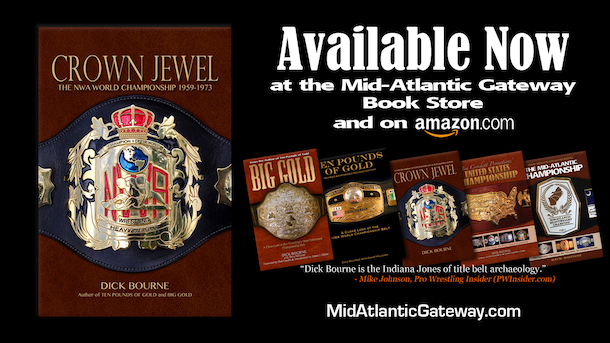
Crown Jewel  |  The Mid-Atlantic Gateway Book Store

Tuesday, November 22, 2022

Dream Team: Flair and Steamboat Go For the Gold

July 21, 1979,Charlotte Coliseum
Charlotte, North Carolina


Mid-Atlantic Wrestling's dream team of Ric Flair and Ricky Steamboat battled reigning NWA world tag team champs Paul Jones and Baron Von Raschke in a Lumberjack match at the Coliseum in Charlotte, NC.

Flair had just tuned "good guy" for the first time ever a few months earlier and was mounting a full court press to defeat Paul Jones (his current arch enemy) and the Baron for the world tag team belts. He enlisted the aid of both Ricky Steamboat and Blackjack Mulligan in that quest.

An interesting tag team combination was featured in the semi-main. The legendary "Nature Boy" Buddy Rogers took one half of the Minnesota Wrecking Crew Gene Anderson as his partner to battle the team of Jim Brunzell and Rufus R. "Freight Train" Jones. Rogers would become the manager of both Jimmy "Superfly" Snuka and John Studd, and following an injury to his ear in late 1979, sold the contracts of his charges to Gene Anderson who became the manager of Snuka and several others to form "Anderson's Army."


Originally published July 2015 on the Mid-Atlantic Gateway.